

 Login
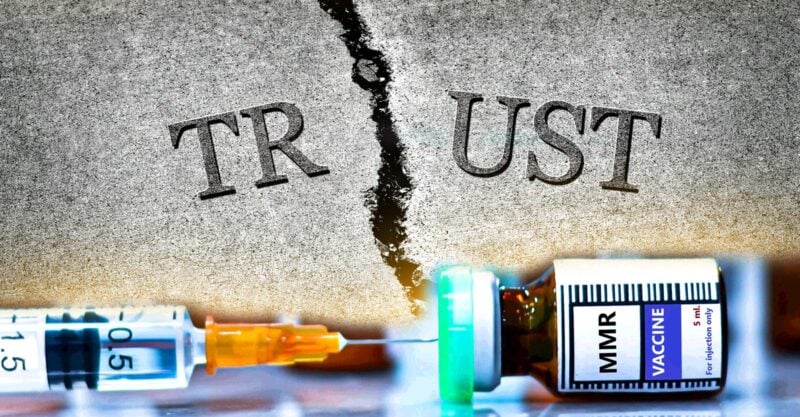


A KFF poll released today found that most Americans remain confident in the safety of the measles, mumps and rubella (MMR) vaccine for children — but are not as confident in COVID-19 vaccines.
Eighty-two percent of adults across political parties expressed confidence in the safety of the MMR vaccine for children, up slightly from 81% in January and May.
Among parents who support the MAHA movement, 69% said the benefits of MMR vaccination outweigh the risks. However, 29% of MAHA-supporting parents said the risks outweigh the benefits, compared with 16% of parents who do not support the movement.
“The timing of this poll — shortly before the midterm elections — suggests that KFF, a pro-vaccine, pro-medical establishment enterprise, is trying to prop up the narrative that most people still have faith in vaccines, regardless of which political party they support,” said Mary Holland, CEO of Children’s Health Defense.
Meanwhile, only half of adults said they were confident in the safety of COVID-19 vaccines for children. That included 77% of Democrats, 50% of independents and 21% of Republicans. A mere 28% of Make America Healthy Again (MAHA) supporters expressed confidence in COVID-19 vaccines for children.
Confidence in COVID-19 vaccine safety during pregnancy has declined across political groups since 2022, including a 17-percentage-point drop among Democrats and a 15-point drop among Republicans, according to the poll.
Overall, 39% of adults said they were very or somewhat confident the vaccines are safe for pregnant women, down from 53% in May 2022. Among women ages 18-49, 37% expressed confidence in the vaccine’s safety during pregnancy, down from 48% in 2022.

Nearly half of parents favor spacing out vaccines
The poll found that parents are nearly evenly divided over whether children are healthier when their vaccines are spaced out rather than receiving multiple shots during one visit.
Nearly half of parents, 48%, said spacing out vaccines is healthier. The remaining 52% said there is no strong evidence that breaking up vaccines into separate visits is a healthier option.
Political affiliation played a major role in these responses. Among Democratic or Democratic-leaning parents, 68% said there is no strong evidence that spacing out vaccines is healthier. Among Republican or Republican-leaning parents, 69% said children are healthier when vaccines are separated.
KFF noted that parents cite receiving multiple vaccines at once as a leading reason for skipping or delaying childhood vaccinations in previous polling.
In August, President Donald Trump signed an executive order calling for changes to childhood vaccine recommendations, including administering MMR vaccines separately rather than as a combined shot.
Trump has also made statements linking the spacing out and separation of childhood vaccines to lower autism rates.
In addition, an October 2025 report by the McCullough Foundation identified vaccination as the leading “modifiable risk factor” for autism in its review of 300 studies on possible causes of the condition. The report’s authors said multiple vaccines given in early childhood may overwhelm infants’ developing systems.
Confidence in childhood vaccines varies by vaccine
KFF found that 82% of adults also expressed confidence in the polio vaccine. Views of hepatitis B (Hep B) and flu vaccines were more divided, although majorities across political groups still expressed confidence in their safety.
At least 83% of Democrats said they were confident in the safety of those vaccines, compared with nearly 60% of Republicans.
MAHA supporters also expressed different levels of confidence depending on the vaccine. Three-quarters said they were confident in the safety of MMR and polio vaccines for children. The figures were 62% for Hep B vaccines and 54% for flu vaccines.
Data from the Centers for Disease Control and Prevention show that kindergarten vaccine exemptions rose nationally from 3.6% in the 2024-2025 school year to 4.2% in 2025-2026.
Meanwhile, lawmakers in several states, including Arizona, Iowa and New Hampshire, have pushed to expand exemptions from school vaccine requirements in recent years.
Americans uncertain about COVID vaccine safety during pregnancy
The poll also examined public views on claims linking COVID-19 vaccination during pregnancy to miscarriage.
About one-third of adults said they had heard the claim that getting vaccinated against COVID-19 while pregnant increases the risk of miscarriage. That included 43% of Republicans, 34% of independents and 22% of Democrats. Among women of reproductive age, 31% said they had heard the claim.
When asked whether the claim was true or false, most respondents did not express certainty. Only 9% said it was definitely true, while 8% said it was definitely false.
Another 37% said it was probably true, and 44% said it was probably false.
The responses varied by party. Eighteen percent of Republicans said the claim was definitely true, while 13% of Democrats said it was definitely false.
Women of reproductive age were similarly divided in their less-certain responses: 40% said the claim was probably true, and 42% said it was probably false.


This article was funded by critical thinkers like you.
The Defender is 100% reader-supported. No corporate sponsors. No paywalls. Our writers and editors rely on you to fund stories like this that mainstream media won’t write.
Most Americans know little about proposed schedule changes
Despite the debate over childhood vaccine policy, 59% of adults said they had heard either “not much” or “nothing at all” about the latest efforts to revise the childhood vaccine schedule. That included 30% who had heard “not much” and 28% who had heard “nothing at all.”
By comparison, 41% said they had heard “some” or “a lot” about the changes. KFF reported that about half of adults had heard at least some information about similar changes announced in January.
The August executive order — currently blocked by federal courts — calls for reducing the number of diseases targeted by routine childhood vaccination from 18 to 11, among other changes.
When asked how the changes might affect children’s health in the U.S., 40% of adults said they expected a negative impact, while 12% expected a positive impact. Another 9% said the changes would have no impact, and 38% were unsure.
Views differed by party. Republicans were more likely to expect a positive impact than a negative one, by 27% to 9%. However, half of Republicans said they were unsure how the changes would affect children’s health.
Among Democrats and independents, respondents were more likely to expect a negative impact than a positive one.
Parents were also uncertain. Half said the changes would either have no impact on children’s health (14%) or that they were unsure of the impact (36%).
Among MAHA supporters, 48% were unsure how the changes would affect children’s health. Twenty-three percent expected a positive impact, while 18% expected a negative result.
Among the 41% of adults who had heard at least some information about the executive order, 60% expected the changes to have a negative impact on children’s health, compared with 18% who expected a positive impact.
Related articles in The Defender
- New Poll: Americans’ Trust in MMR Vaccine Fades
- Breaking Up MMR Vaccine Will Benefit Kids — But It Could Be Years Before Single Shots Are Available
- Trump Signs Executive Order Aimed at Reducing Number of Childhood Vaccines
- COVID Vaccines Triggered Psychiatric Disorders, Including Suicides
- CDC Official: MMR Vaccine Doesn’t Guarantee Protection Against Measles
- COVID Vaccine in Early Pregnancy Led to Higher Rates of Two Birth Defects
