

 Login
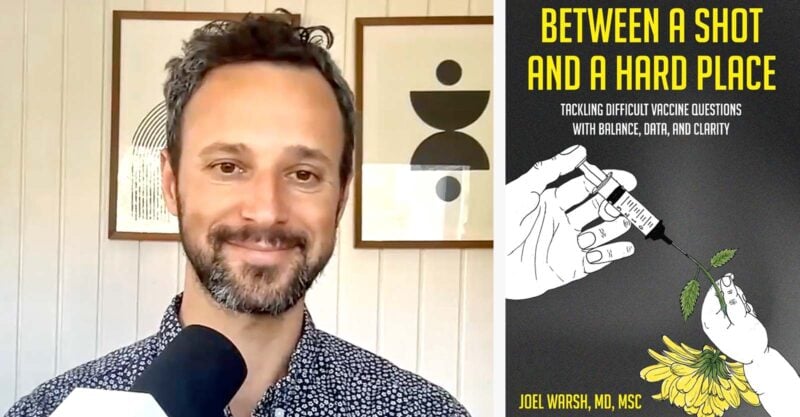


One of healthcare’s biggest wins in recent years is that people can now openly question vaccines and discuss medical freedom, pediatrician Dr. Joel “Gator” Warsh said last week on CHD.TV.
Much of that change stems from U.S. Health Secretary Robert F. Kennedy Jr., Warsh told Children’s Health Defense Chief Scientific Officer Brian Hooker.
“You can love him, you can hate him, but ultimately, you can’t dismiss that he has brought these topics and discussions — like vaccines, like foods, just general health and prevention — out into the open in a way that it never was before,” Warsh said of Kennedy.
“First, there has to be awareness before people can make a change,” Warsh added. “And I don’t think that most people were even aware of a lot of these questions and controversies just a couple of years ago, and now they are.”
Warsh said vaccine safety and the childhood vaccine schedule were rarely open to debate in the past. Now, those subjects regularly make headlines.
“No matter what [Kennedy] does, the media jumps all over him, but at least it’s in the media,” he said. “To me, that is a huge win because it does move things forward.”


‘A lot of very pro-vaccine individuals are never even exposed to another conversation’
Warsh, an integrative pediatrician in Los Angeles, has been treating children and families for more than a decade. His practice incorporates nutrition, exercise and sleep into patient care.
“I’m not against modern medicine,” he said. “I just try to minimize using as much as possible.”
Warsh said he became interested in integrative and functional medicine after realizing how little his conventional medical training had taught him about the root causes of illness.
“This is amazing. Why aren’t we learning this stuff?” he recalled thinking. “There’s nothing out there about learning about diet or exercise or sleep or thinking about the root cause.”
As he developed his practice, he encountered another gap in his education: the questions parents had about vaccines.
“What I learned really quickly when you’re in the integrative space is you better be ready to talk about vaccines,” he said.
Warsh said he initially knew little about the issues parents wanted to discuss. His medical training had only covered what vaccines were, the diseases they targeted and the benefits attributed to vaccination programs.
“When I started getting questions from parents, I realized that I had to learn a lot more,” he said. “And the more that I learned, the more questions that I had.”
Those questions led him to research vaccines and write “Between a Shot and a Hard Place.” Warsh said he wanted his book to help parents navigate competing claims and give physicians a medical perspective on the questions and controversies.
He said he drew on books by Kennedy, Hooker and Dr. Paul Thomas, among others, as he tried to “bridge the gap” between opposing viewpoints.
“I wanted to write something that was as balanced as possible,” he said.
That effort to find a middle ground drew criticism from both sides. But he believes parents and professionals who have heard only one side of the vaccine debate need an opportunity to consider other perspectives.
“A lot of very pro-vaccine individuals are never even exposed to another conversation,” he said. “And you’re not going to move the needle from ‘vaccines are the best thing ever’ to ‘no one should ever get a vaccine again’ without having some sort of middle ground there.”
Kennedy opened the door, but ‘mainstream medicine isn’t hearing it’
Warsh credits Kennedy with bringing vaccine questions into the public eye. But he said the medical profession has largely resisted engaging with those questions, leaving the divide between opposing sides unresolved.
“My big concern still remains that, regardless of what [Kennedy’s] doing, ultimately mainstream medicine isn’t hearing it,” he said. “And as soon as he’s not there anymore, anything [he did] will just get reversed.”
Walsh pointed to legal battles over Kennedy’s vaccine policy changes, disputes over updates to the Centers for Disease Control and Prevention’s (CDC) childhood vaccine schedule and conflicts surrounding the agency’s vaccine advisory committee.
“I do hope over the next two years, if that’s the length of time [Kennedy] has left, then he is able to sit down with more of these individuals who dislike him and maybe have some more conversations, as opposed to lawsuits,” Warsh said.
He specifically called for greater engagement between Kennedy and the American Academy of Pediatrics (AAP), which has repeatedly challenged the administration’s vaccine policies.
“Nothing’s going to happen if AAP just keeps suing him every time he does something,” Warsh said. “They need to … find some common ground on some things and maybe move the needle even just a little bit.”
Coercive vaccine policies are ‘biggest failure of medicine right now’
The COVID-19 pandemic helped fuel public skepticism about vaccines and the medical establishment, Warsh said.
He recalled becoming “extraordinarily frustrated” with officials’ repeated assertions that the COVID-19 vaccines were “safe and effective.”
“It just made no sense,” he said. “If something’s new, that just couldn’t be true.” Claims about the vaccines should have acknowledged the limits of available evidence, he added.
“You could say something like, ‘Based on the research that we have, it seems like it’s effective. … But we obviously don’t know anything five years from now or two years from now,’” Warsh suggested. “That would be a reasonable thing for public health to say, not ‘safe and effective’ because you don’t even know that it is safe. You can’t say such a thing at that point.”
After the pandemic, people began questioning what else they might not have been told about vaccines, Warsh said.
“People are rightfully saying, ‘Well, if you were lying about this, if this is how you handled this, when it comes to the COVID vaccine or COVID situation, what else are you lying about?’”
He also argued that coercive vaccine policies have made matters worse by undermining public trust and pushing people away from the medical establishment.
“The more you keep forcing things, the more you keep ramming things down people’s throats, the more it’s pushing them away,” he said. “That is ultimately the biggest failure of medicine right now.”


This article was funded by critical thinkers like you.
The Defender is 100% reader-supported. No corporate sponsors. No paywalls. Our writers and editors rely on you to fund stories like this that mainstream media won’t write.
‘It’s not my job to make decisions for parents’
For Warsh, the debate ultimately comes down to medical freedom: whether parents can make informed decisions about their children’s medical care without being forced to follow a government-recommended vaccine schedule.
“The vaccine schedule is the CDC-recommended schedule. It’s not the CDC-forced schedule,” he said.
Warsh said he is not opposed to vaccines and that his office offers them. But he believes physicians should educate families about their options rather than decide for them.
“Ultimately, it’s not my job to make decisions for parents,” he said, noting that the word “doctor” is derived from the Latin verb “docēre,” meaning “to teach.” “It’s not to force the vaccine schedule.”
Warsh praised Kennedy’s push for shared decision-making, in which parents and healthcare providers discuss the available information and make decisions together.
“There ultimately isn’t a good case that forcing vaccines helps anything,” he said. “If anything, it’s pushing things in the opposite direction.”
Medicine’s failure to listen to patients and give them meaningful choices has contributed to a deep loss of trust, according to Warsh. Doctors can rebuild that trust, he said, but only if they stop forcing medical decisions on people.
“I do think it’s possible to partner,” he said. “I do think it’s possible to get medicine to become a trustworthy profession again.”
But he warned that trust will not return unless the medical establishment changes course.
Medicine is currently an untrustworthy profession, Warsh said, and “medicine deserves it. … With COVID, it’s deserved. And it’s not coming back unless people stop getting forced to do things.”
Watch Warsh on CHD.TV here:
Related articles in The Defender
- ‘Parents Should Not Need a Chemistry Degree’: RFK Jr. Proposes Key Food Policy Reforms
- Lawyers for RFK Jr. Ask Court to Allow CDC Vaccine Advisers to Get ‘Back to Work’
- Florida Pediatrician Used to Toe the ‘Party Line’ on Vaccines. Then He Started Listening to Parents
- Pediatricians Receive Little Training on Vaccine Injuries, Doctors Report
- Reuters Ran a Hit Piece on RFK Jr. — and Revealed How Hard He’s Worked to Reform Vaccine Policy
- Federal Government Appeals Ruling in AAP Lawsuit that Struck Down RFK Jr.’s Vaccine Policies
- HHS Just Gave Parents More Say in Their Kids’ Vaccines — And the Vaccine Establishment Is Running Scared
