

 Login
Login
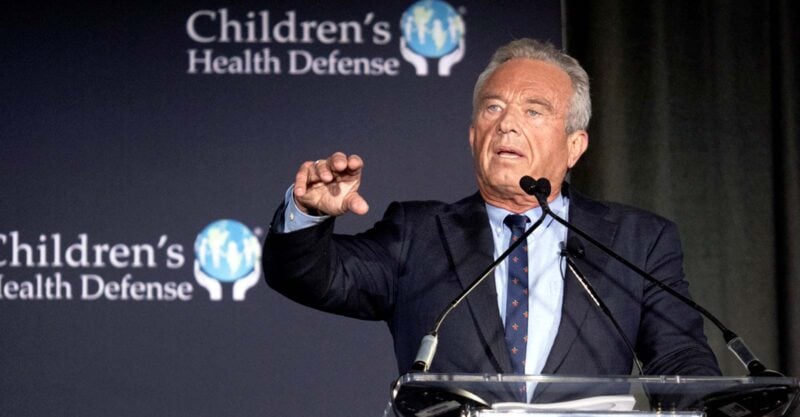


U.S. Health Secretary Robert F. Kennedy Jr. told a sold-out Children’s Health Defense (CHD) conference Thursday that the health-freedom movement has “a strong and steadfast friend at the White House.”
Kennedy urged the audience to be patient as the administration works through a slow-moving federal bureaucracy.
“You have friends in the White House, and we are doing this one day at a time,” Kennedy said during his keynote address at the “CHD in DC” conference in Washington. “We’re putting the science before any changes. … Unfortunately, we’ve had a dearth of science for 30 years.”
Kennedy, who co-founded CHD several years before becoming secretary of the U.S. Department of Health and Human Services (HHS), acknowledged that many people in the health freedom movement expected faster results after he took office.
“A lot of people in this community get frustrated about the slowness in government,” he said. “A lot of them expected me to come in and make sense of this whole system and bring changes immediately.”
But federal agencies cannot simply change policies overnight, he said.
“In government, a bunch of things have to happen before something else happens, or you get sued,” Kennedy said. “It’s a very laborious system, and there’s a lot of inertia built in.”
‘Trump will not allow the government to treat parents … as lepers’
Kennedy said the Trump administration has already made changes that would have seemed unlikely only a few years ago.
“President [Donald] Trump will not allow the government to treat parents who question vaccine orthodoxy as lepers,” Kennedy said.
He said Trump directed HHS to investigate vaccine safety, expand options for families and preserve individual choice.
“Let me be clear: You have a strong and steadfast friend at the White House,” he said. “We’ve accomplished in 19 months things that would have seemed unthinkable two years ago.”
Kennedy pointed to the administration’s review of the childhood vaccine schedule, the reconstitution of the federal vaccine advisory panel and efforts to improve the Vaccine Adverse Event Reporting System (VAERS).
“We’re fixing the VAERS system,” Kennedy said. “This is the system that was designed to fail.”
He said HHS is making the reporting system easier for doctors to use and working to improve the government’s ability to assess vaccine risks.
HHS is also researching autism and vaccine safety, and is seeking public input on how federal vaccine recommendations should be categorized, how uncertainty should be communicated and what evidence should determine the strength of a recommendation.
“We have fundamentally changed how the federal government responds to parents who question what they’ve been told about vaccines,” Kennedy said.

‘Something happened to our kids’
Kennedy said his focus on chronic disease began years before he entered government.
“When I was a kid, we had the healthiest children in the world in our country,” he said. “Today we have the sickest — we have the highest chronic disease burden of any nation in the world.”
By 2001, Kennedy said, he had six children and was seeing health problems in schools that he had never encountered growing up.
“I saw that every school classroom was now equipped with EpiPens, which is something that I had never heard of,” he said. “They had this big list of diseases, of allergic diseases, of autoimmune diseases, of neurological diseases. … Something happened to our kids.”
Kennedy pointed to environmental exposures as a potential explanation for the rise in chronic disease and autism.
He cited a 2010 U.S. Environmental Protection Agency (EPA) study that he said identified 1989 as a “red line” marking the beginning of the autism epidemic. If an environmental exposure was driving the increase, he said, there should be a limited number of potential culprits that could be identified by examining what changed around that time.
“It’s finite, and it’s an easy thing to do for my agency and the public health agencies to identify exactly what those potential culprits are and then eliminate them with science,” he said. “Those are easy, basic studies to do, and yet they were never done because it was a taboo.”
“Now we’re doing that,” Kennedy added. “We’re looking at all of the potential causes.”
New food pyramid won’t ‘change anything unless we also act’
Kennedy devoted a significant portion of his speech to food policy, including nutrition education and the meals served through federal programs.
He said the administration has “flipped the food pyramid,” putting greater emphasis on protein, saturated fats, vegetables, fruits and whole grains.
But changing dietary guidance is only a first step, he said. “That’s just a document,” Kennedy said. “It’s not going to change anything unless we also act.”
Federal agencies are now aligning food subsidy programs with the new dietary approach and improving meals served in schools, hospitals and military bases.
Kennedy also said dozens of medical schools have agreed to provide at least 40 hours of nutrition education beginning in fall 2026, compared with an average of about two hours previously.
“When we came in, there was a poll that showed that 80% of medical school graduates did not feel competent to offer nutritional advice,” Kennedy said. “What are they doing?”
The administration is also targeting ultraprocessed foods and food additives.
About 70% of the U.S. food supply is ultraprocessed, Kennedy said. He noted that some food companies have adopted tactics developed by the tobacco industry to make products more appealing and addictive.
“We have, for the first time in history … people who are in many cases grotesquely obese, and at the same time are chronically malnourished, because there’s no nutrients in those chemicals,” he said.
Kennedy said the U.S. Food and Drug Administration (FDA) estimates there are 10,000 chemicals in U.S. foods, compared with 400 in Europe.
“Many of those foods are associated with obesity, with neurological disorders, with ADHD [attention-deficit/hyperactivity disorder], and many, many of these other injuries,” he said.
HHS has proposed requiring food manufacturers to notify the FDA when they determine that an ingredient qualifies as “generally recognized as safe,” or GRAS. The agency also is working to remove petroleum-based food dyes.
Kennedy also pointed to the Supplemental Nutrition Assistance Program, saying the administration is working with states on restrictions involving purchases of less nutritious foods.
“When I came in, 10% of food stamp dollars were going to sugar-sodas and 8% to candy,” Kennedy said. “If you live in this country, you should be able to get a Coca-Cola or candy anytime you want. That’s freedom of choice. The taxpayers should not be paying for it.”
He also highlighted Operation Stork Speed, an HHS initiative focused on infant formula nutrition, labeling transparency, research and FDA testing.
‘If we want good food, we need good soil’
Kennedy connected the administration’s food agenda to farming, saying HHS is working with the U.S. Department of Agriculture and the EPA to help farmers adopt regenerative practices and reduce reliance on chemical inputs.
“If we want good food, we need good soil,” Kennedy said.
The administration announced more than $1 billion in investments in farm modernization and regenerative agriculture earlier this year.
He said the effort includes helping farmers control weeds with fewer chemicals and reduce chemical exposures in the food supply and environment.
The administration is “already seeing progress” from its focus on nutrition, he said, citing changes in obesity and mortality rates and increased sales of what he called real food.
He also connected food to family and community life through his “The Real Food Show” cooking program.
Kennedy said the program is designed to teach people how to cook and shop for food, while encouraging them to prepare and eat meals together.
“We have a physical chronic disease epidemic in this country, but we also have a mental illness crisis,” he said. “We have a malaise.”
“One of the ways to get people to reconnect to society, to community, in this post-technology era is to get people going back to this sacred ritual that humanity has practiced since the beginning of time — of cooking a meal together and then eating it together, of creating something as a family unit,” he said.
‘These questions deserve rigorous science’
Kennedy also addressed wireless radiation and electromagnetic fields (EMFs), another issue central to CHD’s work.
“We’re bringing the same scrutiny that we brought to our food supply to technologies that shape our children’s lives,” he said.
Kennedy said HHS is examining how screen use affects children, including sleep, physical activity, social interaction and development.
On Thursday, HHS also issued a request for information seeking evidence about the potential health effects of EMFs, radiofrequency radiation and wireless technologies. The agency is asking for information on exposure standards, risk assessment, research gaps and priorities for future federal research.
HHS said the information will help the agency evaluate the state of the science, compare U.S. and international safety standards and identify areas where additional research is needed.
“We’ve opened the process to the public because these questions deserve rigorous science, transparency and answers,” Kennedy said.
‘We have no idea what the risk profile is for these products’
Kennedy returned to vaccines, arguing that federal agencies have failed for decades to conduct adequate research into the risks of products routinely given to children.
He displayed the package insert for the hepatitis B vaccine and pointed to what he described as limitations in the clinical trial supporting the product.
“The trial only had 147 infants, and they were monitored for only five days, and there was no placebo,” Kennedy said. “There’s no way any other product would get FDA approval with that few people.”
“Unfortunately, this is pretty typical,” he said. “We have no idea what the risk profile is for these products.”
He displayed a list of adverse events associated with vaccines and said many overlap with chronic illnesses that have become more common among children. He criticized VAERS, saying the system does not provide enough information to track vaccine injuries and determine how frequently they occur.
Anyone who claims it’s highly likely that most of these injuries are very rare “is not talking about science,” Kennedy said. “There’s no way for us to know this. And even if they are rare, in our country we care about rare illnesses and deaths.”
Kennedy said HHS is now conducting research that federal agencies should have undertaken years ago.
The Defender is 100% reader-supported. No corporate sponsors. No paywalls. Our writers and editors rely on you to fund stories like this that mainstream media won’t write. 

This article was funded by critical thinkers like you.
‘I didn’t come to Washington to protect institutions from uncomfortable questions’
Kennedy acknowledged that HHS will continue to face resistance as it pursues changes in public health policy.
“Government is, in many ways, impervious to science, to facts, to change,” he said.
“We’re going to continue to face resistance,” Kennedy said. “Powerful institutions and entrenched interests do not surrender power easily. They will fight change and the people who are demanding it. They will continue to sue us and try to slow us down.”
Kennedy said the opposition is familiar territory after four decades of advocacy.
“I’ve spent 40 years in these battles,” he said. “I didn’t come to Washington to protect institutions from uncomfortable questions. I came to make those institutions answer those questions.”
He thanked scientists who continued pushing for answers despite opposition.
“All the scientists who were also willing to publish on this, willing to do the research, thank you,” Kennedy said.
“They did that so courageously because for many, probably most of them, it was career-ending,” he said. “And yet they continued to persist.”
Kennedy also praised parents who spent years researching their children’s health problems and advocating for change.
“I know the moms who gave so much … to study the science, to become experts in what happened to their child, and not only care for their children, but also care for all of our children by doing what they could to make sure that those injuries could not happen to other kids,” he said.
Kennedy said those advocates now have a voice inside the federal government.
“For many years, you’ve asked questions from outside the government, as I did,” he told the audience. “And now I have the privilege and the responsibility of leading the department that can put the full weight of the federal government behind answering those questions.”
“I intend to stay in this fight as long as I am able … [and] die with my boots on,” he said.
He added:
“I have an optimistic view of what’s going to happen. I think we can restore science. We can restore trust in our public health agencies, and we can build a health system that puts prevention at the center of healthcare.
“And I believe we can end the chronic disease epidemic and give our children a birthright that every generation owes the next: the chance to grow up healthy, strong and free from preventable disease.”
Watch Kennedy’s speech here:
Related articles in The Defender
- ‘We Will Do That Right Away’: RFK Jr. Promises Better Vaccine Injury Tracking, as White House Launches MAHA Commission
- CDC’s New Vaccine Advisers Vow to Study Cumulative Effect of Childhood Vaccine Schedule
- States Can Sue RFK Jr. Over Vaccine Schedule Changes — But Not Over Changes to Vaccine Advisory Panel
- Watch: He’s Getting Junk Food Out of Military Bases — and Says We Can Do the Same in Schools and Hospitals
- Philip Morris Used Tobacco Playbook to Hook Kids on Ultraprocessed Lunchables
- Breaking: HHS Makes Sweeping Changes to Childhood Vaccine Schedule
