Login
Login
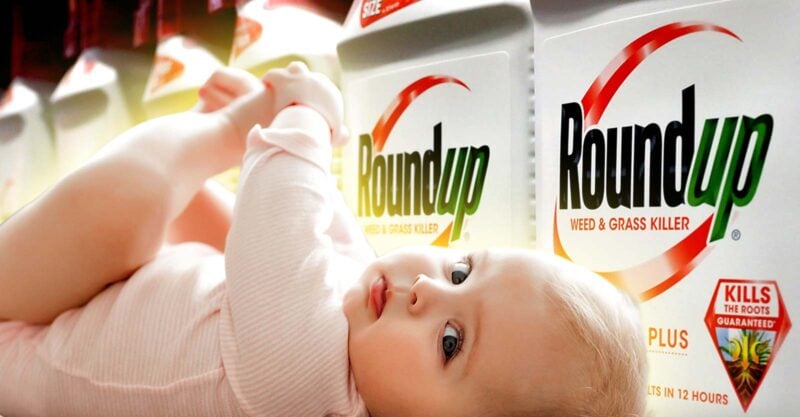


Children’s Health Defense (CHD) today filed an amicus brief with the U.S. Supreme Court (SCOTUS) warning that federal regulators have failed to protect children from glyphosate — the active ingredient in Monsanto’s Roundup weedkiller — despite known risks “that can be both profound and permanent.”
In the case before SCOTUS, Monsanto v. Durnell, CHD urged the court to side with John Durnell. Durnell, who developed cancer from glyphosate exposure, sued Monsanto for failing to include a warning on its product label that the chemical can cause non-Hodgkin lymphoma.
SCOTUS is considering Bayer’s argument that pesticide companies can’t be held liable under state law for failing to warn consumers about glyphosate’s potential health risks because the U.S. Environmental Protection Agency (EPA) does not require such warnings.
Bayer, which acquired Monsanto in 2018, has already paid more than $12 billion to resolve lawsuits filed against Monsanto before the acquisition. The company still faces more than 60,000 lawsuits nationally.
SCOTUS’ decision could reshape whether and how Americans can hold manufacturers accountable for failing to disclose product dangers.
Hundreds of environmental groups, including the Center for Food Safety, also submitted or signed on to briefs challenging Bayer’s position. They cited scientific evidence for glyphosate’s risks to human and environmental health.
“CHD’s amicus brief makes a critical point that others are not making: pesticides harm children exponentially more than adults,” CHD CEO Mary Holland told The Defender.
“As people still in the early phase of development, the toxic nature of pesticides affects them dramatically more than adults. The Court must be aware of this scientific fact so that it may consider it in weighing the case,” she said.
‘Children are not simply little adults’
In its brief, CHD argues a widely accepted principle in environmental health: children are biologically more vulnerable to chemical exposures than adults.
Glyphosate’s use is now so widespread that children regularly ingest the chemical through food and drink, in parks and lawns treated with the chemical, in swimming pools and ponds where runoff occurs, and through oral contact with hands, toys and other objects that are contaminated with the residue, according to the brief.
Yet, the EPA has opted not to study developmental neurotoxicity and other potentially serious effects of glyphosate on children or to adjust its safety standards to keep pace with growing exposure.
CHD argued that extra caution must be taken when evaluating the impacts of chemical exposures on children because “children are not simply little adults.”
It cites a large body of evidence showing that toxins impact children differently and points to international norms and principles recommending comprehensive risk assessments for children that differ from those for adults.
The National Research Council offers a precautionary principle that CHD argues ought to be followed: “In the absence of data to the contrary, there should be a presumption of greater toxicity to infants and children.”
EPA ‘refused to look’ for harms to children’s health
Under the Food Quality Protection Act, the EPA is required to apply a 10-fold safety margin to protect infants and children from agrotoxic exposure — unless reliable data prove it unnecessary.
That means the allowable exposure limit should be 10 times below the level at which a toxin is known to have no harmful effect.
With glyphosate, the EPA did the opposite.
The brief contends that the EPA eliminated this child-protective safety factor in 1998 based largely on a “handful of unpublished, industry-funded, decades-old animal studies” — most conducted by Monsanto in the 1980s.
Those studies examined only short-term, visible physical effects like skeletal abnormalities — not long-term neurological, hormonal or developmental impacts.
“The EPA has failed to identify these effects for the simple reason that it has refused to look for them,” CHD said in its brief — even as glyphosate has increased dramatically.
CHD General Counsel Kim Mack Rosenberg said, “The EPA uses inappropriate exposure metrics, failing to account for the differences between adults and children, and relies on outdated science in making its assessments. If the EPA refuses to do its job, preemption [allowing federal law to preempt state law] is particularly ill-advised.”
Research shows glyphosate has serious health consequences for children
While federal regulators rely on decades-old studies, a growing body of research published over the last two decades shows glyphosate exposure pre- and post-natal has serious impacts on a wide range of children’s health issues.
The brief lists 34 studies linking glyphosate exposure to developmental delays, autism spectrum disorder, neuroinflammation and brain damage; hormonal disruption and reproductive harm; endocrine, immune system, and microbiome-mediated effects; epigenetic changes and more.
Michael Antoniou, Ph.D., professor of molecular genetics and toxicology at King’s College London, is the author of one of the studies cited in CHD’s brief. He told The Defender that his group’s research in rats definitively linked glyphosate formulations — like those used in the U.S. and European Union — to numerous cancers, including leukemia and cancers of the skin, liver, thyroid, nervous system and bone.
Those links were clear at the currently set allowable daily intake levels (ADI) in the European Union — which is half of that allowed in the U.S.
Antoniou said:
“Based on these findings, we currently do not know what a safe daily intake of glyphosate is, only that it must be far lower than what regulators currently say is a safe dose. I have been calling for a reduction in the European Union glyphosate ADI of 100-fold, but even this may not be enough to protect people from chronic (long-term) low-dose exposure.
“It is time for glyphosate, and for that matter pesticides in general, to be considered outside the realms of politics and economics and their risks assessed based on the latest scientific evidence. If this was done for glyphosate there is only one outcome based on the latest science, a total ban.”
The Defender is 100% reader-supported. No corporate sponsors. No paywalls. Our writers and editors rely on you to fund stories like this that mainstream media won’t write. 

This article was funded by critical thinkers like you.
When federal agencies fall short, states must step in
In a previous ruling against Dow Agrosciences LLC, the SCOTUS recognized the importance of tort lawsuits as “a catalyst” for improving product safety.
The court acknowledged that state tort actions can expose new dangers associated with pesticides, prompt EPA labeling changes and incentivize manufacturers to stay informed of all possible injuries from their products.
CHD argued that logic applies directly to Monsanto v. Durnell.
“The need for safety incentives is nowhere greater than in the realm of child welfare,” CHD argued. CHD urged the court to allow states to continue protecting children from the glyphosate risks by requiring labels that fully disclose those risks
The brief also placed the glyphosate case within a larger pattern across industries, where federal agencies fail to update outdated safety standards while simultaneously blocking states from filling the gap.
CHD pointed to two other examples — wireless radiation limits frozen since 1996, and vaccine liability protections that limit legal recourse for vaccine injury victims.
In each case, CHD argues, children bear the greatest risk.
Related articles in The Defender
- Bayer Takes Fight to Avoid Glyphosate Litigation to the Supreme Court
- Trump Officials With Ties to Bayer Ask Supreme Court to Wipe Out Glyphosate Cancer Claims
- Breaking: U.S. Supreme Court to Hear Case That Could Protect Pesticide Giant Bayer From Cancer Lawsuits
- Bayer Will Stop Selling Glyphosate Weedkiller for Home Use — But Toxic Chemical Will Still Be Sprayed on Food Crops