

 Login
Login


When Moderna and Merck announced on Aug. 19 that their experimental mRNA cancer treatment had succeeded in a major Phase 3 melanoma trial, the response was immediate.
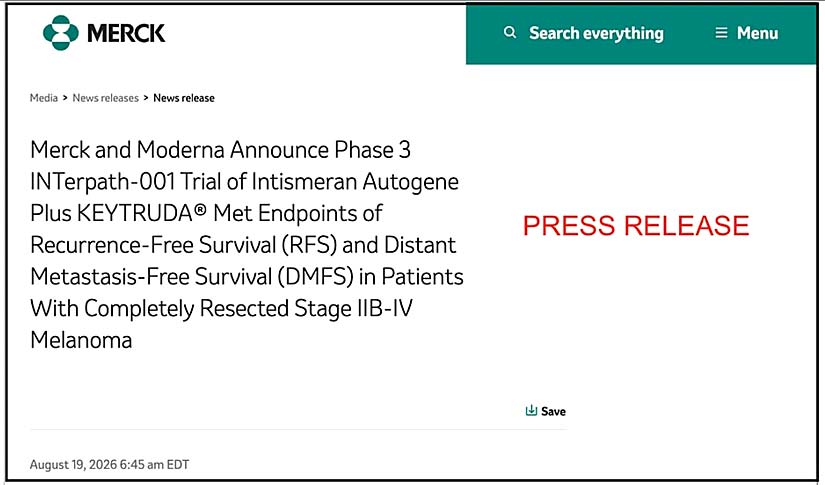
The companies called it a “landmark moment” — the first successful late-stage trial of an mRNA-based cancer treatment. News reports heralded a breakthrough. Elon Musk even declared that “synthetic RNA will cure many diseases.”
Investors were equally enthusiastic. Moderna and Merck’s market values surged, adding approximately $86 billion between them in a single trading session.
But amid the celebration, something important was missing.
The data!
No Phase 3 results have been published in the peer-reviewed literature, and none have been posted to ClinicalTrials.gov.
Instead, all the excitement rests on a company press release.
Moderna and Merck said the trial showed “statistically significant and clinically meaningful” improvements in preventing melanoma from recurring and spreading to distant organs.
But they have not disclosed how many patients experienced a recurrence, how large the absolute benefit was, whether it differed by disease stage or how many patients stopped treatment because of adverse events.
The result may turn out to be impressive. But right now, we are being asked to celebrate a “breakthrough” that nobody outside the companies can properly scrutinize.


Not the ‘vaccine’ most people imagine
Despite being widely described as a “cancer mRNA vaccine,” Moderna’s intismeran is an experimental treatment for people who have already had high-risk melanoma surgically removed.
Although they may have no detectable cancer remaining, microscopic cancer cells can survive and later cause the disease to return.
Intismeran is custom-made for each patient.
Scientists compare genetic material from the patient’s tumor with their normal DNA to identify mutations unique to the cancer. These mutations can produce neoantigens — foreign proteins that flag the cancer cells to the immune system.
Synthetic mRNA is then programmed to code for selected neoantigens. Once injected, it instructs cells to produce them, training T cells to recognize and attack any remaining cancer cells displaying those same neoantigens.
But intismeran is not being trialled on its own.
It is given alongside Merck’s Keytruda (pembrolizumab), an established cancer immunotherapy that blocks PD-1, a pathway cancer cells can exploit to hide from the body’s T cells.
In simple terms, intismeran helps T cells recognize the cancer, while Keytruda helps stop the cancer from hiding from them.
Interestingly, Keytruda alone already substantially reduces the risk of melanoma returning.
So the important question is how much additional benefit does Moderna’s mRNA product provide?
These melanomas already produce plentiful neoantigens. Will instructing cells to make more copies of them actually improve outcomes?
What do the published data show?
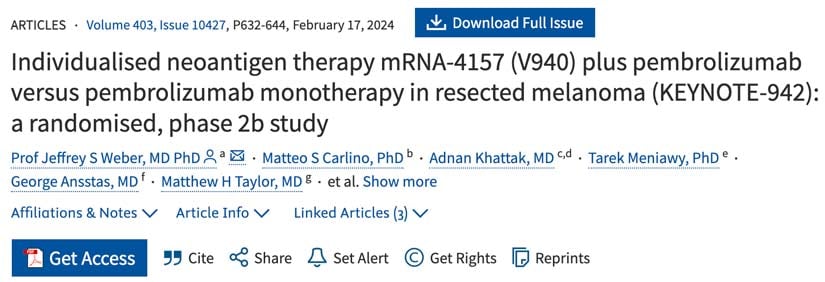
Until Moderna and Merck release the Phase 3 results, the best randomized evidence comes from the much smaller Phase 2b KEYNOTE-942 trial, published in The Lancet.
It enrolled 157 patients: 107 received intismeran plus Keytruda and 50 received Keytruda alone.
The results seemed encouraging.
At 18 months, an estimated 79% of patients receiving the combination remained alive without their melanoma recurring, compared with 62% receiving Keytruda alone — an absolute difference of 17 percentage points.
Across the full follow-up period, however, the recurrence-free survival comparison narrowly missed the conventional threshold for statistical significance, with p=0.053.
The result for distant metastasis was stronger.
At 24 months, an estimated 92% of patients receiving the combination remained alive without distant metastasis, compared with 73% receiving Keytruda alone — an absolute difference of 19 percentage points. The overall comparison was statistically significant, with p=0.013.
In a five-year follow-up analysis of the same patients published recently, the combination group maintained an absolute advantage of 20 percentage points in recurrence-free survival.
But the Phase 2 trial had quite a few limitations. It was small and exploratory. COVID-era manufacturing constraints also disrupted randomization, forcing some patients to be manually allocated.
The groups were not perfectly balanced either. More patients receiving the combination had a high tumour mutational burden, which may elicit a better response to Keytruda.
The researchers performed sensitivity and adjusted analyses to account for these problems and obtained broadly similar results. But statistical adjustments made afterwards are not the same as clean randomisation from the outset.
The Phase 3 trial was supposed to provide the more definitive answer, which is precisely why we need to see that data.
What about the harms?
The press release said there were “no new safety signals” in the Phase 3 trial, but without the underlying numbers, that tells us very little.
The Phase 2 trial showed that adding intismeran also added toxicity.
Every participant receiving the combination who was included in the safety analysis experienced at least one treatment-related adverse event, compared with 82% of those receiving Keytruda alone.
Grade 3 or worse treatment-related adverse events occurred in 25% vs 18%. And 15% stopped intismeran because of adverse events.
Keytruda itself was also discontinued more often when given with intismeran: 25% vs 18%.
Cancer treatments routinely involve serious trade-offs, and many patients would reasonably accept greater toxicity for a substantial reduction in the risk of their cancer returning.
But that calculation depends on knowing the size of both the benefit and the harm. For the Phase 3 trial, we currently know neither.
Does it help people live longer?
There is another unanswered question that tends to disappear beneath the excitement over recurrence.
Does adding intismeran actually extend patients’ lives?
After five years of follow-up in the Phase 2 trial, seven patients had died in each group. Because the combination group was more than twice as large, the survival analysis numerically favoured intismeran plus Keytruda. But with only 14 deaths, the estimate remained extremely uncertain.
Preventing or delaying the return of melanoma is clearly an important outcome, particularly if recurrence means metastatic disease and further treatment.
But we still do not know whether adding intismeran ultimately helps patients live longer — and for patients, that is the most important outcome.
Science or marketing?
Within hours of the company press release, a highly experimental personalized cancer treatment was being presented as proof that the “cancer mRNA vaccine” had arrived.
Perhaps the Phase 3 data will justify that enthusiasm. We simply don’t know yet.
If they soon produce data from a large, well-conducted randomized trial showing that intismeran substantially reduces melanoma recurrence on top of an already effective treatment like Keytruda, that would represent real progress.
But we need to know how large that additional benefit is, what harms come with it, how many patients discontinue treatment and, ultimately, whether it helps them live longer.
I don’t want to dump on progress.
But until Moderna and Merck release the Phase 3 results, their melanoma “breakthrough” remains exactly what it is — science by press release.
Originally published on Maryanne Demasi’s MD Reports Substack page.
