Login
Login
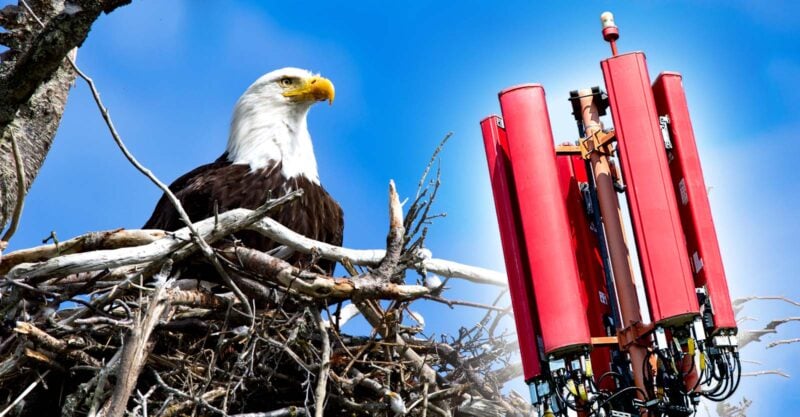


The Federal Communications Commission (FCC) on Thursday ruled against a group of Montana residents seeking to prevent construction of a 260-foot cell tower that they say would harm nearby wildlife, including nesting eagles, and the environment.
The FCC’s Wireless Telecommunications Bureau sided with Harmoni Towers, concluding the company isn’t required to do any further research on how the proposed tower might negatively impact the local environment — even though the company’s “environmental assessment” contained errors and overlooked key information, according to W. Scott McCollough, lead attorney for Children’s Health Defense (CHD) Electromagnetic Radiation (EMR) & Wireless cases.
Members of the nonprofit Stewards of the Swan Valley, who opposed the tower, allege that if built, the tower would harm a host of non-human species, including mammals, birds, insects, amphibians, reptiles and flora.
The proposed tower site is near Condon, Montana, in the state’s Swan Valley, prized for its spectacular wilderness views.
“This is a horrible place for a cell tower with a strobe light on it,” resident Peter Guynn told The Defender. “It announces to the world that this is no longer a natural place.” Guynn called the FCC’s decision “egregious.”
In February, opponents of the tower filed comments, pointing out that Harmoni Towers failed to consider the published evidence on how the radiofrequency (RF) radiation emitted by cell towers affects non-human species.
The FCC said the company’s environmental assessment wasn’t required to address the effect on non-human species, arguing that the agency’s RF radiation exposure limits pertain only to the human environment.
“We find that the tower will not have a significant impact on the quality of the human environment,” the FCC wrote.
McCollough told The Defender, “Essentially, the FCC covered both its eyes so that it couldn’t see an impact.”
The residents are considering next steps, McCollough said. The FCC’s decision becomes final in 30 days, unless the residents submit an application asking for it to be reviewed.
Miriam Eckenfels, director of CHD’s EMR & Wireless Program, said that the FCC’s decision shows yet again that communities dealing with unwanted cell towers cannot rely on the FCC to help them.
“The FCC is the poster child of a captured government agency. It serves industry alone, and people are left to fend for themselves,” Eckenfels said. “This decision also highlights the importance of CHD’s 704NoMore initiative and its goal to change the federal framework towards consideration of health effects of RF radiation.”
The 704NoMore campaign is raising money to legally challenge Section 704 of the Telecommunications Act of 1996, which prohibits local and state governments from considering possible health impacts from RF radiation when making cell tower decisions.


FCC admits RF radiation exposure limits don’t protect animals or environment
McCollough and Eckenfels have been supporting the Montana residents through CHD’s Stop 5G initiative.
In February, McCollough filed comments with the FCC on the residents’ behalf outlining how and why Harmoni Towers’ environmental assessment was inadequate. The comments also included written testimony from a local woman who had personally witnessed eagles nesting less than a half mile from the proposed tower site.
McCollough said he wasn’t surprised the FCC brushed aside the residents’ comments and sided with the cell tower company. He explained that the FCC is responsible for doing an environmental assessment, but that the agency delegates the task to the company applying to build a tower.
However, McCollough said it was a big deal that the FCC, in its Aug. 20 decision, admitted that the agency’s RF exposure limits pertain only to humans, not non-human species or the environment.
In other words, there is nothing in the FCC RF radiation regulations that protects animals, insects or plants. “That’s been clear, but they’ve danced around it forever,” McCollough said.
Now they have explicitly stated it, he said.
McCollough pointed out that page 4 of the decision states that, based on “the Commission’s rules,” the company’s environmental assessment didn’t have to evaluate the impact of RF radiation on non-human species.
According to McCollough, the FCC doesn’t want to have to determine if and/or how to set RF radiation limits that would protect non-human species and the environment, he added.
The Defender is 100% reader-supported. No corporate sponsors. No paywalls. Our writers and editors rely on you to fund stories like this that mainstream media won’t write. 

This article was funded by critical thinkers like you.
FCC moves to end environmental safety reviews for cell towers
The FCC still has done nothing to comply with a 2021 court order requiring the agency to explain how it determined that current RF radiation exposure limits adequately protect people and the environment. In May, CHD filed a new federal case seeking to force the FCC to comply.
The 2021 court decision stated:
“The Commission completely failed to acknowledge, let alone respond to, comments concerning the impact of RF radiation on the environment. … The record contains substantive evidence of potential environmental harms.”
Meanwhile, the FCC has taken action to end environmental safety reviews for cell towers.
In August 2025, the agency announced a proposed regulation change to “streamline” and “modernize” the agency’s environmental review process under the National Environmental Policy Act of 1969 (NEPA).
The proposed changes would exempt many wireless projects from NEPA review requirements.
Under NEPA law, federal agencies must consider the environmental impact of every “major federal action.”
Most wireless infrastructures are considered major federal actions because the FCC regulates their construction and grants permits for their use. That means they are subject to environmental impact review.
For instance, the Montana residents argued that, under NEPA, the FCC needed to do a full environmental impact review, or “environmental impact statement,” for the proposed tower. However, the FCC decided the proposed tower would have “no significant impact” and thus did not require the review.
Related articles in The Defender
- Children’s Health Defense Seeks to Force FCC to Comply With 2021 Ruling
- Critics Blame ‘Agency Capture’ as FCC Seeks to End Environmental Safety Reviews for Cell Tower Projects
- CHD Urges FCC to Scrap Plan for 4-Fold Increase in Power Limits for Wireless Devices
- Children’s Health Defense Urges FCC to Drop Plan That Would Strip Communities of Local Control Over Cell Towers