

 Login
Login
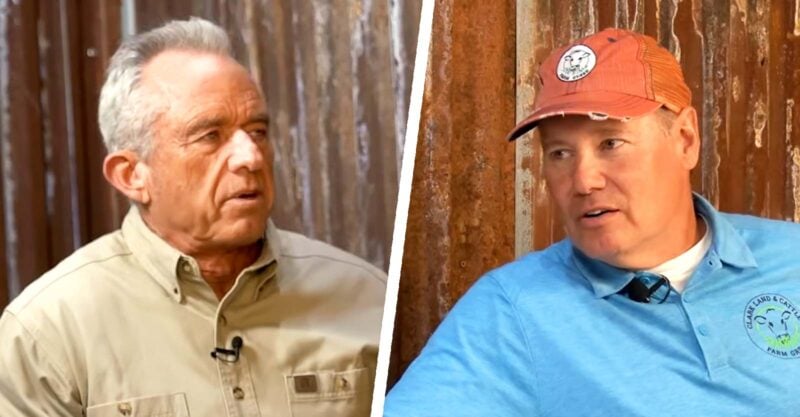


U.S. farmers could dramatically reduce their reliance on synthetic fertilizers, pesticides and other chemicals much faster than most people think — and without sacrificing profits, regenerative farmer Rick Clark said last week on “The Secretary Kennedy Podcast.”
“I’m pretty confident that we could go just about anywhere in the U.S. and reduce inputs by 30% tomorrow and not see a change in profitability,” Clark said.
The fifth-generation Indiana farmer isn’t speaking from theory. He manages 6,500 acres of crops and livestock and said the chemical-free approach saves his operation more than $2 million a year.
Yet Clark said the biggest obstacle preventing more farmers from making the switch isn’t economics. It’s education.
For skeptics who assume regenerative agriculture is too expensive or impractical, Clark had a simple response.
“Let’s talk money. The advantage is real,” he told U.S. Health Secretary Robert F. Kennedy Jr.
While many farmers focus on maximizing yield, Clark argued that profitability matters more. Harvests may dip during the transition period, but significantly lower input costs can more than make up the difference.
“I didn’t say yield, I said … profitability. They’ll be more profitable,” Clark said.
“The risk-to-reward is the simple fact of, I don’t have all of those inputs purchased and lying out there at risk of what Mother Nature’s gonna give to us,” he added.
By avoiding synthetic fertilizers, pesticides and other inputs, while also cutting fuel costs, Clark estimates his operation saves roughly $2.4 million annually.
‘The crossroads that we’re at now is the teaching’
If the financial case is compelling, why haven’t more farmers made the transition?
Clark said crop insurance rules, lending requirements and decades of conventional farming practices make change feel risky.
“You have to get the proper teaching,” he said. “The crossroads that we’re at now is the teaching.”
Clark understands that hesitation. He didn’t set out to become a regenerative farmer. He said concerns about soil erosion first pushed him to question conventional farming practices.
“The one thing that really set me off and got me in this direction was erosion,” Clark said. After watching dirt — “It wasn’t soil. It was dirt then,” he said — wash off one of his fields during a storm, he decided, “Enough. We gotta stop.”
What followed was an 18-year transition to regenerative farming.
A breakthrough came when Clark learned how to use a roller crimper, a tool that flattens cover crops into a thick layer that helps retain moisture, suppress weeds and protect the soil.
“That was my gateway to eliminating the chemistry because we didn’t need it any longer,” Clark said. “We had a way to grow cover crop, roll them down with a roller crimper, suppress weeds and grow cash crops in that.”

‘Most of the farms across the Midwest are out of balance’
For Clark, the shift wasn’t simply about replacing one farming practice with another. It was about working with nature instead of trying to overpower it with chemicals.
“Once you stop applying the salts and the acids and the chemicals and the insecticides and stop killing the microbial biome … you then create a healthy environment for, now, your cash crop to grow in,” he said.
Clark said the benefits extend far beyond healthier soil.
“People say to me all the time, ‘How can you raise non-GMO [non-genetically modified organism] corn and not have any insecticide?’” he asked. “Once you stop killing the beneficial species that prey on the rootworm that’s going to affect that corn plant without insecticide, you don’t need the insecticide because the beneficial is there to keep the balance.”
According to Clark, “most of the farms across the Midwest are out of balance.”
“If you want to promote and build soil health … you’ve got to get it into balance,” he said. “And that’s what you can see happen to these soils immediately with a soil test. You don’t need fancy, expensive equipment to validate that what we’re doing is correct.”
‘This is all about human health, and it’s all about soil health’
For Clark, the conversation ultimately comes back to something bigger than farming.
“We’re at a part in the journey for me where this is all about two major things,” he said. “This is all about human health, and it’s all about soil health.”
He said healthier soil can produce more nutrient-dense food while reducing the need for farmers and farmworkers to handle potentially hazardous chemicals.
“Here’s how I look at human health,” Clark said. “The one way is the way everybody looks at it, which is exactly right. We gotta increase nutrient density of the food we’re producing.”
But Clark said the issue is also deeply personal.
“A lot of these products have skull and crossbones on them. That’s death. That’s danger,” he said. “So I look at human health as saving the health of my team members and my family, my grandchildren, my daughters, my wife.”
Looking across generations of his family, Clark said he sees a troubling pattern.
“When I look back at our family tree, it’s cancer, cancer, cancer, cancer; diabetes, diabetes, diabetes,” he said. “Why? I got a 24-year-old nephew had non-Hodgkin’s lymphoma. It’s all coming back to what we all feel like is the answer.”
“The soil on our farm … it’s healthy. It’s alive,” Clark said.
He acknowledged that regenerative farming cannot eliminate the impacts of extreme weather. Still, he said healthier soils are better able to withstand drought and other stresses because they hold water longer and resist erosion.
‘No farmer wants the inputs. They don’t want them’
Clark’s comments come as regenerative agriculture gains attention from policymakers, public health advocates and even Hollywood.
In December 2025, the U.S. Department of Agriculture (USDA) launched a $700 million pilot program designed to help farmers adopt regenerative practices while lowering production costs. According to Kennedy, more than 13,000 farmers have already applied.
Kennedy said many farmers feel trapped in a system built around expensive fertilizers, pesticides and other chemical inputs.
“No farmer wants the inputs. They don’t want them,” Kennedy said. “A lot of that stuff is poison.”
He argued that federal policies helped create the system farmers now operate in.
“A lot of this system was created by the federal government,” Kennedy said. “It wasn’t created by the farmers. The farmers want markets. They don’t want federal handouts. They don’t want inputs. We’ve created a system for them that has locked them into this model.”
The debate over agriculture’s future has intensified in recent months.
In February, supporters of the USDA program expressed frustration when President Donald Trump signed an executive order aimed at increasing production of glyphosate, the active ingredient in Monsanto’s Roundup weedkiller.
Regenerative agriculture advocates faced another setback last month when the U.S. Supreme Court ruled that federal pesticide law bars state-law claims alleging Bayer failed to warn consumers that Roundup could cause cancer. Bayer acquired Monsanto in 2018.
Yet on the same day, Trump signed a separate executive order promoting regenerative agriculture and farm resilience.
The Defender is 100% reader-supported. No corporate sponsors. No paywalls. Our writers and editors rely on you to fund stories like this that mainstream media won’t write. 

This article was funded by critical thinkers like you.
Clark: ‘All or nothing’ thinking impedes progress
Kennedy has repeatedly called glyphosate a “poison” and said regenerative farming offers a long-term path away from dependence on such chemicals.
The movement has also reached wider audiences through documentaries such as “Groundswell,” executive produced by Woody Harrelson and Demi Moore. The film explores connections between human health, climate change and rural economies.
Still, Clark rejects the idea that regenerative farming must replace conventional agriculture entirely to make a meaningful difference.
“Too many times, we look at things as all or nothing,” he said. “If you were to move the needle on 30% of the acres in the U.S., that’s roughly … 250, 270 million acres.”
After years of helping other farmers make the transition, Clark said he hears the same response again and again.
“I’ve never had one person say, ‘I wish I never would have done that,’” Clark said. “But almost every one of them says, ‘Why didn’t we do that 10 years ago?’”
Watch Clark on ‘The Secretary Kennedy Podcast’ here:
Related articles in The Defender
- ‘Farm by Farm’: New Documentary Explores How Farming Could Help Heal People and the Planet
- ‘We’ve Addicted Our Farmers’ to Glyphosate, RFK Jr. Tells Joe Rogan
- ‘Feeding America Safely’: Pesticides, Regulatory Failures, and America’s Chronic Disease Crisis
- U.S. Supreme Court Sides with Pesticide Giant Bayer in Landmark Cancer Lawsuit
