

 Login
Login



By Roger McFillin, Psy.D.
The treatment of clinical depression has fueled a multibillion-dollar mental health industry.
The U.S. antidepressant drugs market size was valued at $6.9 billion in 2022 and is estimated to expand at a compound annual growth rate of 3.9% from 2022 to 2030 and will reach $9.37 billion in 2030.
Psychotherapy is now a mega industry, with most communities reporting a shortage of available therapists to meet the demand. Venture capitalists are scouring the country to invest in mental health start-ups.
Today, mental illness drives 200 million lost workdays each year at a cost of $17 to $44 billion to employers annually, according to the Centers for Disease Control and Prevention.
A community-based study of American adults found the one-year prevalence of “Major Depressive Disorder” rose from 3.33% to 7.06% between 1991-92 and 2001-02.
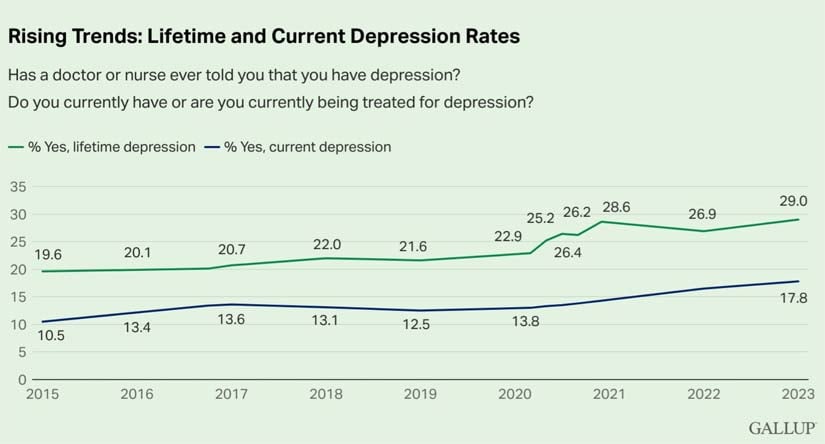
The percentage of Americans who currently have or are being treated for depression is now 17.8%, according to a recent Gallup poll, up about 7% since 2015!
What is happening?
Historically, the perception of clinical depression as a chronic and severe condition necessitating medical intervention was uncommon. It wasn’t considered a public health concern, and psychiatrists were not in high demand.
This trend continued until the mass marketing of antidepressants to the general population, bringing the profession back from the brink of extinction.
In the period from 1950 to 1990, the prevalence of people self-identifying as “depressed” remained relatively low, typically hovering around 2% of the population and rarely exceeding 5%.
Is the purported 250% surge in clinical depression genuine, or is there a darker and more insidious force at play?
What happens if more people identify as depressed?
Life is undeniably challenging. Some might contend that the conveniences and technological advancements of modern living have rendered it more bearable — think indoor plumbing, sanitation, modern medicine, clean water and accessible grocery stores.
Infant and child mortality rates have seen a significant decline. Given these advancements and the reduction in famine and starvation, one would logically expect clinical depression to, at the very least, remain stable, if not decrease in prevalence.
Consider this scenario:
You work for a company manufacturing running sneakers. If only 2% of the population were avid “runners” and this prevalence remained stagnant, your sales would likely plateau, making growth a formidable challenge. In fact, with increasing competition for that limited market, sales might even decline.
Now, imagine a different scenario. What if you could double the number of people embracing running? Or, better yet, what if you could increase the demand for running sneakers by a staggering 250%?
Manufacturing depression
To expand the number of individuals identifying as depressed, one would initially have to construct the notion that depression is an under-recognized and undertreated disease. This involves portraying depression as an unidentified public health concern, silently afflicting millions and wreaking havoc on families.
By framing depression in this light, a narrative is created to foster greater awareness and, subsequently, a surge in individuals recognizing and acknowledging their struggles under the umbrella of this purportedly pervasive and under-addressed condition.
We can all agree that life is hard. Is anyone looking for more stress and hardship in their life?
Despite the comforts of indoor plumbing, modern medicine and various conveniences, existence itself is marked by pain. War, unemployment, loss, disease and trauma persist. Some may argue that the experience of suffering is intrinsic, a normal part of the human condition.
What if, however, this very normalcy is marketed as abnormal? What if the ebb and flow of emotions and hardships are pathologized, labeled as disorders? The message is sold as: you should be, at the very least, content, if not constantly happy.
It’s acceptable to be sad, but only within a designated timeframe. Struggle beyond that arbitrary period, and suddenly, you’re deemed disordered — and you can buy our product … I mean “seek treatment.”
Indeed, the contemporary framing of depression as a disease has been deliberately constructed and marketed to the public. The narrative surrounding depression has been carefully crafted, shaping perceptions and influencing how individuals interpret their experiences.
This manufactured portrayal serves as a powerful force in shaping public understanding and contributing to the widespread acceptance of depression as a prevalent and treatable condition.
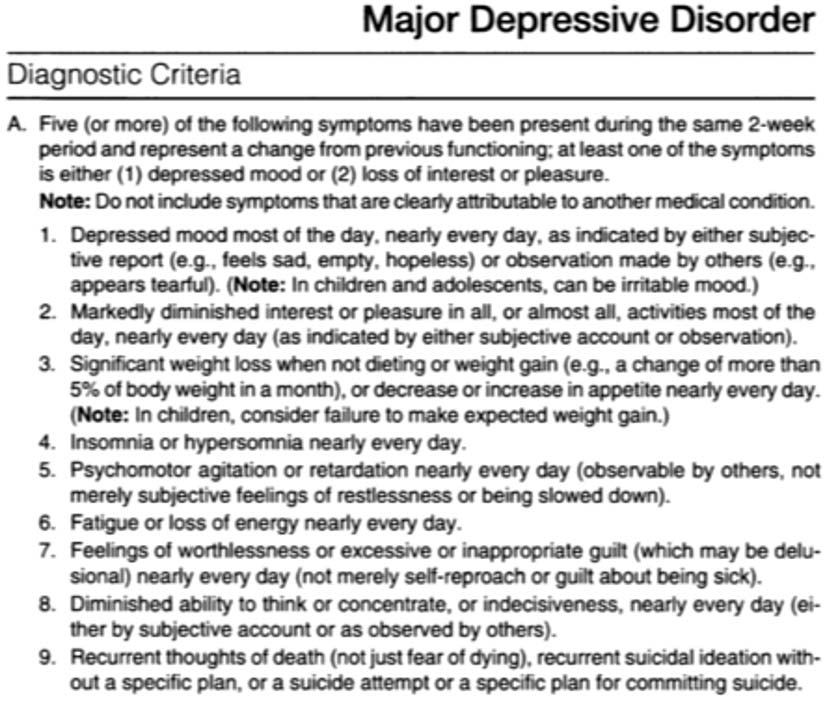
Consider the evolution of “major depressive disorder.” It necessitates only a two-week designation of change from the previous “functioning.” Essentially, a brief period of struggle within this timeframe could be interpreted as indicative of a “disorder.”
How do we amplify the number of people identifying as depressed? The strategy involves creating “symptoms” that lack context and attributing them to an underlying disease, thereby broadening the scope of what can be construed as signs of depression.
This approach effectively expands the pool of individuals who may perceive themselves as sufferers, contributing to the perceived prevalence of the disorder.
Consider this scenario:
Within the span of a single month, your live-in romantic partner has decided to end the relationship, and you’ve received the news that your job is downsizing, leaving you unemployed in just four weeks.
The emotional toll of losing a loved one is compounded by the financial strain of losing a roommate, which threatens your ability to cover rent, all while facing the uncertainty of unemployment.
Indeed, the pain experienced in scenarios such as the end of a relationship and the loss of employment may not match the profound grief of losing a child or the physical challenges of contracting a debilitating illness like polio.
Nevertheless, it undeniably constitutes significant distress, introducing layers of stress and difficulty into one’s life. Yet, in acknowledging these challenges, such hardships are an inherent part of life — a series of inevitable trials that, in their own way, define the normal course of human experience.
Now, let’s refer to the diagnostic criteria for “Major Depressive Disorder.” Bear in mind that historically, clinical depression was deemed a debilitating condition affecting only a small percentage of the population. Now it only requires 5 of the 9 “symptoms.”
How easy is it to achieve a diagnosis of clinical depression?
- Depressed mood most of the day for this two-week period? Check.
- Diminished interest or pleasure in activities? Check.
- Trouble sleeping? Absolutely. Check.
- Agitated or restless? Naturally. Check.
- Feelings of worthlessness or guilt? Considering a relationship ended and a job was lost, what else should one feel? Check.
- Fatigue or loss of energy? Well, I just mentioned struggling with sleep. Check.
- Diminished ability to concentrate? Make decisions? Absolutely, given the sleep troubles, worries about the future, and coping with a profound loss. Isn’t this within the realm of normalcy? Check.
There you have it — seven out of nine “symptoms” right there. This is how you manufacture “Major Depressive Disorder” and increase the prevalence rate of a disease.


Manufacturing ‘severe depression’
Society is filled with rational thinkers, academics and ethical professionals who are bound to identify the scam. Reasonable people will debate the merits of pathologizing the expected and normal reactions to life events.
So, the solution becomes creating an arbitrary threshold of “severe” to legitimize the condition as disordered and warrant the existence of a pharmaceutical fix and professional help.
Remember — a small percentage of people struggle with prolonged and severe clinical depression, undoubtedly warranting professional help. Yet, the challenge arises when serving this limited demographic proves insufficient to sustain a multi-billion-dollar industry — an industry fundamentally tied to shareholder interests.
To meet the demands of growth, there’s a need to cultivate a larger pool of individuals identifying as “severely depressed.”
The clinical trials for “antidepressants” are notorious for their inefficacy, offering a clinically irrelevant response in comparison to placebo for all but a small percentage.
Despite this, the marketing persists, framing the drug as at least partially beneficial for the “severely depressed” individuals.
But who exactly are these individuals? Those characterized as catatonic, enduring multiple hospitalizations, facing prolonged and debilitating depression — a condition lasting months or years — not two weeks.
These are NOT the typical people being placed on antidepressants in primary care or being designated as severely depressed by a therapist. This condition is rare. In fact, I would venture to say most typical outpatient therapists who designate their clients with severe depression have never met these individuals.
Statistically speaking, it’s highly probable that if you were prescribed an antidepressant drug, you shouldn’t have been. The unsettling truth is that you have been misled, manipulated and essentially scammed into a pharmaceutical solution.
Now, everyone views their depression as severe, and thus most professionals are validating this experience. The word “sad” has been completely eliminated from our lexicon.
How would one know if they are severely depressed? What is their point of comparison? What is their experience with people who are severely depressed? Same with therapists and primary care docs?
This is why you see the dramatic rise in being diagnosed and treated for depression. There is a complete distortion of the normal variation that exists in response to life events.
This is purposeful! Create a fear campaign around depression as a disease that requires early intervention and treatment. Condition people to believe what they are experiencing is abnormal.
This in itself will drive a self-obsession and internal judgment of their own emotional reactions as disordered. View themselves as disordered, broken or imbalanced. Get a professional to validate the experience with a diagnosis and treatment.
This is disease mongering and a very effective marketing tactic to increase pharmaceutical sales and psychiatric treatment.
AWAKEN
Originally published on Roger McFillin’s Radically Genuine Substack page.
Roger McFillin, Psy.D., is a clinical psychologist and host of the “Radically Genuine Podcast.”