

 Login
Login
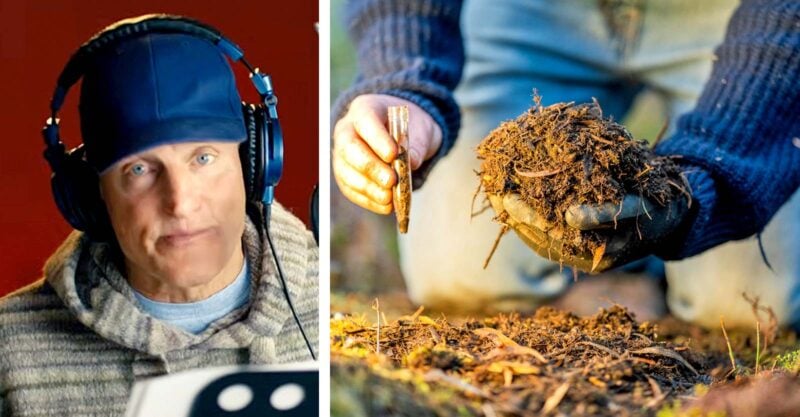


Healing the world’s soil could help heal the planet and its people, according to the documentary “Groundswell,” which debuts Friday on Prime Video.
“The film is about food and about how we grow it,” narrator and executive producer Woody Harrelson says in the trailer.
Through the perspectives of farmers, scientists and Indigenous leaders, the documentary explores the growing regenerative agriculture movement and its potential to restore degraded land while producing food in ways that benefit both people and the environment.
At the heart of the film is the sweeping idea that rebuilding carbon-rich soil can help address some of the world’s most pressing challenges, including climate change, biodiversity loss, declining human health and struggling rural economies.
“Farm by farm, we can actually heal the entire world,” the trailer states.
“Groundswell” is directed by Josh Tickell and Rebecca Tickell and executive produced by Harrelson and Demi Moore.
The film is the third installment in the filmmakers’ regenerative agriculture trilogy, following “Kiss the Ground” in 2020 and “Common Ground” in 2023. Both earlier films are also available on Prime Video.


‘Ultimate how-to guide to fix the planet and help save humanity’
“Groundswell” documents regenerative farming projects in Kenya, India, the U.S., Australia, Brazil and Colombia.
This is “the ultimate how-to guide to fix the planet and help save humanity,” Josh Tickell said in a statement, as reported by Deadline.
Supporters of regenerative farming argue that decades of industrial agriculture practices — including intensive tillage, monocropping and heavy chemical use — have contributed to soil erosion and declining soil health.
Plants naturally draw carbon dioxide from the atmosphere. Regenerative farming practices are designed to return that carbon to the ground, which helps the soil retain more water during droughts and support more nutrient-dense food and more diverse ecosystems.
André Leu, author and co-founder of Regeneration International, said he has practiced regenerative agriculture for more than 50 years and worked with thousands of farmers around the world.
“In every case, we increase yields, reduce production costs, and eliminate the need for costly, toxic pesticides and environmentally damaging fertilizers,” he told The Defender.
Regenerative agriculture is “the way that farming used to be done,” Rebecca Tickell said during an interview with KNWA.
She described the approach as using fewer synthetic chemicals, minimizing tillage, keeping soil covered, supporting farm workers and growing crops suited to local conditions.
According to the film’s synopsis, “farmers, scientists, Indigenous leaders, and visionaries are already proving it at all scales.” The trailer states that regenerative agriculture is now practiced on 250 million acres worldwide.
The filmmakers say their goal with “Groundswell” is to help expand regenerative agriculture to 1 billion acres worldwide, which they said is a critical threshold for stabilizing the climate.
Rebecca Tickell spoke about the real-world impact of the film during an acceptance speech at the Cannes Film Festival, where the film received the Golden Globe Prize for Documentary.
According to The Hollywood Reporter, she said acreage under regenerative management in the U.S. increased from about 3.5 million acres when the earlier films were released to more than 86 million acres today.
The growth comes even as total U.S. farmland has gradually declined over the past several decades. The country had 876.5 million acres of farmland as of 2024, according to the U.S. Department of Agriculture.
‘Soil is at the heart of our health’
A central theme throughout the film is the connection between soil health and human health.
“Soil is at the heart of our health,” Josh Tickell told KNWA. “Soil is the way we get healthy food. Healthy food is the way we heal our bodies.”
The idea that soil health and human health are closely linked extends beyond the documentary. At a March 2026 Heritage Foundation event, physicians, attorneys, farmers and policymakers voiced similar concerns about the relationship between modern agriculture, diet and chronic disease.
“You cannot have human health until you first have soil health,” Rick Clark, a fifth-generation Indiana farmer using regenerative organic practices, told the panel.
The filmmakers also argue that regenerative agriculture could provide economic benefits for farming communities.
“What if we could bring back agriculture, bring back Main Street, bring back the economic engine of the country?” Josh Tickell said. “This film shows us how to do that.”
“We need to see a resurgence in agriculture where the farmer gets paid, and that helps the economy,” he added.
Leu argued that regenerative agriculture can help reverse the economic pressures driving farmers off the land.
“At the moment, there is a farming diaspora, with millions of farmers leaving the land worldwide, including in the U.S., where farming families are being forced off their properties due to debt. This causes rural communities to decline,” he said.
By contrast, Leu said thousands of farms are adopting regenerative practices because they offer “a prosperous future with high yields, better profits, and healthier food without toxic residues.”
It’s “a win for farmers, consumers and the environment,” he said.
The Defender is 100% reader-supported. No corporate sponsors. No paywalls. Our writers and editors rely on you to fund stories like this that mainstream media won’t write. 

This article was funded by critical thinkers like you.
‘Can the regenerative model feed the world? Of course it can’
The film’s release comes amid ongoing debate over how large a role regenerative agriculture can play in feeding a growing global population.
A 2025 analysis published in Frontiers in Nutrition described regenerative agriculture as offering “potential approaches to mitigate the myriads of challenges associated with global agricultural food production.”
At the same time, the paper noted that adoption remains limited across much of the world’s farmland.
One of the central questions is whether regenerative farming can produce enough food to meet global demand. The documentary answers that challenge directly. “Can the regenerative model feed the world? Of course it can,” the trailer states.
However, a review in The Wall Street Journal argued that the film does not fully engage with the debate, instead urging viewers to consider whether current agricultural practices can continue feeding a growing population if soil degradation continues unchecked.
For the filmmakers, their answer comes from what they saw firsthand.
After traveling to remote communities, refugee settlements and desertified regions around the world, Rebecca Tickell said they witnessed people restoring damaged land through changes in farming.
“What we saw is people all around the world healing their climates through how they grow their food,” she told KNWA.
Watch the ‘Groundswell’ trailer here:
Related articles in The Defender
- ‘We’ve Addicted Our Farmers’ to Glyphosate, RFK Jr. Tells Joe Rogan
- ‘Day of Reckoning Is Coming’: New Films Showcase Benefits of Organic, Regenerative Farming
- Pesticide Makers Are Corrupting the Regenerative Agriculture Movement
- Gates Bets $5M on AI Crops for Poor Farmers — Critics Say It’s All About Profit and Control
