Login
Login
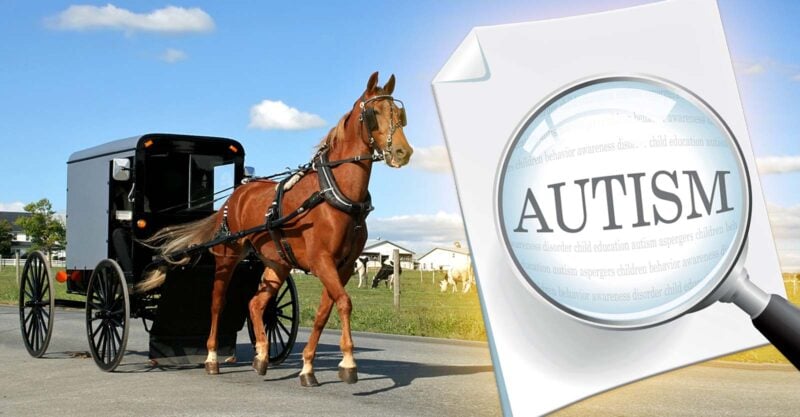


Controversy is swirling around a 2010 study on autism rates among the Amish, after President Donald Trump on Monday posted a graphic citing the study.
Trump’s post on Truth Social claimed, “No published case has explicitly documented an unvaccinated Amish child with autism.”
The social media post cited a study, conducted in 2008 and 2009 by researchers who screened 1,899 Amish children in Indiana and Ohio for autism. The researchers confirmed seven cases of autism among the children.
The study concluded that among the Amish children in the study, the autism rate was roughly 1 in 271 — far lower than the national rate, which at the time was estimated by the Centers for Disease Control and Prevention (CDC) as 1 in 91.
According to Trump’s post, the study authors collected vaccination histories for the children but “did not report any confirmed case” of autism as “completely unvaccinated.”
The post drew a mix of cheers and fact checks, according to health writer Sayer Ji.
🚨Trump’s Amish autism post is lighting up X today — cheers on one side, reflexive “fact-checks” on the other.
But everyone is missing the actual story.
The Amish have among the lowest vaccination rates AND the lowest autism rates in the U.S. Both facts are on the peer-reviewed… pic.twitter.com/LWTxX8hPVv
— Sayer Ji (@sayerjigmi) August 31, 2026
Ji called Trump’s post “factually imperfect” but “genuinely important.”
The post contained factual inaccuracies — for instance, it stated that the Amish have been around for 330 years. However, although the Amish broke away from the Mennonites 333 years ago in 1693, Amish settlements in the U.S. didn’t begin until the 1720s.
Trump’s post also drew attention to the verifiable fact that the Amish tend to have lower vaccination rates and lower autism rates, compared to the mainstream.
Ji praised the president for highlighting the 2010 study. “Whatever else you think of the man, he [Trump] pointed at the study,” Ji wrote.
Children’s Health Defense (CHD) CEO Mary Holland told The Defender she was pleased that Trump highlighted the relative absence of autism among the Amish, who typically have lower vaccination rates than mainstream communities.
“It’s high time we start dealing with reality — the current vaccine schedule causes brain injury called autism. Let’s be humble enough to learn from the Amish,” Holland said.

What did the 2010 Amish autism study show?
Trump’s post cites a 2010 study conducted by human genomics researchers from the University of Miami and Vanderbilt University, according to a conference abstract about the study.
However, contrary to Trump’s post, the study was never published in a peer-reviewed journal.
The study’s abstract, dated May 22, 2010, appeared on the website for the International Meeting for Autism Research, a research gathering held by the International Society of Autism Research.
The study authors appeared to have presented the study at the May 2010 meeting. There is no online record of the study’s full report.
The abstract’s methods section states that the researchers collected the children’s vaccination data. However, the results section doesn’t state whether the seven Amish children in the study who were identified as having autism were vaccinated or unvaccinated.
The abstract states:
“Preliminary data have identified the presence of ASD [autism spectrum disorder] in the Amish community at a rate of approximately 1 in 271 children using standard ASD screening and diagnostic tools although some modifications may be in order.”
The authors wrote that “further studies are underway” to address the cultural norms and customs that may affect how parents talk about their children’s behavior when interviewed by researchers.
It is unclear if the study authors looked at whether the seven children with autism had been vaccinated.
The study’s lead author, listed as J. L. Robinson, did not respond to The Defender when asked if the researchers ever ran a vaccination-stratified analysis of the seven confirmed autism cases, and why the researchers never published the study.
The Defender asked Margaret Pericak-Vance, Ph.D., director of the John P. Hussman Institute for Human Genomics at the University of Miami and one of the study’s authors, the same questions. However, the inquiry was directed to the university’s public relations director, who did not respond by deadline.
Ji searched online public records to see if the study authors ever spoke again publicly about the study or submitted it for publication in a peer-reviewed journal, but found nothing.
That is significant, Ji told The Defender. “I searched for and could not find any public statement by any of the six authors, in sixteen years, on why the paper never appeared or what became of the data. That absence is the finding.”
Ji said he isn’t accusing the study authors of intentionally burying their data on the Amish children’s vaccination histories. “I am not alleging that any of the six destroyed data or acted in bad faith — I have no evidence of that.”
But their data were effectively “buried,” in that the data were never published and never appeared in a future study.
Ji acknowledged that even if the study had explicitly linked all seven autism cases to not vaccinating, the study wouldn’t prove that unvaccinated children do not get autism, because seven is too small a number to power a statistical model.
But the data would still be helpful because they “would fill a hole in the record and tell us whether the screening infrastructure can be rebuilt at scale,” he said. “A statistician could do it in weeks if the files exist.”
The study authors did not respond when The Defender asked if they still had the original research files for the study.
Given that the study appeared to use federally funded research dollars, according to the abstract, the public deserves to know what happened to the files, Ji said.
Trump focused on uncovering autism-vaccine link
Trump’s post referencing the 2010 study comes amid a roiling debate about vaccines and autism. In May, Trump pressed U.S. Health Secretary Robert F. Kennedy Jr. to do more to investigate a possible link between vaccines and autism, according to a July 27 Wall Street Journal report.
Last month, Trump signed an executive order calling for sweeping changes to U.S. vaccine policy, including reducing the number of diseases for which kids receive routine childhood vaccines from 18 to 11.
According to The Associated Press, Trump is “fixated on connecting autism to vaccines.”
During a Sept. 22, 2025 press conference, Trump said, “There are certain groups of people that don’t take vaccines and don’t take any pills that have no autism. … The Amish, as an example, they have essentially no autism.”
According to Ji, the 2010 Amish study does not prove that vaccines cause autism.
However, the story of what happened to the 2010 study reveals that when data are collected that could potentially contribute to answering the question of whether vaccines cause autism, that data “doesn’t become available,” Ji said.
In Ji’s view, studies looking at Amish autism rates should examine many factors, including vaccination status, exposure to glyphosate, acetaminophen, ultrasound, diet, endogamy and access to healthcare.
The full results should be made public, regardless of what the studies find. “That isn’t anti-vaccine. It’s science.”
The connection between lower vaccination and autism rates among the Amish was something that investigative journalist Dan Olmsted spent years documenting.
Olmsted, founder of Age of Autism, authored “Age of Autism: Mercury, Medicine, and a Man-Made Epidemic” (2011) and “Denial: How Refusing to Face the Facts about Our Autism Epidemic Hurts Children, Families, and Our Future” (2017) before he passed away in early 2017.


This article was funded by critical thinkers like you.
The Defender is 100% reader-supported. No corporate sponsors. No paywalls. Our writers and editors rely on you to fund stories like this that mainstream media won’t write.
Where did Trump get the graphic he posted?
The Amish continue to be central to ongoing national debate on vaccines. In New York, Amish are threatening to leave the state due to the state’s school-based vaccine mandate, according to an Aug. 26 New York Post report.
Pennsylvania, which is home to the largest Amish population in the U.S., has been making headlines for its current measles outbreak and ongoing investigation of measles-related deaths.
Steve Kirsch created the graphic that Trump posted to social media. On Aug. 14, Kirsch posted the graphic on X with the statement, “Baffling, isn’t it? Autism is only found in vaccinated Amish kids. I wonder why?”
Kirsch told The Defender he created the graphic using ChatGPT.
He instructed ChatGPT to create a graphic based on the 2010 study and based on his understanding that there is no evidence that an unvaccinated Amish child has ever been diagnosed with autism.
“Nobody has ever heard of an unvaccinated Amish child with autism,” Kirsch told The Defender.
Kirsch said he referred to the study as “published” in the graphic because the International Society of Autism Research posted the study’s conference abstract online. He acknowledged that the study itself was never published.
The White House did not respond to our comment request by the deadline.
Related articles in The Defender
- Trump Signs Executive Order Aimed at Reducing Number of Childhood Vaccines
- Disappointed Trump Pressed RFK Jr. to Find Link Between Vaccines and Autism, and Reduce Number of Shots Required for Kids
- Pennsylvania Coroner Investigating Death of Second Child With Positive Measles Test
- Coroner Contradicts Pennsylvania Health Officials, Says Measles Didn’t Cause Newborn’s Death