Login
Login
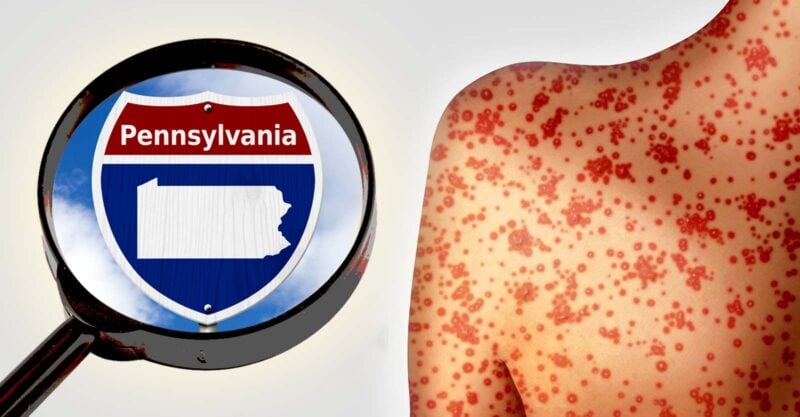


An Amish family grieving the death of a newborn has found itself at the center of a growing political and public health dispute over whether measles contributed to the infant’s death.
The family’s newborn son died shortly after birth on Aug. 14. The family said that the baby’s mother had been ill with measles during pregnancy.
On Aug. 25, the Pennsylvania Department of Health reported two “measles-associated” deaths. Officials initially declined to release any information, including age or gender, reporting only that the two individuals were unvaccinated.
However, the Lancaster County Coroner’s Office disputed that report, stating that it had recorded zero deaths caused by measles — and only one death of a person who tested positive for measles.
The coroner, Dr. Stephen Diamantoni, told the Philadelphia Inquirer that one of the deaths involved a newborn who died shortly after birth from a lacerated spleen. The infant tested positive for the virus after death, but the coroner said the forensic pathologist found no evidence that the spleen had been enlarged by measles.
Measles antibodies were present in postmortem testing, but Diamantoni said the death was not caused by measles.
Meanwhile, Diamantoni’s office today announced that it is investigating the death of another child in Lancaster County who tested positive for measles. It was unclear whether the death was one of the two “measles-associated” deaths reported last week by Pennsylvania health officials, or if the announcement involved a new case.
The dispute over the cause of the deaths has now moved beyond Pennsylvania. The Centers for Disease Control and Prevention (CDC) excluded both deaths from its latest national measles tally, saying available information does not establish whether measles caused or contributed to the deaths or whether the individuals died from other causes while infected.
The decision, ordered by newly installed CDC Director Erica Schwartz, is highly unusual because the agency has historically relied on state and local health departments for such reporting.
Pennsylvania officials said they followed the standard reporting process.
“Every reported measles case is thoroughly reviewed to confirm it meets the Centers for Disease Control and Prevention’s (C.D.C.) case definition for a measles case,” Neil Ruhland, a spokesman for the Pennsylvania Department of Health, said. “To date, D.O.H. has provided all required epidemiological data to the C.D.C.”
The Pennsylvania Department of Health uses the term “measles-associated” when there is laboratory or epidemiological evidence of the virus.
Shapiro, Kennedy spar over political implications
Pennsylvania Gov. Josh Shapiro sparked a political controversy when he used the deaths to criticize the Trump administration’s approach to vaccination policy and public health messaging shortly after the deaths were announced.
“When the information we see coming from the federal government, in some cases, isn’t driven by facts and by science, it makes it even more confusing for parents, and that has a serious impact,” Shapiro said.
U.S. Health Secretary Robert F. Kennedy Jr. responded on social media by accusing Shapiro of announcing the deaths with “giddy delight” for partisan purposes. He called the governor’s announcement “unseemly” and accused him of using the COVID-19 playbook, which includes “the weaponization of infectious disease fears for political gain.”
The CDC’s decision not to include the deaths in its national count has only added another layer to the dispute. Public health experts say the episode risks undermining confidence in the relationship between state health departments and the federal government.
“Having the C.D.C. question what the state is sharing will only lead to a further erosion of what is a really critical partnership between states and the federal government,” Anne Zink, a public health expert at Yale University and former chief medical officer for Alaska, told The New York Times.
Probe into newborn’s death remains ongoing
The family at the center of the dispute says it never intended to become part of a national argument over vaccines.
The parents told The Atlantic that measles had spread through their household several weeks before their son was born. Several of their children became sick, and two required IV fluids because of dehydration.
The mother, who was pregnant, became extremely sick, developing a fever of 102 degrees and struggling to eat and drink. On Aug. 13, she received IV fluids for dehydration.
The following day, she went into labor.
The baby was born at a birthing center shortly after 5 p.m. He weighed 7 pounds but was not breathing. Emergency responders attempted to revive him with oxygen and chest compressions. He died within a half hour.
The parents said they were unaware that the coroner had identified a ruptured spleen as the immediate cause of death until reporters told them about the public statements.
Diamantoni told The Atlantic that the investigation remains ongoing.
Medical experts have noted that the relationship between congenital measles infection and the spleen is not well understood because measles infection during pregnancy is rare.
Pediatrician Dr. Paul Offit argued that congenital measles infection could have contributed to splenic injury in newborns. Other experts have cautioned that the available evidence is insufficient to establish that connection.
The CDC has likewise said it needs more information before determining whether measles caused or contributed to the deaths.


This article was funded by critical thinkers like you.
The Defender is 100% reader-supported. No corporate sponsors. No paywalls. Our writers and editors rely on you to fund stories like this that mainstream media won’t write.
As outbreak continues, scientific and political questions remain unresolved
The dispute comes as Pennsylvania continues to experience a major measles outbreak.
The state reported 497 measles cases and 87 hospitalizations as of Monday, with Lancaster County among the hardest-hit areas.
Lancaster County is home to the country’s largest Amish community, where vaccination rates have historically been lower than in the general population. Pennsylvania health officials estimated last year that only about 25% of Lancaster County’s Amish population had received the measles, mumps and rubella (MMR) vaccine.
The Amish Church has no official doctrine prohibiting vaccination. In the family interviewed by The Atlantic, the parents said their decision not to vaccinate their children was not politically motivated and was not based on extensive research.
The Pennsylvania Department of Health says vaccination remains the best protection against measles and has expanded vaccination clinics in response to the outbreak. The state says more than 35,000 Pennsylvanians received an MMR vaccine in July, about 10,000 more than in a typical month.
As the CDC, Pennsylvania officials and the Lancaster County coroner continue to debate how the newborn’s death should be classified, the parents are waiting for the coroner’s final report.
The scientific and political questions remain unresolved. The family, meanwhile, has already buried its child.
Related articles in The Defender
- Coroner Contradicts Pennsylvania Health Officials, Says Measles Didn’t Cause Newborn’s Death
- 2 ‘Measles-Associated’ Deaths in Pennsylvania Spark Media Blitz — But Officials Won’t Release Details
- RFK Jr. Rejects Blame for Measles Outbreak, Calls for Better Care After Texas Girls’ Deaths
- Measles Cases Surged 20% Globally But Deaths Declined by 8% — Are More Vaccines the Answer?
- Exclusive: ‘Just Normal Doctoring’ — a Texas Doctor’s Eyewitness Report on Measles Outbreak