

 Login
Login
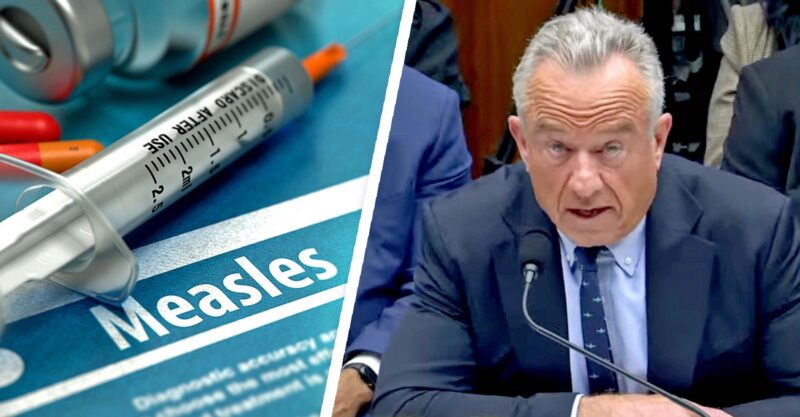


During a heated congressional hearing on April 17, U.S. Health Secretary Robert F. Kennedy Jr. denied responsibility for the U.S. measles outbreak and pointed to the deaths of two unvaccinated girls in Texas last year as evidence of deeper problems in patient care.
Testifying before the U.S. House of Representatives Committee on Education and Workforce, Kennedy said critics have blamed the measles spread on his vaccine policies and public statements. “I have been accused of that,” he said. “The accusation is not science-based.”
Kennedy quickly shifted focus to the 2025 Texas deaths, arguing the issue goes beyond vaccination and into how sick children are treated once they reach the hospital.
“I want to say something because two little girls died tragically in the Mennonite community in Texas,” he told lawmakers. He said he attended one funeral and spent time with the other family.
“Both of [the families] told me that when they took their children to the hospital, they were treated as pariahs,” he said. “They were shamed. They were not given proper treatments.”
He added, “Both families believe their daughters … could have been saved if the hospital gave them proper treatment.”
🚨 “They were not given proper treatments.” 🚨
RFK Jr. shares disturbing details of two unvaccinated girls who died of measles after hospitals did not give them proper care.
“I went to the funeral of one of those little girls, and I spent a day with the family of the other.”… pic.twitter.com/02NydpYfhA
— Children’s Health Defense (@ChildrensHD) April 17, 2026
Agency fails to ‘advise doctors about how to treat people who are actually sick’
Kennedy argued that federal health policy focuses too narrowly on prevention while neglecting treatment for those who are ill.
“This agency has been so focused on a single intervention that it does not advise doctors about how to treat people who are actually sick,” he said.
He called for a different approach for patients who refuse vaccination.
“There’s a lot of people in this country who, for religious reasons or other reasons, are not going to vaccinate,” Kennedy said. “And I believe that we need to treat them with compassion and understanding and empathy.”
The deaths of two children in Texas — the first deaths associated with measles in the U.S. in years — intensified debate over how the country handles both vaccination policy and treatment during outbreaks.
Kennedy said he plans to keep pressing that point. “We need to … get them the treatments that they would get anywhere else in the world except for this country,” he said.


Investigations by Children’s Health Defense point to ‘medical error’ in deaths
Extensive coverage by Children’s Health Defense (CHD) of the measles outbreak in Texas focused on the circumstances surrounding the two deaths, and raised questions about whether medical care — not measles alone — played a decisive role.
In one case, CHD obtained records for a 6-year-old girl who died after developing pneumonia following a measles infection.
A review by critical care physician Dr. Pierre Kory concluded the child died from a secondary bacterial pneumonia. Kory said the girl’s medical records showed that delays in administering the correct antibiotic proved fatal. He called the case “tragic” and said the girl “died of a medical error.”
In another case, the father of an 8-year-old girl who died in Lubbock said measles was “absolutely not” the cause of death. He attributed her death to poor hospital care.
Doctors who analyzed the 8-year-old’s medical records said the child died from acute respiratory distress “secondary to hospital-acquired pneumonia,” which she likely developed during one of her stays at three different Texas hospitals.
However, state officials classified the deaths as measles-related, as reported by The New York Times and other outlets.
The Defender is 100% reader-supported. No corporate sponsors. No paywalls. Our writers and editors rely on you to fund stories like this that mainstream media won’t write. 

This article was funded by critical thinkers like you.
‘Measles outbreak began in January 2025 before I took office’
At the same hearing, the Texas measles outbreak and proposed changes to the vaccine schedule sparked broader clashes.
Rep. Suzanne Bonamici (D-Ore.) told Kennedy that he has been “a voice against vaccination,” arguing that his rhetoric has contributed to declining immunization rates and increased risk of exposure to disease.
He rejected the characterization. “I’ve never been anti-vaccine,” Kennedy said. “I’m pro-science.”
“The measles outbreak began in January 2025 before I took office,” he added. “Almost 90% of the people affected are over 5 years old. … Their decision to not vaccinate predated my occupation of this seat.”
He framed the measles cases in the U.S. as part of a global trend. “The measles outbreak is not an American phenomenon. It is global. It’s happening all over the world,” he said.
“Last year, we had approximately 2,200 cases,” Kennedy said. “Mexico had … more than three times that number, and they have one-third of our population. Canada had double that number, and they have one-eighth of our population.”
He stressed that vaccines should undergo safety trials. “Vaccines should be adequately safety tested so we know both the risk and the benefits,” he said.
Rep. Haley Stevens (D-Mich.) challenged Kennedy’s comments on vitamin A.
“You have also pushed vitamin A as a treatment for measles. … According to America’s Poison Centers, vitamin A overexposure among children increased by nearly 40% and in this time frame, children in the hospitals with both measles and unsafe levels of vitamin A has occurred,” Stevens said.
Kennedy pushed back. “I’m not recommending unsafe levels,” he said. “I’m recommending what every major international health organization recommends.”
He also defended his broader approach to scaling back vaccine guidance. “Do you think that we should recommend interventions that have not been safety tested?” he asked.
Related articles in The Defender
- CHD.TV Exclusive: Parents of Child Who Died During Texas Measles Outbreak Speak Out
- 8-Year-Old in West Texas Died From Hospital-acquired Pneumonia, Medical Records Show
- Texas Reports 8-Year-Old Died of ‘Measles Pulmonary Failure,’ CHD Requests Medical Records
- ‘Medical Error’ Led to Death of 6-Year-Old Who Developed Pneumonia After Measles Diagnosis
- ‘I Just Get So Angry’: Dad of West Texas Child Who Died Talks to CHD.TV
- Exclusive: Mennonite Community in Texas Is ‘Frustrated’ by Media Coverage of Measles Outbreak
