Login
Login


By Sophie Kevany
The World Bank and other large international development banks say they want to provide sustainable food systems, support biodiversity, reduce poverty and fight climate change.
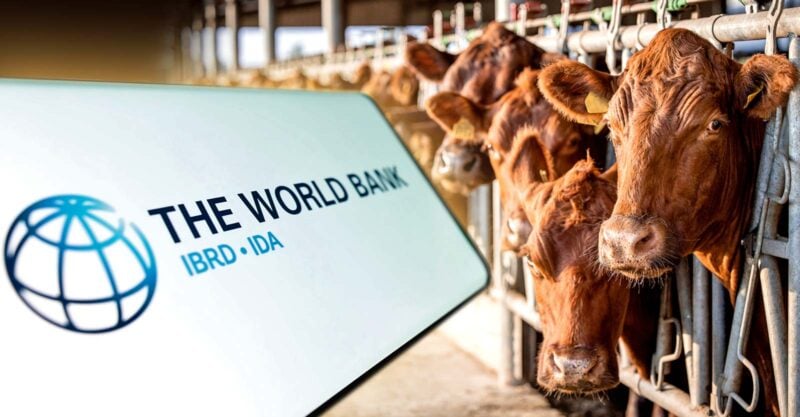
But development banks are funneling billions more dollars into factory farms than into smaller farms that may mix crops and livestock and support a greater diversity of animal breeds, a new policy brief finds.
While development bank funding usually aims to increase food security in poorer countries, one of the brief’s three authors warns that, in at least one example, bank lending could be indirectly supporting the expansion of fast food restaurants in a richer country in addition to securing food supplies in a poorer one.
Over the five years from 2020 to 2024, 16 development banks collectively directed about $13 billion of financial support to industrial animal farms, compared to about $9 billion to support smaller, more diversified animal farms, according to the new policy brief by the International Accountability Project and the Critical Research on Industrial Livestock Systems Network.
The remaining $7 billion directed to animal agriculture was uncategorizable due to limited information. The policy brief has not been peer reviewed by a scientific journal.
This funding pattern, the brief says, “indicates a growing preference among major development finance institutions to support large-scale, commercially oriented animal agriculture operations,” while the non-industrial systems that “often represent smallholder or small-scale producers” receive less.
“We’ve known there’s a trend” toward development banks funding industrial livestock operations, Mehroosh Tak, one of the report’s co-authors and associate professor in economics at London’s SOAS University, tells Sentient. But this is the first time researchers have quantified that trend, she says.
Factory farms cause documented harms to the environment, animals and people. For example, they cause widespread destruction of forests and other wildlife habitats to grow vast monocultures of soy, corn and other animal-feed crops.
These monocultures reduce biodiversity, degrade the soil and rely on heavy pesticide use. The industry also relies on highly selective breeds of pigs, chickens and other livestock to produce ever more eggs, meat and milk at the expense of the animals’ own health.
Many animals endure extreme confinement and the removal of body parts including tails and beaks. Factory farms use such high levels of antibiotics that they act as ideal incubators for antibiotic-resistant bacteria, which in total kill 1.27 million people per year.
The facilities also subject people to air and water pollution from animal waste.
Now that the researchers have demonstrated a trend toward favoring industrial farmers over smallholders, Tak says development banks need to pay attention to those saying that “intensive and industrial agriculture is bad for our community.”


Instead of supporting industrial models, she says the banks should focus on lending to more egalitarian ones that involve integrated agricultural projects.
“So you give someone five chickens, they may be able to produce some eggs that they can sell in the local market but also keep some of the eggs for themselves. That’s a very good example of an integrated project,” she says.
The report further notes a “misalignment” between development banks’ funding of industrial animal agriculture and their stated goals on climate, biodiversity and poverty reduction.
To quantify the percentage of finance provided to different livestock production systems, the authors analyzed investments by 16 development institutions from 2020 to 2024 using data from the Factory Farming Finance Tracker, a Stop Financing Factory Farming initiative.
Development banks analyzed included the World Bank, the International Finance Corporation and the European Investment Bank.
Another problem with development banks’ focus on funding industrialized livestock projects, says Alessandro Ramazzotti, one of the report’s co-authors and a researcher at the International Accountability Project, is that in at least one example the support provided by a development bank could have boosted fast food operations in a richer country, the U.S., rather than simply focusing on food security in a poorer one, Guatemala.
Since 2018, the Guatemalan food corporation CMI Alimentos has received various financial support packages totaling $725 million via IDB Invest, an arm of the Inter-American Development Bank Group. Over the course of that time period, the company has invested heavily in expanding its U.S. fast food chain, Pollo Campero.
In 2022, the company website reported a plan to use $190 million to open 100 Pollo Campero locations in the U.S., a goal the company says it achieved in 2024. A 2023 post declared a new goal of reaching 250 Pollo Campero locations in the U.S. within five years.
Although no direct link can be made between the money lent by IDB Invest and the money spent on fast food restaurants, Ramazzotti says there is an indirect one.
“I would say those funds from development banks are probably ringfenced,” meaning they should only be used for projects laid out in the financing agreement, but even using the funds only for a specific purpose would mean “the company frees up capital that it can reinvest in its U.S. operations.”
Ramazzotti points out that despite CMI Alimentos receiving hundreds of millions of dollars since 2018 — money that comes with the expectation of contributing to food safety in Central America — the “food security situation in Guatemala and the wider Central America region remains the same, with levels of food insecurity in the range of 15-35% of the population.”
Furthermore, he adds, an Indigenous Guatemalan Xinka community has made accusations that a CMI Alimentos intensive chicken farm has brought pollution and disease. The community is home to about 65 families, Ramazzotti says.
“In Guatemala, when we talk to communities living near the farm, they were saying that their own chickens, their own animals were getting sick because of the impacts of the farm pollution on air quality and soil and water.”
As well as the unpleasant physical effects, which include bad smells, dust and fly infestations, Ramazzotti says the community is bearing increased costs for medicines, fresh water and fly repellent.
Ramazzotti says the community told him it received only a small compensation from the farm’s owners and was not consulted about the arrival of an intensive chicken facility.
“Just one day they were told, yeah, there will be a big farm right next to your house. And they couldn’t say no.”
Sentient reached out to CMI Alimentos, IDB Invest, the World Bank and the International Finance Corporation for comment. There were no responses.
Originally published by Sentient Media.
Sophie Kevany is a freelance journalist writing for The Guardian, Sentient Media and other publications. She previously worked for Dow Jones and Agence France Presse and has a master’s in journalism from Dublin City University. She has lived and worked in Ireland, the U.S., South Africa, France, Peru and Spain.