Login
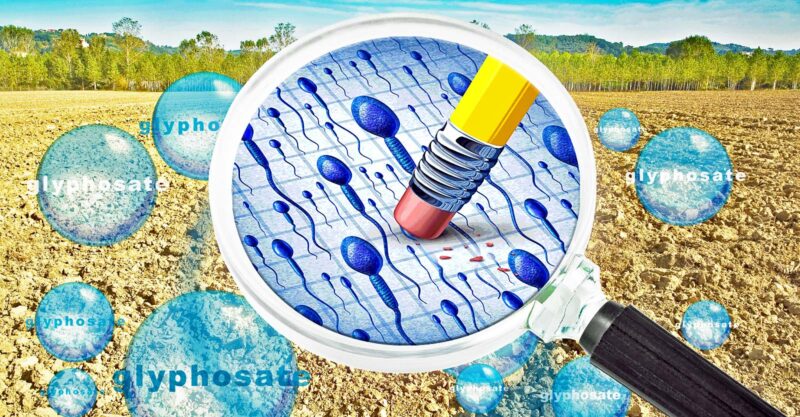


Glyphosate damages sperm health in lab animals and may interfere with testosterone production, according to a new National Institutes of Health (NIH) review.
NIH scientists, who analyzed 55 glyphosate toxicity studies in non-human mammals, said they found strong evidence that the chemical used in Roundup and other widely used weedkillers was consistently associated with lower sperm counts, reduced sperm motility and increased numbers of abnormally shaped sperm.
They also found evidence that glyphosate exposure reduced testosterone levels, particularly in juvenile and adult animals exposed for 30 days or longer.
The systematic review and meta-analysis, accepted for publication in the peer-reviewed Environment International on Nov. 9, was conducted by scientists from the NIH’s Division of Translational Toxicology at the National Institute of Environmental Health Sciences.
The scientists analyzed the effects of glyphosate alone and of glyphosate-based herbicides (GBH), and concluded with high confidence that both had an overall negative effect on sperm health and sperm abundance. They said they were moderately confident that both also reduce testosterone.
They said the data provide a “biologically plausible hypothesis that glyphosate and GBH might affect male reproductive health of humans.”
Glyphosate toxicity expert and MIT scientist Stephanie Seneff, Ph.D., told The Defender she was glad to see the study published.
“I have long suspected that glyphosate is contributing to our current crisis in infertility. I wrote about glyphosate’s toxicity to sperm in my book ‘Toxic Legacy,’” she said. “Glyphosate is an endocrine disruptor at very low exposure levels.”
Seneff noted that there are also several other papers published in peer-reviewed journals such as Toxicology in Vitro, the International Journal of Environmental Research and Public Health and ACS Omega that weren’t included in the study, but that also find links between glyphosate exposure and sperm and testicular damage.
Michael Antoniou, Ph.D., professor emeritus in molecular genetics and toxicology at King’s College in London, who for years led a leading global research group investigating the health risks of glyphosate herbicides, told The Defender the NIH review was “well-executed.”
Given that regulators regularly rely on toxicity studies from rats and mice, he said the findings are relevant to assessments of human health risk.
“Of greatest concern is the finding that both glyphosate and commercial GBH formulations showed negative male reproductive effects at doses that regulatory agencies in both the U.S. and the EU, as well as other countries across the world, deem safe to be ingested on a daily basis over a lifetime,” Antoniou said.
“This adds to a growing body of evidence that current regulatory-set safety limits of exposure to this pesticide should be lowered,” he added.
Children’s Health Defense Senior Research Scientist Karl Jablonowski said the review adds to persistent evidence that glyphosate is a hormone disruptor with implications for fertility in humans.
“In this context, what is warranted is precaution — which is an impetus of action, not an impetus to wait-and-see,” he said.


Both glyphosate and GBH lowered testosterone levels
Several of the studies reviewed by NIH scientists identified adverse reproductive effects at doses overlapping with exposure limits established by U.S. and European regulators. They reported reproductive effects at doses as low as 0.5 milligrams per kilogram (mg/kg) body weight per day.
The European Food Safety Authority has established an acceptable daily intake of 0.5 mg/kg per day, while the U.S. Environmental Protection Agency’s (EPA) reference dose is 1.75 mg/kg per day.
For the study, the authors searched PubMed, Web of Science, Scopus and the Chinese databases CNKI and Wanfang through April 2026, narrowing more than 19,000 references to 55 eligible studies.
For glyphosate alone, 10 of 11 studies addressing the three main sperm issues found damage to sperm health. For GBH, 16 of 18 studies reported higher percentages of abnormal sperm, 12 of 14 reported reduced motility, and 13 of 17 reported reduced sperm count.
Researchers found that the effects were most consistent when exposure lasted 30 days or more, which is the approximate amount of time necessary for a full sperm production cycle in the animals studied.
They also found evidence that both glyphosate and GBH lowered testosterone levels, particularly when animals were exposed as juveniles or adults — rather than in vitro.
Seven of 12 glyphosate studies marked this trend, and 13 of 23 GBH studies also found significant decreases in testosterone levels.
“The main driver for most outcomes was the glyphosate, as animals exposed to glyphosate alone consistently showed comparable adverse effects with those exposed to the GBH formulations,” Antoniou said.
However, he noted that the GBH formulations had a greater effect on sperm motility and morphology than glyphosate alone, suggesting “that the co-formulants play an important role in harming sperm,” he said.
“The real outcomes are probably worse than what is reported in this review because the relevant industry data were not available in full for scrutiny by the authors,” Antoniou added.
Glyphosate exposure is widespread
Due to widespread exposure, most Americans have detectable levels of glyphosate present in their urine, according to the Centers for Disease Control and Prevention (CDC).
People are exposed to glyphosate through food, drinking water, skin contact, and inhalation of airborne particles.
The toxin is present on fruits and vegetables and in higher concentrations on foods that retain residue, particularly grains and legumes.
Farmers who apply the chemical to crops have glyphosate present in their bodies at higher levels. However, studies have also found glyphosate in dust in non-agricultural homes.
A French study in 2024 found glyphosate present in 55% of sperm samples from an infertility clinic.
Last year, a major scientific study that regulators around the world relied on for decades to justify continued approval of glyphosate was quietly retracted over serious ethical issues — including secret authorship by Monsanto employees — raising questions about the pesticide-approval process in the U.S. and globally.
In March 2015, the World Health Organization’s International Agency for Research on Cancer classified glyphosate as “probably carcinogenic to humans.”


This article was funded by critical thinkers like you.
The Defender is 100% reader-supported. No corporate sponsors. No paywalls. Our writers and editors rely on you to fund stories like this that mainstream media won’t write.
Three days left to submit glyphosate comments to EPA
The EPA is updating its human health risk assessment and evaluation of glyphosate’s carcinogenic potential. As part of the process, the agency made its open literature review available for public comment.
Typically, when the EPA reviews a pesticide, it relies largely on confidential data sponsored and submitted by chemical companies.
However, glyphosate has been extensively studied by scientists globally with results published in scientific literature. That body of independent research is called “open literature.”
The EPA released a document describing how it plans to do the systematic review and presenting a list of publications in the open literature collected since the agency’s last review in 2017.
In September, the EPA extended the deadline for public comment by 60 days, encouraging researchers, farmers, families, and every stakeholder from the general public to submit evidence they think ought to be considered.
For example, Antoniou submitted a comment encouraging the EPA to consider the nearly 1,000 studies on glyphosate/GBH’s health and environmental effects that have been published in the last 12 months alone and to abandon its use of the retracted study.
The deadline to submit comments at Regulations.gov is Nov. 23.
Related articles in The Defender
- ‘Serious Ethical Concerns’: Journal Retracts Key Glyphosate Safety Study, Allegedly Ghostwritten by Monsanto
- Widely Used ‘Chemical Cocktails’ Tied to Gut Damage, Inflammation
- Glyphosate Present in 57% of Sperm Samples From Infertile Men
- Exposure to Glyphosate Could Harm Not Only You, But Your Kids and Grandkids, Too
- 55% of Sperm Samples Contained High Levels of Glyphosate Weedkiller
- Glyphosate Causes Permanent Damage to Reproductive Organs, Affects Fertility