Login
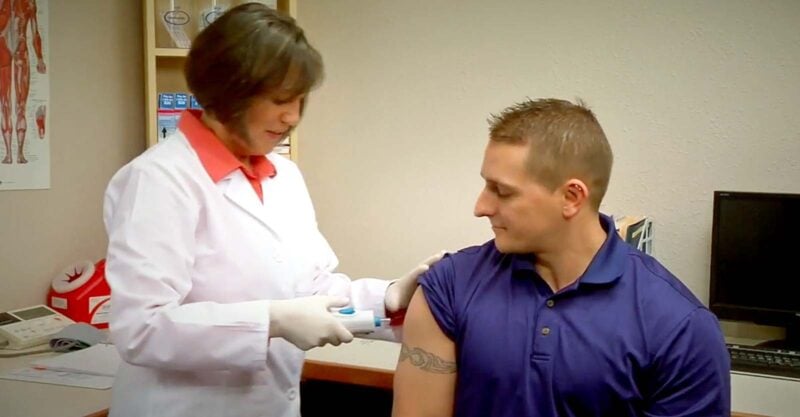


Scientists have developed a needle-free mRNA vaccine that protects mice against COVID-19 and flu and causes less inflammation than conventional formulations, according to a new study published in The Journal of Clinical Investigation.
The vaccines use a high-pressure liquid jet to deliver genetic material directly through the skin, unlike the Pfizer-BioNTech and Moderna COVID-19 shots, which use lipid nanoparticles as the delivery system.
The authors — researchers from Rutgers University and Japanese institutions — reported that the technology generated strong immune responses and reduced viral replication in vaccinated mice.
The vaccine hasn’t been tested in humans, and researchers haven’t established whether it could reduce serious adverse reactions.
“Showing that a carrier-free, needle-free vaccine can be made protective opens a different design space than the one the field has been working in,” said study co-author Renata Pasqualini, Ph.D., a Rutgers researcher, in a university announcement.
COVID vaccines linked to serious adverse events
The study comes amid continuing concerns about COVID-19 vaccine injuries, and a study released this week comparing Pfizer and Moderna vaccine mortality rates.
The Centers for Disease Control and Prevention (CDC) has recognized a causal link between mRNA COVID-19 vaccines and myocarditis and pericarditis, particularly among adolescent and young adult males.
A 2022 study published in JAMA identified 1,626 reports meeting the CDC’s case definition for myocarditis following mRNA vaccination during the study period.
Reporting rates were highest among adolescent boys after their second dose, reaching approximately 106 cases per million Pfizer doses among males ages 16 and 17.
Symptoms of myocarditis can include chest pain, shortness of breath and an irregular heartbeat. Although many patients recover, some require hospitalization, and others have reported being permanently disabled.
Other documented serious adverse reactions include anaphylaxis following vaccination and a rare blood-clotting disorder associated with Johnson & Johnson’s COVID-19 vaccine.
The federal Vaccine Adverse Event Reporting System (VAERS) collects reports of suspected vaccine injuries and deaths. The latest figures show 1,678,901 adverse event reports following COVID-19 vaccination submitted to VAERS as of Sept. 25, 2026, including 39,260 reported fatalities and 29,299 reports of myocarditis or pericarditis.
The Rutgers study did not investigate whether its mRNA needle-free vaccine could prevent serious injuries.
Pasqualini and co-author Wadih Arap, M.D., Ph.D., told The Defender in a statement:
“We did not study myocarditis, and a mouse challenge experiment could not address it. Nor did we compare our vaccine with any licensed vaccine, so we are unable to draw any comparison on safety.”

Aluminum adjuvants boosted immune responses — but are they safe?
Conventional mRNA vaccines rely on lipid nanoparticles — microscopic fat-based particles that protect genetic material and help deliver it into cells. The particles can contribute to inflammatory reactions following vaccination.
The Rutgers researchers developed a system that delivers unencapsulated, or “naked,” mRNA directly into the skin without those particles.
Because earlier attempts to use a “naked” mRNA delivery system produced relatively weak immune responses, the researchers added two immune-stimulating substances: aluminum phosphate and CpG oligonucleotides, synthetic DNA sequences that activate immune signaling.
The combination increased antibody production and cellular immune responses.
“One of the most exciting discoveries in developing our carrier-free mRNA vaccines was that a combination of adjuvants could markedly improve vaccine efficacy while maintaining a favorable safety profile in our animal studies,” said Satoshi Uchida, M.D., Ph.D., of the Institute of Science Tokyo, the study’s senior author.
Adjuvants — substances added to vaccines to increase immune response — can produce adverse effects. Although aluminum is an effective adjuvant, scientists have long raised concerns about its safety in vaccines, because it is a known neurotoxin and inflammagen.
Researchers administered three doses before exposing mice to SARS-CoV-2 or influenza A.
In mice receiving the enhanced COVID-19 vaccine, infectious virus fell below the laboratory test’s detection threshold. Viral RNA levels were approximately 24 times lower than in animals vaccinated without the enhanced adjuvant combination.
Similar results emerged in mice exposed to flu.
Could needle-free shots introduce genetic material into cell nuclei?
Children’s Health Defense Senior Research Scientist Karl Jablonowski questioned whether the experimental needle-free mRNA vaccine could introduce genetic material into cell nuclei and whether DNA contamination from manufacturing could pose additional risks.
“How does a jet-injection of mRNA material not hit the nucleus?” Jablonowski asked. “What about the DNA contamination, a necessary byproduct of production, being jet-injected into cells and cellular organelles?”
Jablonowski also criticized the study’s limited safety monitoring, noting that researchers assessed acute inflammation six hours after vaccination and tracked body weight over time.
“The favorable safety claim versus LNPs [lipid nanoparticles] rests on a six-hour acute inflammation window plus body-weight curves — nothing longer-term, and no histopathology-based safety follow-up,” he said.
Pasqualini and Arap said in a statement that while the research showed potential, it also had restrictions. They told The Defender:
“This is a study in mice, and that is its central limitation: it shows that a carrier-free mRNA vaccine can be made protective in mouse models of respiratory infectious diseases, which has not been shown before, but it says nothing about how such a vaccine would perform in people.”
The Defender is 100% reader-supported. No corporate sponsors. No paywalls. Our writers and editors rely on you to fund stories like this that mainstream media won’t write. 

This article was funded by critical thinkers like you.
Less inflammation doesn’t necessarily mean fewer injuries
The researchers reported less local and systemic inflammation in mice receiving the needle-free formulation in the study compared with laboratory vaccines containing lipid nanoparticles.
The findings suggest that eliminating lipid carriers could reduce some inflammatory reactions. But reduced inflammation in mice does not establish improved safety in humans.
A 2026 study comparing the safety of five COVID-19 vaccines found that laboratory measures of inflammation did not reliably predict adverse reactions in humans.
The study also found that serious injuries — including myocarditis and vaccine-induced blood clotting disorders — were not predicted by preclinical safety testing, raising concerns about whether reduced inflammation in animal experiments indicates a safer vaccine.
Study authors have financial ties to biotech firms
The researchers disclosed financial relationships with biotechnology companies.
According to Rutgers Cancer Institute, Uchida is a founder and chief medical officer of Crafton Biotechnology Co. Ltd.
Pasqualini and Arap are founders and equity shareholders of PhageNova Bio and MBrace Therapeutics and serve as paid consultants. Pasqualini also serves as PhageNova Bio’s chief scientific officer.
The researchers say additional animal studies and dose optimization are needed before human clinical trials can begin.
“What encourages us is that we achieved protective immunity in mice with a delivery device and adjuvant components that have each already been clinically used in human patients,” Arap said.
Related articles in The Defender
- Woman Injured by COVID Vaccine Not ‘Disabled Enough’ to Qualify for Compensation
- Lipid Nanoparticles in COVID Vaccines Travel to Vital Organs, Including Heart
- They Got the COVID Vaccine. When They Were Injured, Doctors, Military and Health Agencies Blew Them Off
- Can You Trust CDC’s Flu Vaccine Effectiveness Estimates? Epidemiologist Says No
- Moderna Plan to Test mRNA COVID and Flu Vaccines on 410,000 Elderly a ‘Catastrophe in the Making,’ Critic Says
- COVID Vaccines for Kids Now Available Through CDC Program That Serves Low-Income Children