Login
Login
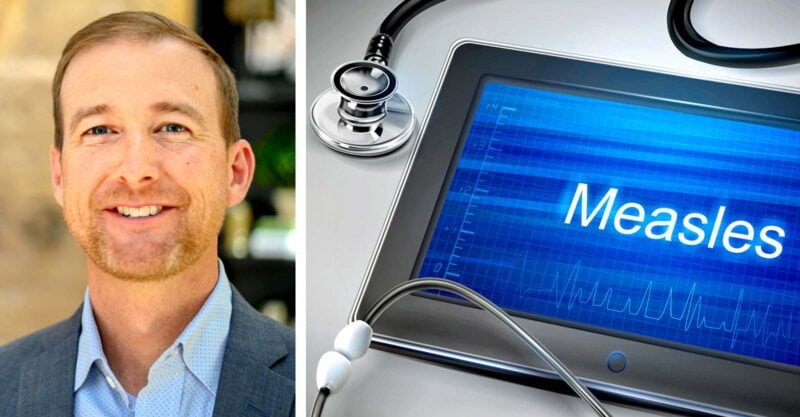


Children can overcome measles — and in some cases, even become stronger for having fought it off, according to Dr. Ben Edwards, an integrative medicine family practitioner in Lubbock, Texas, who runs a private practice serving roughly 2,000 patients.
In 2025, Edwards successfully treated roughly 300 children in Gaines County, Texas, who had the measles.
In an exclusive interview this week with The Defender, Edwards shared why he believes recent media reports spreading fear about measles are misguided — and how parents can help their children if they become infected with the virus.
“It’s unfortunate when the fear-mongering starts up instead of just some informed consent and truth-telling, which is what needs to happen,” Edwards said.
Edwards acknowledged that measles is a highly infectious virus, so prevention may not always be realistic once measles starts circulating in a person’s community.
For example, he said he got measles last year from being in close contact with the many children he treated — even though he was fully vaccinated against measles. The latest research shows that vaccinated people can and do spread measles.
“It’s just a pretty contagious thing,” Edwards said. “So from a preventative standpoint, for those who choose not to vaccinate, I think the best bet is just trying to bolster your own ‘terrain,’ is how I would term that — your immune system.”
The stronger a person’s immune system, the more likely it will be able to identify and deal with the measles virus, he said. Someone who has a strong immune system may even be able to handle the measles virus without showing symptoms of illness, he added.
Edwards also mentioned general prevention methods to mitigate the spread of any illness, such as frequent hand-washing and avoiding sharing saliva or airspace with someone who is sick.
However, given how easily measles spreads once it’s in a community, Edwards recommended focusing on how to treat it.
Vitamin A, C and getting the fever down are important
Although there is no antiviral treatment for measles, there are several well-researched treatments that can reduce symptoms and lower the risk of complications and death, according to the Mayo Clinic.
Vitamins A and C, hydration and good nutrition are key for maintaining a healthy immune system and supporting the immune system while it’s handling a measles infection, Edwards said.
Some studies, including one published in 1990 in The New England Journal of Medicine involving a randomized controlled trial of vitamin A in kids with severe measles, have shown that vitamin A reduces measles morbidity and mortality.
Edwards called vitamin A “absolutely essential” for fighting all viral illnesses and respiratory illnesses, especially measles.
“Measles has a particular tendency to deplete the body of vitamin A, which is called retinol,” he said.
Edwards recommends taking cod liver oil prophylactically. “It’s the best food-based source of vitamin A.”
He also recommended Vitamin C:
“Vitamin C historically has been known to decrease the severity of these illnesses — anything from intravenous vitamin C, intramuscular vitamin C, but obviously you can just eat your vitamin C with your fruits and veggies.
“You can take supplemental vitamin C. I tend to recommend every one to two hours to bowel tolerance when you’re in an active infectious state.”
Parents don’t need to be afraid of the measles, but they do need to know how to care for their child during a measles infection.
The child may have a very high fever, which can be dangerous — especially in babies — because of the risk of dehydration.
“A 101, 102 [degree] fever, the literature shows it’s actually beneficial to not treat that. But if you get into that 103 and above, it is helpful to bring that down,” he said.
Parents can bring down their child’s fever by running a lukewarm bath, applying cold packs under the arms or peppermint oil on the feet, and having the child be naked, rather than clothed and wrapped in blankets.


It’s possible to overcome the measles — and be stronger for it
Edwards pushed back against the narrative that children must avoid getting measles at all costs. “We can all just overcome these illnesses and go on about our lives and be stronger for it,” he said.
He pointed to studies showing that kids who overcome measles naturally have a decreased risk of cardiovascular disease and certain cancers, including leukaemia. “So there is actually some benefit,” he said.
The measles vaccine was first licensed for use in the U.S. in 1963, according to the Centers for Disease Control and Prevention (CDC).
Some people attribute the decline in measles mortality to the vaccine. However, historical mortality data suggest there was a roughly 99% drop in measles mortality before the vaccine was introduced, Edwards said.
In 2010, researchers from Johns Hopkins and the CDC’s National Center for Health Statistics published a report in Pediatrics showing that nearly 90% of the decline in infectious disease mortality in U.S. children occurred before 1940.
The researchers attributed the major declines in child mortality to several non-vaccine factors, including improved sanitation, food safety and public education about hygienic practices.
“It was a cesspool in the big cities in the Industrial Revolution — late 1800s/early 1900s — and these kids were malnourished, and they were living in filth,” Edwards said. “And in that environment, the immune system is very depressed, and these germs are just going rampant.”
In other words, cleaning up the environment — including the children’s internal environment with better nutrition — led to the drastic decline in infectious disease deaths, Edwards said.
Fear can suppress the immune system
Edwards encouraged parents to avoid falling into fear around measles.
“It’s really, really important,” he said. “In fact, I found this to be probably one of the most important things in Gaines County last year when we were treating the measles — just to deal with the fear.”
He added:
“When you go into fear — fight-or-flight mode — that actually shuts down your white blood cell production. Your white blood cells are your troops. That’s your Marines, that’s your frontline guys going out there to gobble up these viruses.”
Edwards said he wanted to encourage parents. “Continue to be informed and continue to trust the amazing design in the body. The immune system’s incredible. It will overcome [illnesses] if you steward it — and you need to steward it.”
Parents need to nourish their kids with “real food and get them outside in the sun, get them off these tablets, encourage community and play,” he said. “We’re designed to overcome these illnesses. Your kids will be fine. Nurture them, love on them, and don’t let the spirit of fear come into your home.”
Watch for a secondary bacterial infection
Parents also need to be aware that a measles infection can sometimes quickly be followed by a bacterial infection, including certain types of pneumonia.
He described what that can look like. “The rash is clearing up, the fever’s waning, their appetite’s back, they’re on the downhill side of things, doing pretty good, almost normal, and then boom — fever comes back, cough starts, oxygen levels drop, respiratory distress starts to set in. That’s the bacterial pneumonia. That has to be treated.”
Appropriate treatment typically involves specific antibiotics, he said. “Doctors know this. They know how to treat pneumonias — or they should. I think doctors can get a little swept up with the media frenzy too, unfortunately, and that can bias our judgment sometimes.”
Edwards discussed how the Texas 6-year-old whose Feb. 26, 2025, death was reported by mainstream media as having been caused by measles actually died of a bacterial pneumonia that was inappropriately treated by hospital staff.
“I’m not saying this was on purpose. I’m sure it wasn’t, but a medical mistake was made. She was given the wrong antibiotic,” he said.
“So she died from a very, very treatable bacterial pneumonia in her lungs that would’ve actually been cleared with azithromycin — your basic Z-Pak that everybody probably knows about.”
Just months later, staff at a nearby hospital made a similar error. In April 2025, 8-year-old Daisy Hildebrand died from a bacterial pneumonia that was inappropriately treated after she was hospitalized following measles complications.
On April 6, the Texas Department of State Health Services issued a news release calling Daisy’s death the “second death in [the West Texas] measles outbreak,” attributing the death to “measles pulmonary failure.”
However, Dr. Pierre Kory — who analyzed the child’s medical records and has extensive experience in pulmonary and critical care medicine — told The Defender in an earlier interview that the child’s medical records showed she died from acute respiratory distress syndrome due to hospital-acquired pneumonia, which she likely developed during a previous hospital stay.
Kory said:
“The causative organism was a highly antibiotic-resistant E. coli (‘superbug’), which she contracted during the first hospital ICU [intensive care unit] stay.
“This went largely unrecognized and poorly treated during the second hospital stay because they began to ‘tunnel in’ by blaming measles for her worsening pneumonia and repeatedly writing in the chart that she was unvaccinated.”
What’s the real risk-benefit ratio for MMR vaccine vs. measles?
Edwards said that mainstream media tends to report only on the benefits of the measles-mumps-rubella (MMR) vaccine while failing to mention the vaccine’s risks.
He agreed that it is “pretty well established” that the MMR vaccine decreases a person’s likelihood of acquiring measles. “But at what cost? There’s benefit, and there’s risk,” he said.
“So all we hear is the benefit, benefit, and no one wants to talk about the risk. Well, not nobody. Actually, there were 12 vaccine-injured Mennonite families in Gaines County who wanted to talk about that.”
To compare the risk of death from measles to the risk of death from the MMR vaccine, Edwards looked at deaths reported to the Vaccine Adverse Event Reporting System (VAERS) following MMR vaccination.
“When you look back over the past 30 years, which I did this morning, 1995 to 2025, on average, if you average out every year, it’s anywhere from some years it’s one or two deaths, some years it’s up to 10. The average is six and a half, roughly, or 6.43,” he said.
However, VAERS has historically been shown to report less than 1% of all adverse events.
“That means a 99% unreported rate. So that 6.43 deaths per year would be 643 deaths per year from the MMR vaccine,” he said.


This article was funded by critical thinkers like you.
The Defender is 100% reader-supported. No corporate sponsors. No paywalls. Our writers and editors rely on you to fund stories like this that mainstream media won’t write.
‘We’re not taught to correlate that at all’
Edwards, who was conventionally trained and formerly board-certified before pivoting to integrative medicine, said doctors aren’t trained to recognize vaccine adverse reactions or report them.
Doctors need to think critically when their pediatric patients start reporting symptoms, to correctly identify whether the symptom might be vaccine-related.
He shared a story to illustrate his point:
“I was just casually overhearing a conversation at a restaurant this past week. A sweet little old lady was saying that her granddaughter just quit speaking. She was talking, and she just quit talking all of a sudden.
“And I overheard the conversation when someone said, ‘Well, when did this happen?’ ‘Well, about a year and a half, so that’s 18 months.’”
A doctor “automatically” should wonder whether the girl received vaccinations at her 18-month wellness visit, Edwards said.
“Get the timeline on when that little girl was in the clinic and [received] her injection — but we’re not taught to correlate that at all,” he said.
Watch Dr. Edwards’ interview here:
Related articles in The Defender
- Exclusive: ‘Just Normal Doctoring’ — a Texas Doctor’s Eyewitness Report on Measles Outbreak
- Media Reports of Vitamin A Toxicity in Kids Being Treated for Measles ‘Misleading,’ Doctor Says
- RFK Jr. Rejects Blame for Measles Outbreak, Calls for Better Care After Texas Girls’ Deaths
- Measles Cases Surged 20% Globally But Deaths Declined by 8% — Are More Vaccines the Answer?
- 4-Year-Old Hospitalized Post Measles Infection Goes Home 36 Hours After Budesonide Treatment