Login
Login
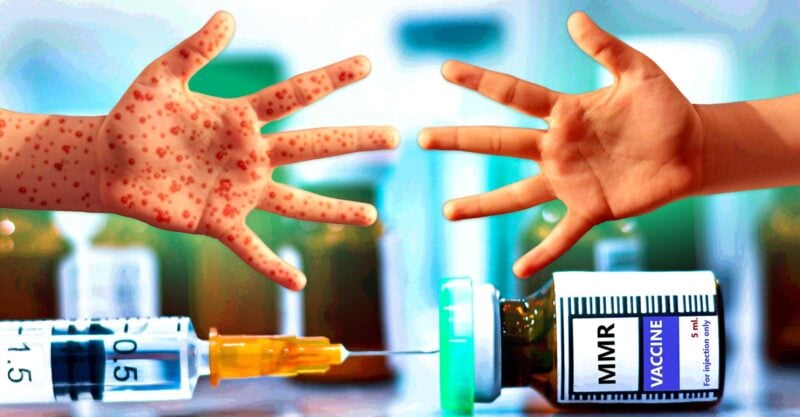


People who were vaccinated against measles can still contract and transmit the virus to others, and in some instances can initiate substantial chains of transmission, according to a new systematic review and meta-analysis.
The study, published Aug. 14 in the peer-reviewed Expert Review of Vaccines, examined decades of evidence on measles transmission from people who had received at least one dose of a measles-containing vaccine.
Researchers at Public Health Ontario identified 70 vaccinated people who transmitted measles, resulting in 237 directly linked secondary cases. When the researchers included subsequent generations of infection, 812 measles cases were traced back to transmission from vaccinated individuals.
“Measles transmissions from vaccinated cases, although relatively uncommon, must be considered in public health investigations, as such transmissions can contribute to outbreaks,” the authors wrote.
U.S. mainstream news coverage routinely blames measles outbreaks on unvaccinated people and on clusters of vaccine refusal, often alongside data from the Centers for Disease Control and Prevention (CDC) showing that the vast majority of cases occur in people who have no record of having received the measles-mumps-rubella (MMR) vaccine.
For example, Reuters blamed the relatively higher number of measles cases in 2026 on the medical freedom movement and declining vaccination rates. Covering outbreaks in Texas last year, The New York Times reported that measles had “hopscotched through unvaccinated communities.”
Recent coverage of reported “measles-associated” deaths in Pennsylvania has consistently underscored the fact that the deceased were Amish, a community that typically doesn’t vaccinate.
Yet outbreaks have also spread among vaccinated people. In 2011, a fully vaccinated person in New York also infected others. In measles outbreaks in Italy, between 2017 and 2021, many vaccinated people became infected.
The same was true for a 2025 outbreak in Colorado, when many people who got measles were fully vaccinated.
Outbreaks at schools and universities in the late 1980s and early 1990s led the CDC to up the recommended dose of the vaccine to two doses.

Only one of nearly 12,000 papers estimated vaccine efficacy
The authors of the meta-analysis searched five major scientific databases, along with gray literature and resources from the World Health Organization (WHO) and European Centre for Disease Prevention and Control. They identified 11,911 peer-reviewed records and 22 gray-literature records.
Of those, only 33 studies met their criteria, they said. Most of those were outbreak investigations. Twelve of the outbreaks occurred in the U.S.
Among 890 vaccinated people with measles identified in the included studies, 70 — or 7.9% — transmitted the infection to someone else.
Those 70 cases generated 237 direct secondary infections, with a median of two transmissions per vaccinated case. Individual cases transmitted measles to between one and 69 people.
Thirty of the 33 studies contained information about subsequent generations of infection. Across those studies, researchers identified 812 measles cases that could be traced back to transmission from a vaccinated person.
There was no statistically significant difference between transmission by people who had received one dose of the vaccine versus those who had received two doses.
Only a few of the studies reported whether the transmitters got sick themselves. Among the 19 known to have contracted measles, more than half of them reportedly had mild cases.
“The paper is a scathing review of the popular narrative, by the very people who are credited for writing the narrative,” said Children’s Health Defense Senior Research Scientist Karl Jablonowski.
“Of the 11,911 papers and 22 gray-literature reports, only one attempted to estimate the efficacy of the vaccine preventing transmission,” he said. “The estimate was not statistically different from the unvaccinated.”
That means the authors didn’t know whether a partially or fully vaccinated person was more or less likely to transmit the disease than an unvaccinated person.
Jablonowski said measles vaccine promoters are unable to quantify how well the vaccine actually protects against measles transmission, because scientists don’t study it. “We cannot know what we do not study.”
Why do vaccines sometimes fail?
Researchers said vaccines can fail for one of two reasons: “primary” failure, where vaccination fails to produce an adequate immune response, or “secondary” failure, where immunity wanes over time.
However, only a few of the studies reviewed by the authors provided the lab with the information necessary to investigate why the vaccine failed to protect the individuals who developed measles despite being vaccinated.
Health writer Sayer Ji suggested it’s likely, as the authors posited, that the infected vaccinated people had breakthrough infections of the wild-type measles virus. However, it’s also possible they acquired a vaccine strain — a version of the virus that mutated in response to the vaccines.
There have been some reports of vaccinated people who became sick with a vaccine strain of measles.
The Defender is 100% reader-supported. No corporate sponsors. No paywalls. Our writers and editors rely on you to fund stories like this that mainstream media won’t write. 

This article was funded by critical thinkers like you.
Authors say unvaccinated cases still drive outbreaks
The authors said vaccine failure remains rare and that only a small proportion of vaccinated people exposed to measles develop the disease, with an even smaller proportion going on to transmit it.
As a result, they said measles outbreaks remain “critically driven by unvaccinated cases.”
Yet, they said their findings provided “no evidence to contradict” the prevailing view that vaccinated people with breakthrough measles are much less likely to transmit the virus than unvaccinated people.
Ji noted that the authors come from a group of researchers, public health officials and vaccine industry consultants deeply committed to promoting vaccines. They are “not outsiders raising doubts,” he wrote. They are “the people who spent their careers building the measles elimination framework.”
The conflicts-of-interest statement shows one co-author, Dr. Walter A. Orenstein, is a consultant for Merck, Sanofi and Moderna. He is also the former director of the U.S. Immunization Program at the CDC and the former assistant surgeon general and the co-editor of “Plotkin’s Vaccines,” a leading vaccine textbook.
Other authors work for the WHO or major Canadian medical organizations.
Related articles in The Defender
- CDC Official: MMR Vaccine Doesn’t Guarantee Protection Against Measles
- Measles Cases Surged 20% Globally But Deaths Declined by 8% — Are More Vaccines the Answer?
- 2 ‘Measles-Associated’ Deaths in Pennsylvania Spark Media Blitz — But Officials Won’t Release Details
- Latest Measles Outbreaks a Result of Failed Vaccines — Not Failure to Vaccinate