Login
Login
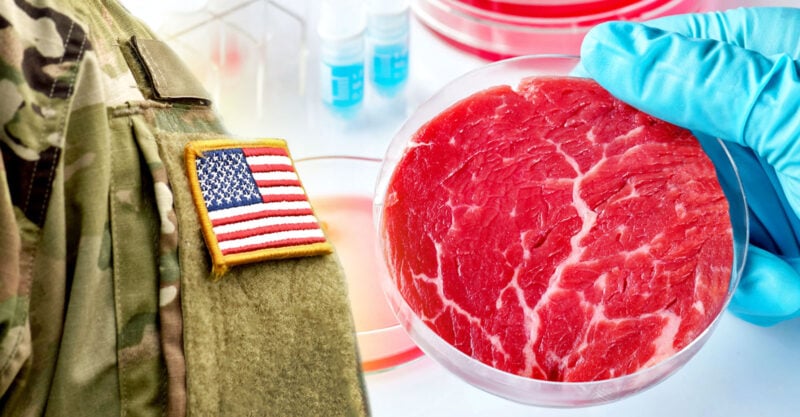


The U.S. Department of Defense (DOD) is partnering with a bioindustrial manufacturing firm to fund research exploring the development of lab-made food — like cultivated meat — for soldiers as a way to reduce the military’s carbon footprint and address climate change, the Washington Free Beacon reported.
BioMADE, or BioIndustrial Manufacturing and Design Ecosystem, a largely DOD-funded public-private partnership in May requested proposals for projects to address global climate change through bioindustrial manufacturing.
Bioindustrial manufacturing, or biomanufacturing, uses living organisms to make new manufactured products or replacements for existing products of all types, ranging from pharmaceuticals to textiles, to food ingredients, fuel enzymes and plastic alternatives. Proponents say the process is more sustainable and responsible than typical industrial production.
Among the projects BioMADE plans to fund are “innovations in food production” to make the food at DOD outposts more sustainable.
The company specified that proposals could “include, but are not limited to, production of nutrient-dense military rations via fermentation processes, utilizing one carbon molecule (C1) feedstocks for food production, and novel cell culture methods suitable for the production of cultivated meat/protein.”
Critics of the plan, including the National Cattleman’s Beef Association, said U.S. troops shouldn’t be test subjects for experimental lab-grown food products.
“It is outrageous that the Department of Defense is spending millions of taxpayer dollars to feed our heroes like lab rats,” said Ethan Lane, the group’s vice president of government affairs.


Lane added:
“U.S. cattle producers raise the highest-quality beef in the world, with the lowest carbon footprint — and American troops deserve to be served that same wholesome, natural meat and not ultra-processed, lab-grown protein that is cooked up in a chemical-filled bioreactor.
“This misguided research project is a giant slap in the face to everyone that has served our country. Our veterans and active-duty troops deserve so much better than this.”
BioMADE funding typically ranges between $500,000 and $2 million. Project awardees must provide matching funds or in-kind contributions to share the cost.
Using biotechnology, which “harnesses the power of biology to create new services and products,” and biomanufacturing, which applies those technologies to the manufacturing process, to “innovative solutions” in health, climate, food security and climate change is an ongoing priority across multiple government agencies.
President Joe Biden, in September 2022, announced an Executive Order on Advancing Biotechnology and Biomanufacturing Innovation that promised more federal investment in such technologies, a more robust “biological data ecosystem,” the expansion of biomanufacturing and the creation of “climate-smart incentives” for agriculture.
The proliferation of biomanufactured foods
Cell-cultivated meat is made using techniques developed in the biopharma industry. Cells from live animals or a cell bank — where “immortalized” cells are produced from cultured stem cells — are grown in large steel tanks called cultivators, or bioreactors.
The cells are “fed” a mixture of sugars, amino and fatty acids, salts, and vitamins to proliferate quickly into masses or sheets of muscle and connective tissue to be used as food.
It is still experimental with the first lab-grown chicken authorized for sale in the U.S. in June 2023.
The production methods used to create lab-grown meat raise a series of human health and food safety concerns, according to Jaydee Hanson and Julia Ranney at the Center for Food Safety (CFS), who analyzed patents in 2020 before the products went to market.
They wrote that public patents from companies with lab-cultivated meats, like Memphis Meats (rebranded as Upside Foods in 2021) and Eat Just (Good Meat) show the companies use growth factors that could promote the development of cancer-like or mutated cells in the lab meat.
The cells could be absorbed into the human bloodstream after digestion.
Despite the mainstream media boosterism around lab-grown meat’s alleged environmental benefits, those benefits are largely assumed — based on the known impact of the existing industrial meat system, rather than actually measured. Or they are estimated based on narrow and potentially misleading metrics.
Recent research from the University of California, Davis, shows lab-grown meat’s environmental impact is “likely to be ‘orders of magnitude’ higher” than that of regular animal-grown meat, based on current and near-term future production methods.
However, health and environmental concerns have not stopped the proliferation of all types of biotech applications for food production.
Over the last year, the U.S. Department of Agriculture has allowed bioengineered foods, including lab-grown chicken and gene-edited mustard greens to proceed to market.
Lab-grown meat: food or drug?
Lab-grown meat also has a long history of overlap with DOD interests. The concept was first popularized by national security expert Jason Matheny, now head of the Rand Corporation, a DOD contractor.
Matheny and several co-authors popularized the concept in a 2005 paper. He went on to found New Harvest, the first nonprofit dedicated to cultivated meat research, before moving to several key intelligence positions in the U.S. government and then Rand.
Investigative reporter Corey Lynn, who has been investigating lab-grown meat since 2018, told The Defender she thought it was unlikely that such research projects would have any impact on food production.
The industry has “been unsuccessful in producing anything remotely edible in the lab-grown meat area,” she said. “It’s not environmentally friendly, there’s obviously no long-term study on potential health issues (which would take years if done correctly), it costs a fortune to produce, and no human being has any interest in eating this fabricated version of protein.”
On a recent episode of the Solari Report, host Catherine Austin Fitts said such products weren’t food, they were drugs and should only be issued via pharmacies.
The Food System: ‘It’s Totally Out of Control’
⚠️ BEWARE: Bioengineered food ingredients are on the rise, and while the health impacts are “unknown,” we know this manipulation of the food supply is NOT in our best interest.
“It’s not food — it’s a drug.” — Catherine Austin… pic.twitter.com/ZaKaSnhUMY
— Children’s Health Defense (@ChildrensHD) June 18, 2024
Neither the DOD nor BioMADE responded to The Defender’s questions about criticism of lab-grown food and the call for proposals.
BioMADE, a DOD project to promote ‘sustainable’ biomanufacturing
BioMADE launched in 2021 as a public-private partnership, housed at the University of Minnesota in St. Paul, after the DOD granted it an initial $87 million to establish the organization in 2020.
That funding would be combined with another $187 million in non-federal money from 31 companies, 57 colleges and universities, six nonprofits and two venture capital groups across 31 states, the DOD announced.
BioMADE says its mission is “to enable domestic bioindustrial manufacturing at all scales, develop technologies to enhance U.S. bioindustrial competitiveness, de-risk investment in relevant infrastructure, and expand the biomanufacturing workforce to realize the economic promise of industrial biotechnology.”
It does this by using its funding to catalyze “collaboration and innovation” in pursuit of its goal to “build a sustainable, domestic end-to-end bioindustrial manufacturing ecosystem.”
The company funds researchers who are members of the organization and include universities, industry and the nonprofit sector. Member grantees include organizations like the biotech company Amyris and Bayer-Monsanto’s Ginko Bioworks.
The Defender is 100% reader-supported. No corporate sponsors. No paywalls. Our writers and editors rely on you to fund stories like this that mainstream media won’t write. 

This article was funded by critical thinkers like you.
Last year the company announced its DOD funding would increase from an initial $87 million to over $500 million. It uses the money to fund research on a broad range of bioindustrial projects across all industrial sectors.
Several projects include funding for food-related development, often for technologies that also have other applications or for biotech firms that do research in multiple sectors.
For example, last month’s call for proposals is not the first lab-grown protein project BioMADE has funded.
It is currently funding a project by Superbrewed Food to create “sustainable protein, formulate it into a format that would be desired by warfighters, and conduct ex vivo studies to identify the nutrition and functional food benefits associated with their postbiotic protein ingredient.”
The goal is to sustainably improve “military readiness” in warfighters.
In March, Superbrewed Food became the first company in the U.S. to have its bacteria biomass protein passed by the U.S. Food and Drug Administration (FDA).
The company doesn’t only make edible proteins. In another BioMADE-funded, joint project with Lockheed Martin, the company is “doping” nanoparticles with metals to modify their magnetic properties for various defense and commercial applications.
Other food-related funding by BioMADE includes funding to global food giant Cargill to scale up fermentation processes in its bioreactors. Bioreactors have applications in biotechnology, pharmaceuticals, food production and wastewater treatment.