Login
Login


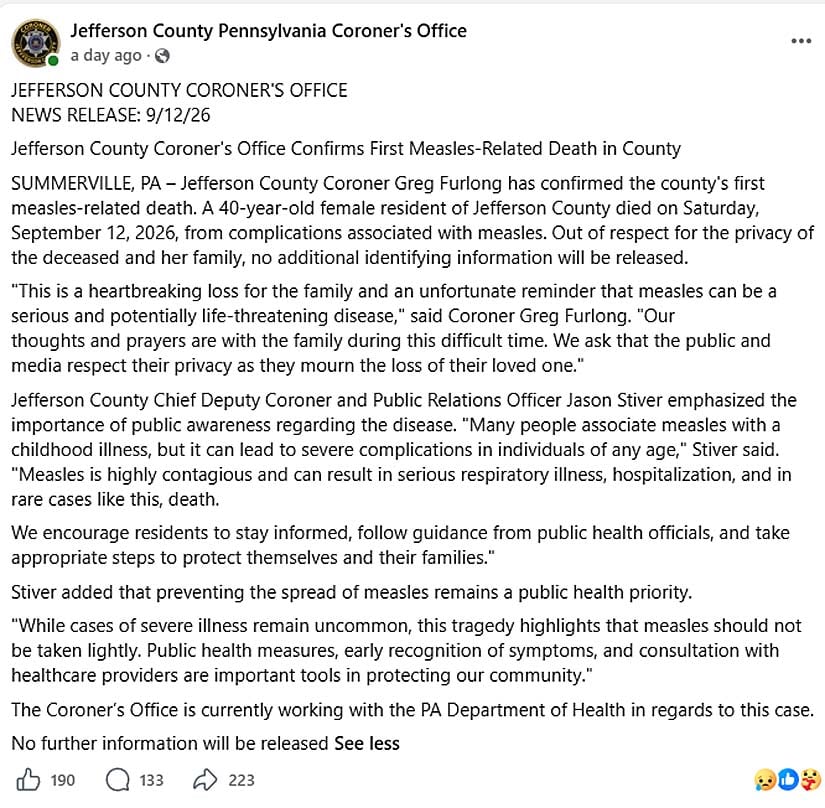
A 40-year-old woman in Jefferson County, Pennsylvania, died on Sept. 12 “from complications associated with measles,” according to a Sept. 12 county coroner’s office news release posted on Facebook.
Jefferson County Coroner Greg Furlong today told The Defender that the woman, who never received the measles-mumps-rubella (MMR) vaccine, suffered from a “long, long history” of underlying illnesses. “I’ll just give you a little bit of it,” he said.
According to Furlong:
“She had restrictive lung disease. She had acute chronic hypoxemic respiratory failure. She had COPD [chronic obstructive pulmonary disease]. These are issues she’s had for years and years, not just something recently.
“She had asthma, she had hypertension, anemia and supplemental oxygen dependence. She was on oxygen 24 hours a day.”
Still, in Furlong’s view, the woman would likely still be alive if she had not been exposed to the measles. “Measles absolutely contributed to her death,” he said.
Although the woman was not tested for measles before she died, she showed typical symptoms of measles, including a cough, fever, white spots in the mouth and a rash, Furlong said.
She also was recently exposed to a neighbor who had tested positive for measles.
A post-mortem nasal swab sent to the state laboratory will be tested for measles, Furlong said. The results should be in on Tuesday or Wednesday, he added.
The preliminary death certificate stated that the immediate cause of death was respiratory failure due to “suspected measles,” chronic obstructive pulmonary disease and asthma, The Washington Post reported.
Furlong told The Defender he plans to update the death certificate from “suspected” to “probable” measles, now that his investigation has determined the woman had contact with someone who tested positive for measles.
It is unclear if the state will count the woman’s death as a confirmed “measles-associated death,” given that she had no positive measles test before her death.
The Pennsylvania Department of Health (DOH) defines “measles-associated death” as a death that occurs “within 30 days of symptom onset in an individual with clinical evidence of a measles infection and a positive laboratory test and that is not due to unrelated causes.”
The DOH did not include the woman’s death in its Sept. 14 update on the state’s ongoing measles outbreak. The update also noted that four of the state’s 693 cases have been among vaccinated individuals.
The woman’s death is the third measles-related death reported in Pennsylvania this year, although a local coroner disagreed with characterizing one of those as having been related to measles.
Lancaster County Coroner Stephen Diamantoni said a newborn who died shortly after birth on Aug. 14 tested positive for measles. However, Diamantoni said the pathologist who performed the autopsy determined the primary cause of death was a lacerated spleen, not measles.
The other death, which also occurred in Lancaster County, involved a 6-week-old Amish infant who was born with Amish lethal microcephaly, a condition that typically causes infants to die within six months of birth. Diamantoni said the infant, who died on Aug. 18, died from measles.
The two infant deaths sparked political controversy after the DOH on Aug. 25 announced the deaths, but reported only that the individuals were “unvaccinated” — without reporting any other identifying information, including the age, gender, history of illness or comorbidities.
The Centers for Disease Control and Prevention doesn’t recommend the MMR vaccine until children are at least 12 months old — well under the age of the two infants who died.


MMR vaccine carries risks, doctor says
In an earlier interview with The Defender, Dr. Ben Edwards — who successfully treated hundreds of West Texas children with measles in 2025 — said mainstream media tends to report only on the benefits of the MMR vaccine while failing to mention the vaccine’s risks.
He agreed that it is “pretty well established” that the MMR vaccine decreases a person’s likelihood of acquiring measles. “But at what cost? There’s benefit, and there’s risk,” he said.
According to Physicians for Informed Consent, there is no proof that measles causes more injuries or deaths than the MMR vaccine.
To compare the risk of death from measles to the risk of death from the MMR vaccine, Edwards looked at deaths reported to the Vaccine Adverse Event Reporting System (VAERS) following MMR vaccination.
“When you look back over the past 30 years … 1995 to 2025, on average, if you average out every year, it’s anywhere from some years it’s one or two deaths, some years it’s up to 10. The average is six and a half, roughly, or 6.43,” he said.
However, VAERS has historically been shown to report less than 1% of all adverse events.
“That means a 99% unreported rate. So that 6.43 deaths per year would be 643 deaths per year from the MMR vaccine,” Edwards said.
As of July 31, there were 95,470 adverse event reports filed since 1990 in VAERS following MMR vaccination, including 501 deaths, according to OpenVAERS.
Trump signs executive order to split MMR into separate shots
Some experts argue that splitting up the vaccine would reduce children’s risk of injury.
On Aug. 10, President Donald Trump signed an executive order that called for breaking up the MMR vaccine into three single-disease vaccines administered at separate medical visits.
Spacing out the shots over separate visits reduces the amount of vaccine and adjuvant that a child’s immune system has to handle at once, which can reduce the child’s risk of vaccine-induced inflammation, particularly cerebral inflammation, noted Dr. Robert Malone, who spoke with The Defender about Trump’s order.
Cerebral inflammation can be associated with autism.
At the signing of the executive order, Trump and U.S. Health Secretary Robert F. Kennedy Jr. both mentioned a possible link between vaccines and increased autism rates in the U.S.
The Defender is 100% reader-supported. No corporate sponsors. No paywalls. Our writers and editors rely on you to fund stories like this that mainstream media won’t write. 

This article was funded by critical thinkers like you.
‘It was MMR or nothing’
In an earlier interview with The Defender, Dr. Andrew Wakefield said that decades ago, the U.S. and U.K. offered a single measles vaccine for parents concerned about the safety of the combined MMR vaccine.
Wakefield is a former U.K. gastroenterologist who was lead author on a 1998 study published in The Lancet — which later retracted the study — on a novel inflammatory bowel disease in children with autistic regression and gastrointestinal distress.
In the majority of children, the onset of symptoms followed MMR vaccination, Wakefield said.
Wakefield said he had thoroughly reviewed all published studies on measles-containing vaccines, including the monovalent measles vaccine. “I came to the conclusion that such studies were inadequate to qualify the safety of [the] MMR vaccine.”
“Moreover, independent studies identified ‘interference’ between the measles and mumps components that altered the anti-viral immune response,” he said. “The implications of this ‘interference’ for safety were completely unknown.”
Wakefield began recommending that parents opt for a monovalent measles vaccine — which at the time was available in the U.K. and U.S. — rather than the MMR vaccine.
Six months later, the U.K. withdrew the importation license for the monovalent measles vaccine. “It was MMR or nothing.”
A monovalent measles vaccine hasn’t been available in the U.S. since 2009.
Related articles in The Defender
- 6-Week-Old Amish Infant With Fatal Genetic Condition Died From Measles, Coroner Confirms
- Exclusive: Most Kids Can Fight Measles Naturally — and Having the Virus May Even Make Them Stronger
- Coroner Contradicts Pennsylvania Health Officials, Says Measles Didn’t Cause Newborn’s Death
- 2 ‘Measles-Associated’ Deaths in Pennsylvania Spark Media Blitz — But Officials Won’t Release Details
- Breaking Up MMR Vaccine Will Benefit Kids — But It Could Be Years Before Single Shots Are Available