Login
Login
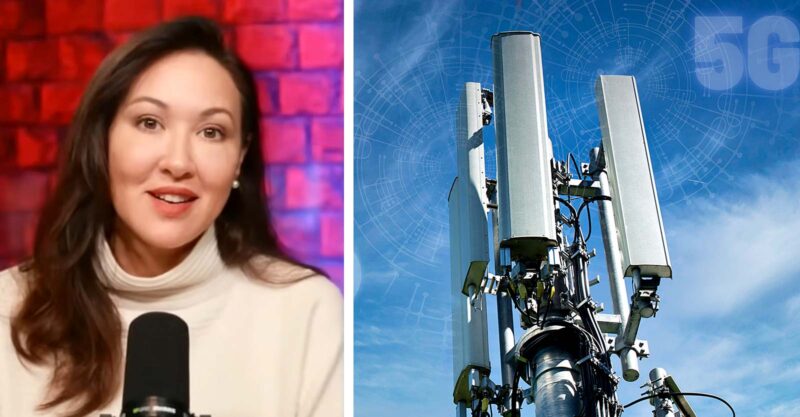


“I am all for technology … we just want to fast-track safety,” wireless radiation expert Theodora Scarato told political commentator Kim Iversen.
In an interview on “The Kim Iversen Show,” Scarato said many people are rightly concerned about the health impacts of wireless technologies and infrastructures. “What it comes down to is that the federal government has failed to adequately protect us with up-to-date limits” for wireless radiation exposure, she told Iversen.
Scarato directs the Wireless and EMF (electromagnetic field) Program for Environmental Health Sciences.
The Federal Communications Commission (FCC) hasn’t updated its wireless radiation safety limits since 1996, Scarato told Iversen. And the agency still has yet to comply with a 2021 court mandate to explain how its limits protect human health.
Children’s Health Defense (CHD) on Tuesday filed a motion with the FCC, urging it to comply with the court mandate.
How can residents or city leaders feel confident that cell towers are safe “when the FCC can’t even explain how those limits are adequate?” Scarato asked.
But Iversen said everyone is “just thinking about convenience.” They’re not thinking, “Are these towers going to cause long-term damage to pregnant women and their babies?”
Many other countries have “much more restrictive” wireless radiation limits, Scarato said. In fact, the U.S. allows 10 to 100 times more radiation from cell towers than several countries, “including China and Russia, which have active research programs on the issue,” she told Iversen.
Belgium, Italy and Switzerland also have far stricter limits.
Wireless companies should compete on safety
Aside from the FCC needing to require stricter limits, the wireless industry needs to start competing on safety, Scarato said. “There are software and hardware fixes which could make the exposure much less.”
People don’t need to stop using technology — the tech companies just need to make safer products. Scarato told Iversen to think back to how car companies first made cars without seatbelts. Now, car companies compete on safety. “That’s where we’re at,” Scarato said.
For instance, companies could design cellphones that don’t bombard the user with so much wireless radiation.


This article was funded by critical thinkers like you.
The Defender is 100% reader-supported. No corporate sponsors. No paywalls. Our writers and editors rely on you to fund stories like this that mainstream media won’t write.
People should tell FCC to reject new rules that would strip away local control
Iversen and Scarato discussed the FCC’s new proposed rules that would strip local communities of the right to control, or even have a say in, where cell towers are placed.
On Sept. 9, the FCC unveiled its proposal, which the agency said was designed to eliminate “barriers to wireless deployments” by silencing local communities that resist telecom companies’ efforts to build new cell towers next to their homes and children’s schools.
Cell towers negatively impact property values, making it difficult for residents to sell their homes if a tower goes up nearby, Scarato said. “The character of our communities will be fundamentally changed by all of these installations going up without our control.”
Scarato urged viewers to submit a public comment to the FCC, urging it to reject the new rules. CHD created an action alert that walks people through how to submit a comment to the FCC and Congress.
“Responsible placement” of cell towers means keeping them a good distance from people’s homes, Scarato said. “That’s what we need.”
Watch here:
Related articles in The Defender
- ‘New Phase of Attack’: Children’s Health Defense Tells FCC to Protect People, or ‘Get Out of the Way’
- FCC Limits for Wireless Radiation Exposure Decades Out of Date, Experts Say
- ‘People Need to Wake Up’: Babies in Homes With High Levels of Wireless Radiation Have Triple the Risk of Developmental Delays
- Historic New Mexico Town Blocks Cell Tower After Consulting Lawyer Featured in The Defender