

 Login
Login


When the U.S. Food and Drug Administration (FDA) licensed Moderna’s new mRNA flu vaccine last week, legacy media coverage focused almost exclusively on efficacy.
The pivotal trial reported that the vaccine was “26.6% more effective” than a conventional flu vaccine at preventing protocol-defined influenza-like illness.
What received far less scrutiny was a much more serious problem in the trial data published in The New England Journal of Medicine — much of it relegated to an appendix behind a paywall.
An analysis of that appendix alongside the FDA’s own briefing document exposes clear regulatory malfeasance.
A statistically significant safety signal from the pivotal trial was systematically diluted until it disappeared from the official story.


The safety signal
Moderna’s pivotal Phase 3 trial (P304) enrolled roughly 40,000 adults aged 50 and older, randomized 1:1 to either the company’s mRNA-1010 vaccine or a traditional trivalent flu vaccine.
This study evaluated an “optimized” version of Moderna’s vaccine after earlier versions produced disappointing efficacy results.
Even with this updated formulation, the headline “26.6% relative efficacy” figure was misleading. In absolute terms, the vaccine reduced the risk of illness by just 0.8%.
Most concerning, however, were the serious adverse event (SAE) data.
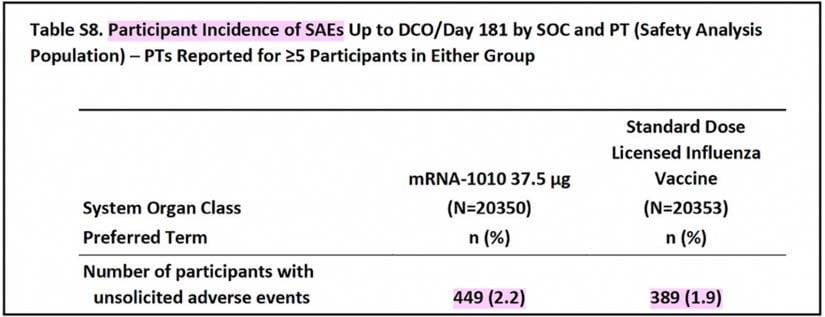
The six-month data show that 449 participants in the mRNA group experienced at least one SAE, compared with 389 in the conventional group — an excess of 60 people.
So, while the pivotal trial showed there were four fewer influenza hospitalizations in the mRNA group, 60 additional people experienced an SAE.
SAEs are not mild events — they are usually severe enough to require hospitalization, threaten life, cause significant disability or result in death.
The imbalance of SAEs in Moderna’s pivotal trial was statistically significant — meaning it was unlikely to be a random fluke.
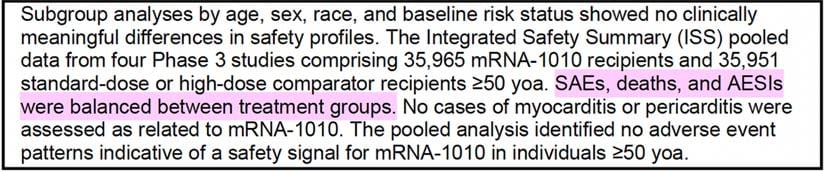
Yet in the briefing documents presented to the FDA’s Vaccines and Related Biological Products Advisory Committee, the agency characterized SAEs as “balanced.”
So how did the FDA make the SAE imbalance disappear?
Making serious adverse events disappear
The short answer is that the FDA used pooled data that obscured the safety signal.
Specifically, the agency relied on Moderna’s own “Integrated Safety Summary,” which combined data from four separate Phase 3 trials (P301, P302, P303 and P304), involving nearly 72,000 participants.
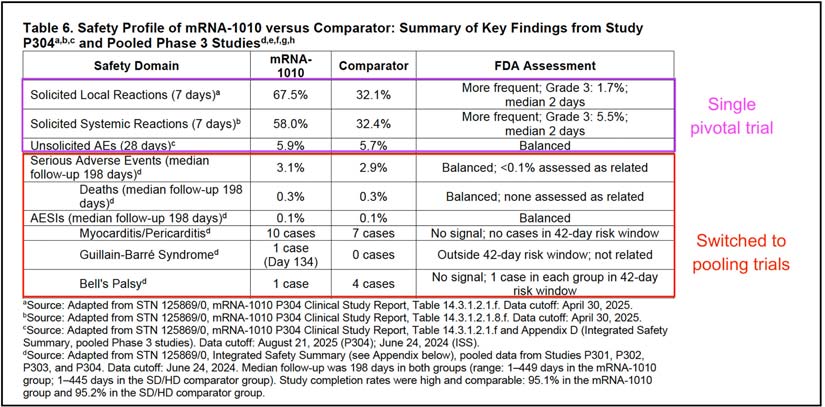
Once the pivotal trial P304 was combined with the other trials, the SAE rate became 3.1% in the mRNA group versus 2.9% in the comparator group — allowing the FDA to state that the rates were “balanced.”
Pooling data across clinical trials is common when regulators are looking for rare events. But the four trials Moderna pooled were very different in many aspects.
They tested different mRNA vaccine formulations against different flu vaccines — standard-dose and high-dose, quadrivalent and trivalent — across different age groups and countries, with follow-up ranging from six months to a year.
When these disparate trials were combined into a single analysis, the safety signal that stood out in the large pivotal trial was diluted.
The FDA accepted the approach — despite being aware of the problem.
In an appendix to its own briefing document, the FDA acknowledged that differences between the trials could produce safety variations “not fully captured by pooled analyses” — but proceeded anyway.
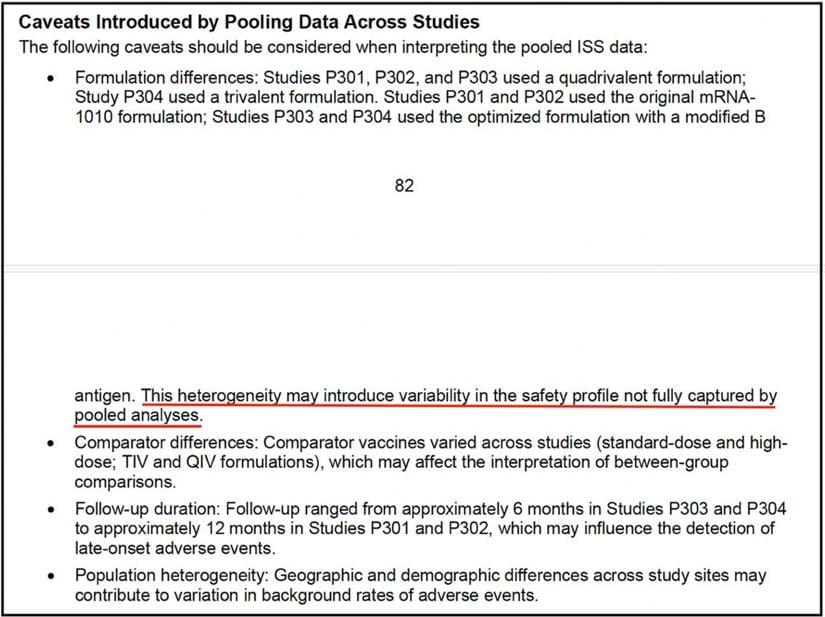
Table 6 of the FDA’s own review makes the switch even clearer (see below).
For the first 28 days after vaccination, when serious adverse events were still balanced between the groups, the agency reported safety results from the pivotal P304 trial alone (purple box).
But as more SAEs accumulated over the following months, a statistically significant imbalance emerged.
Instead of reporting those longer-term results from P304 in the same way, the FDA switched to Moderna’s pooled analysis (red box), where the signal was diluted enough for the agency to continue describing the rates as “balanced.”
The pooled analysis also obscured a concerning pattern in all-cause mortality.
In the pivotal trial P304, there were 40 deaths in the mRNA arm versus 34 in the comparator arm.
In the preceding trial P303, deaths were consistently higher across all three mRNA sub-studies:
- Sub-study 1 (mRNA vs Standard Trivalent): 5 deaths in the mRNA-1010 arm vs. 1 death in the comparator arm (5 vs. 1).
- Sub-study 2 (mRNA vs High-Dose Trivalent): 3 deaths in the mRNA-1010 arm vs. 2 deaths in the comparator arm (3 vs. 2).
- Sub-study 3 (mRNA vs Standard Quadrivalent): 3 deaths in the mRNA-1010 arm vs. 1 death in the comparator arm (3 vs. 1).
Notably, in Sub-study 1, Moderna’s own trial investigators assessed one of the five deaths in the mRNA group as caused by the vaccine — the same product that has now been licensed.
Together, these numbers raise serious concerns about a possible excess in mortality in the mRNA groups — a pattern the FDA failed to highlight.
One rule for efficacy, another for safety
The FDA’s handling of efficacy reveals an even more striking double standard.
For efficacy, the agency relied strictly on study P304 — the large pivotal trial testing the exact formulation submitted for licensure.
Earlier trials of Moderna’s vaccine had produced weaker efficacy results — and in at least one case, negative efficacy. Had the FDA pooled those trials for efficacy, the “26.6% efficacy” figure would almost certainly have been substantially lower.
But, as noted above, when the pivotal trial produced an unfavourable safety result, the FDA did the opposite — it pooled the data.
One approach maximised the efficacy. The other diluted the safety concerns.
Who is protecting the public?
On the surface, the FDA says Moderna’s flu mRNA vaccine is “safe and effective.”
Dig deeper, and the pivotal trial shows a statistically significant excess of participants experiencing SAEs.
Dig deeper still, and you discover the statistical trickery Moderna used — and the FDA accepted — to make the SAE signal disappear.
This brings us back to a fundamental question I have raised over years of reporting on regulatory failure.
When the FDA accepts the manufacturer’s trial design, adopts its data analyses and rubber-stamps statistical methods that dilute a safety signal, who is actually protecting the public from harm?
Originally published on Maryanne Demasi’s MD Reports Substack page.
