

 Login
Login



By Regeneration International
By André Leu
The official requirements set by regulatory authorities for specific testing of pesticide-induced diseases in children are nearly non-existent.
The guidelines followed by the Organisation for Economic Co-operation and Development (OECD) — a collection of about 150 of the most relevant internationally agreed testing methods used by government, industry and independent laboratories to identify and characterise potential hazards of chemicals — call for testing them on adult animals only.
The guidelines state: “Young healthy adult animals of commonly used laboratory strains should be employed.” The fetus, infant and pubertal animals (i.e., children) are not tested.
This indicates there will be no data on the safety of pesticides and other chemicals for children in the experiments that utilize these OECD and similar guidelines, which represent the majority of tests.
The developing fetus, young children and adolescents undergoing puberty are three critical stages in human development that are completely overlooked in the guidelines for diseases, endocrine disruption and cancer.
There is no published, scientific, evidence-based testing showing that any of the current chemicals and pesticides are safe for our children, as there is no requirement to specifically evaluate their safety.
The current best practice testing guidelines will fail to detect whether chemicals are causing today’s massive epidemic in our children.


Conversely, there is a substantial body of published, peer-reviewed scientific research demonstrating that exposure to minute levels of chemicals and pesticides in unborn and growing children is linked to:
- Autism spectrum disorders
- Lower IQs
- Attention deficit/hyperactivity disorder (ADHD)
- Cancers
- Thyroid disorders
- Endocrine disruption
- Immune system problems
- Lack of physical coordination
- Loss of temper — anger management issues
- Bipolar/schizophrenia spectrum of illnesses
- Depression
- Digestive system problems
- Cardiovascular disease
- Reproductive problems (as adults)
- Deformities of the genital-urinary systems
- Changes to metabolic systems, including childhood obesity and diabetes.
A good example is the autism epidemic in the developed world. According to the Centers for Disease Control and Prevention (CDC), in 2000, 670 children per 100,000, or 1 child in 150, had autism. By 2014, the rates of autism rose to 1,680 children per 100,000, or 1 child in 59. This reflects a startling 250% increase over 14 years.
The most recent data from the CDC’s Autism and Developmental Disabilities Monitoring Network, published in 2025, estimates that 1 in 31 children aged 8 years in the U.S. were identified with autism in 2022.
This marks an increase from 1 in 36 in 2020. For boys, the rate is significantly higher at 1 in 20, while for girls, it’s approximately 1 in 93. About 26.7% of children with autism have profound autism and require constant long-term care.
It is criminal neglect that has permitted this epidemic to expand to the point where it affects such a high percentage of children. Until recently, it was ignored or denied, and the rise in rates was primarily attributed to increased awareness, screening, diagnostic practices and genetic factors.
The causes of the epidemic were overlooked despite strong scientific studies showing significant links to the rise in neurotoxins, such as glyphosate from genetically modified organism (GMO) foods, and mercury and aluminum due to the rapid increase in the number of childhood vaccines.
Nancy Swanson, Ph.D., my co-authors Jon Abrahamson and Bradley Wallet, and I published a peer-reviewed paper, “Genetically engineered crops, glyphosate and the deterioration of health in the United States of America,” demonstrating how glyphosate and GMOs are linked to over 20 chronic diseases in the U.S.
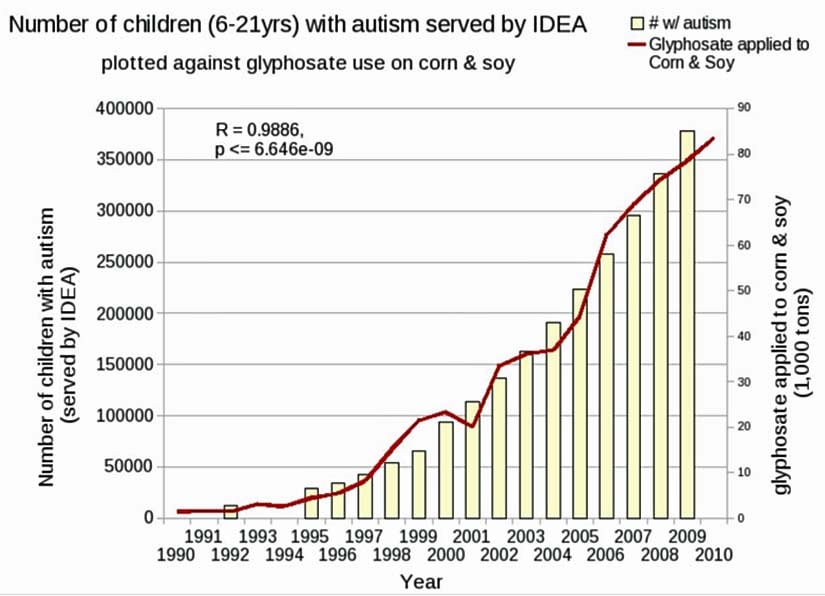
In the chart above, we illustrate the strong correlation between the increase in glyphosate usage and the rise in autism among children.
Through a standard statistical analysis, we demonstrated a 10,000 to 1 probability linking the increase in glyphosate use to the rise in autism. When analyzing side effects from a medication, this level of probability of harm is deemed sufficient evidence to withdraw it.
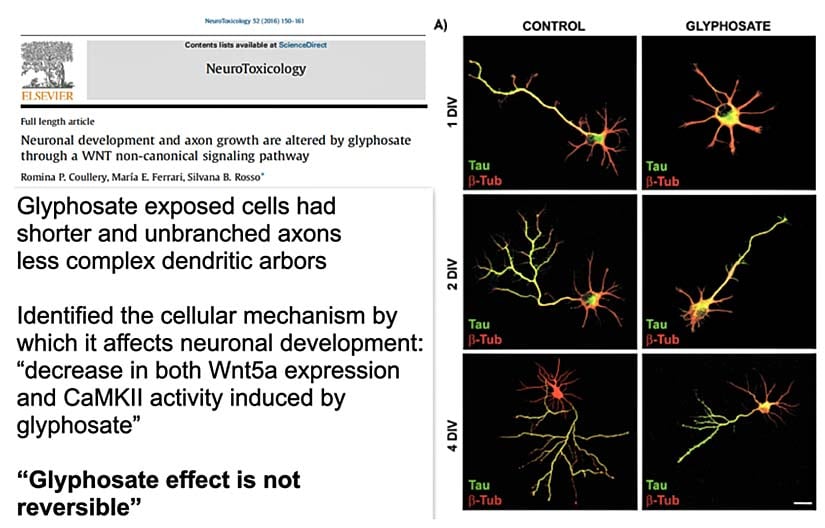
The image above, from Coullery et al., illustrates how glyphosate damages nerve development. The glyphosate-exposed cells exhibited shorter, unbranched axons (the long extended ‘arms’ of the nerve) and less complex dendritic arbors (the smaller ‘fingers’ coming out of the body of the cell).
It is evident from the image that the cells exposed to glyphosate do not develop properly and, therefore, cannot function effectively.
The study reveals that gestational exposure to glyphosate leads to neurobehavioral impairments in rat offspring, characterized by motor and cognitive deficits.
The scientists identified the mechanism by which glyphosate affects nerve development, specifically by inhibiting the Wnt5a-CaMKII pathway, stating that this effect cannot be reversed. This indicates that the nervous system is a primary target for glyphosate toxicity, raising serious concerns about its effects during critical developmental periods.
The study, “Gestational glyphosate exposure and early childhood neurodevelopment in a Puerto Rico birth cohort,” by Jenkins et al., examined the relationship between prenatal exposure to glyphosate and its metabolite, aminomethylphosphonic acid (AMPA), and early childhood neurodevelopment.
It found that prenatal AMPA concentrations were significantly associated with reduced communication scores at 12 months.
At 24 months, AMPA was linked to declines across multiple domains. The study concluded that gestational glyphosate exposure, particularly through AMPA, is associated with adverse neurodevelopmental outcomes, with effects becoming more pronounced at 24 months.
The critical issue is that AMPA results from the degradation of glyphosate and is more persistent and toxic in the environment and in human bodies. Therefore, the argument that glyphosate breaks down rapidly and is harmless is a dangerous myth. In fact, it becomes more harmful and persistent as it breaks down!
This is why its widespread use in food production, gardening, roadsides, sidewalks, parks, schools and playgrounds is dangerously irresponsible.
The primary concern is that the brain is the largest collection of nerves in the human body and continues to develop in unborn, newborn and growing children.
Exposure to small amounts of glyphosate and AMPA in food can adversely affect the brain’s normal development, leading to a range of serious issues observed in children, including autism spectrum disorder, bipolar disorder, ADHD and other developmental and behavioral challenges.
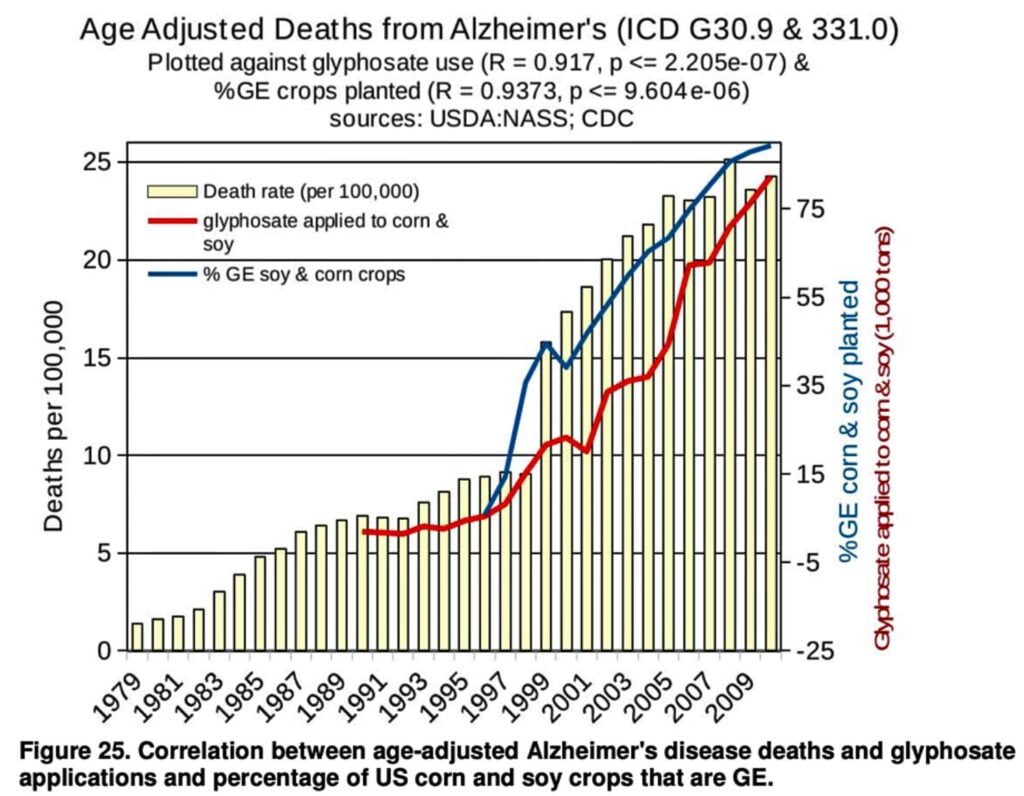
Adult brains continually regenerate brain cells. These nerve cells are also negatively impacted by glyphosate. The graph below is from our paper “Genetically engineered crops, glyphosate and the deterioration of health in the United States of America.”
It illustrates a strong correlation, 10,000 to 1, between the rise in glyphosate usage in GMO crops and deaths from dementia.
The widespread use of glyphosate and other pesticides results in nearly everyone having pesticide residues in their blood and urine. Most individuals are not farmers, and the majority of their exposure comes from food residues.
This is why consuming regenerative organic food is essential for our health, especially the health of our children and the overall environment.
Professor André Leu holds a doctorate in science, co-founded Regeneration International, and has served as its international director since 2017.
Originally published by Regeneration International.