

 Login
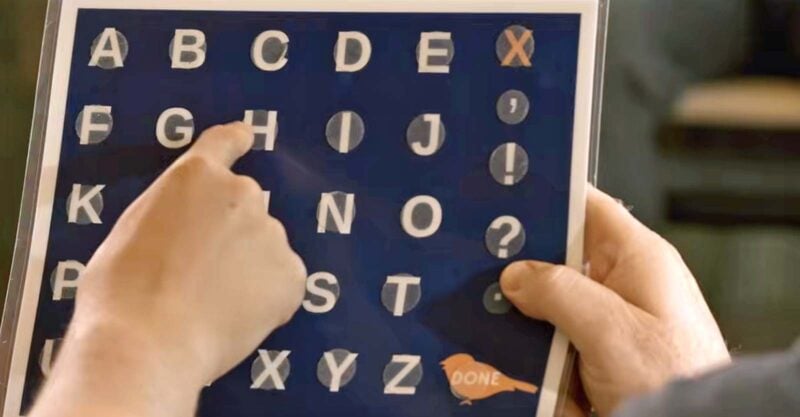


“We need for every nonspeaker to be given a voice,” Elizabeth Bonker told Children’s Health Defense (CHD) CEO Mary Holland. “Most suffer in silence.”
Bonker, who does not speak, communicated those words through a letter board at the inaugural Spellers Freedom Conference, sponsored in part by CHD.
About 650 spellers, families and advocates gathered in San Diego this month to share how spelling has opened doors for people who have spent years unable to communicate with the world around them.
“Spellers” are nonverbal or partially verbal people, many of whom have autism. They communicate by pointing to letters on a letter board, or typing words and phrases.
Brian Hooker, Ph.D., CHD’s chief scientific officer and the father of a nonspeaking adult son with autism, described the change that spelling can bring.
“This is a revolution of individuals that have been locked away in their bodies, not able to communicate, really, in any meaningful way, shape or form,” Hooker said on “Good Morning CHD.” “And, all of a sudden, they become able to communicate.”
But spelling has also sparked a fierce debate. Some healthcare professionals and parents question whether spellers independently produce the messages attributed to them. They warn that facilitators who help spellers communicate may be influencing what spellers say.
For families who say spelling has transformed their lives, the debate has profound implications. They see spelling as a way for their children to express thoughts and abilities that others may have underestimated for years.
Spelling is “arguably the best breakthrough we’ve seen in 30 years in autism,” Holland said.
‘We all need this’
J.B. Handley, whose nonverbal adult son is a speller, believes the movement will grow as more families witness what spelling can do.
“We all know how astonishing the numbers of nonspeakers really are, and this is the thing that we know so far that does the most to change their lives,” Handley said. “Once you experience this personally, what else could you possibly do for your kid than to do this?”
Holland compared the experience of nonspeakers who cannot communicate with solitary confinement, which is seen as “the worst punishment possible in a prison.”
“Literally, some of these people have been in solitary confinement for decades,” she told CHD.TV. “So they’ve been through incredible suffering, and they now have this opportunity through letter boarding.”
Holland said that being unable to speak doesn’t mean a person can’t understand the world around them. She attributed many spellers’ difficulties to apraxia, which she described as a disconnect between the brain and the mouth.
“That’s all it is,” she said. “It’s not that these people can’t think. It’s not that these people don’t have all of the other human emotions and abilities and inabilities that the rest of us do.”
For Handley’s son, Jamie, spelling changed his life. He spent his first 17 years unable to communicate. His experience of learning to use a letter board was documented in the film “SPELLERS.”
Today, Jamie says his purpose is to help other nonspeakers find a way to communicate. “We all need this,” he told Holland at the conference.

‘We never thought that we would have something that unlocked them’
Hooker said spelling has “unlocked” people who were underestimated for years.
“It’s an amazing, amazing movement,” Hooker said. “We’re just seeing these transformations that are unimaginable. It turns your life completely around.”
Hooker said that since his son began communicating through spelling a few years ago, he has made friends online and started exploring subjects that once seemed out of reach.
“We were trying to teach him his shapes six years ago,” Hooker said. Now he is “doing calculus and physics that I’ve never seen.”
Hooker said many spellers have learned far more than other people thought possible.
“These spellers are so astounding,” he said. “They’ve been able to read since they were 4 or 5 years old. … During the time that they were locked in their bodies, boy, they were making good use of that time and learning.”
Some spellers have gone on to complete high school and college. Bonker, executive director of Communication 4 ALL and the conference’s keynote speaker, was a valedictorian of Rollins College. Her 2022 commencement speech went viral, with 4 billion potential views across media platforms.
For Haley Bennett, who works with the Spellers Freedom Foundation and the Medical Academy of Pediatrics & Special Needs (MAPS), spelling has transformed her relationship with her two teenage children with autism.
“We never thought that we would have something that unlocked them,” she said. “We always knew they were in there, but what does that look like? And it still blows our mind all the time, the things that they can tell us.”
Bennett said parents do not have to choose between accepting their children as they are and seeking ways to improve their lives.
“I don’t think we have to choose between acceptance and treatment,” she said. “Of course we love and accept our children. … But we want life to be as good as it can be.”
Spellers launch fight for ‘communication equality’
For families, finding a way to communicate is only part of the battle. They also want the freedom and financial support to use the methods that help their children.
The conference marked the launch of a “Communication is a Human Right” campaign in California, according to Bonker. She described the push as a way to “chart our course for communication equality.”
The Spellers Freedom Foundation notes that California regional centers have denied families permission to use state-allocated funds for spelling or typing devices.
Dawnmarie Gaivin, executive director of the organization, said families have spent years trying to reach children and adult children who could not communicate with them.
Now, they face a new fight to protect their access to communication.
“Our kids were locked in there for so long,” Gaivin told Holland at the conference. “They found this way to communicate. … But now … it’s a civil rights battle.”
The fight extends beyond California
In March 2026, proposed changes to a New York bill that would deny funding for certain communication methods, including those used by spellers, sparked an outcry from disability advocates.
Members of Helen Keller’s family, including descendants of the renowned deaf-blind activist, also objected to the changes.
Holland said existing disability-rights protections, including the Americans with Disabilities Act, should ensure that spellers receive the accommodations they need to communicate. But she said those protections are not consistently recognized.
Some families report that their children cannot use spelling even in residential settings. Holland pointed to a speller living in a New York group home who was not allowed to spell there.
“Why has the issue around muteness or inability to speak been treated so differently than blindness or deafness?” Holland asked.
The potential reach of spelling is enormous. A 2021 study in The Lancet Psychiatry estimated that more than 60 million people worldwide are on the autism spectrum. If roughly one-third have profound autism and are nonspeaking or partially speaking, that would represent an estimated 20-30 million people, Holland said in her address at the conference.
“That is over a million individuals in the U.S. right now that need and could really, really blossom under this particular modality,” Hooker told CHD.TV. He estimated that there are “probably about 5,000 spellers in the U.S. right now.”
Holland said the laws and public policies must catch up with the needs of nonspeakers. “We need change in education, in housing, in work, in medicine, in the legal system to affirm spellers’ right to communicate,” she said at the conference.
The Defender is 100% reader-supported. No corporate sponsors. No paywalls. Our writers and editors rely on you to fund stories like this that mainstream media won’t write. 

This article was funded by critical thinkers like you.
‘This is a serious, science-based intervention’
Critics are challenging whether nonspeakers with profound autism can independently produce the messages attributed to them. Some suggest that facilitators may influence or control what is communicated.
The American Speech-Language-Hearing Association and the American Academy of Pediatrics (AAP) question the scientific validity and clinical evidence for spelling methods. They warn that facilitators may undermine spellers’ autonomy.
Hooker rejected the claim that the communication tools limit users’ ability to express themselves. “Nothing could be further from the truth,” he said.
He described hearing his son’s thoughts via spelling and through a voice avatar. “Through his words, I’ve heard things that didn’t come out of me,” he said, describing the “wonderful poetic things” his son has expressed.
Holland sharply criticized organizations for “denying access to communication.”
“This is a serious, science-based intervention,” she said. “The spellers are not being puppeted by the people behind them. … That’s just a smokescreen. It’s a pretext so that these other organizations that are making billions of dollars — often for things that are not very helpful for people with autism — that they don’t lose their money.”
Honey Rinicella, executive director of MAPS, also challenged the AAP’s approach to children’s health and well-being.
Rinicella said her twins, now 26, experienced severe vaccine reactions as toddlers. Decades ago, she discussed their reactions on a news show where the AAP’s president acknowledged that “there’s a small subset of kids that will have a reaction, but for the masses it protects the most.”
Rinicella told Holland that the experience changed her views on medical care.
“I knew right then and there, 24 years ago, we needed to individualize medicine,” she said. “We need to educate the doctors to know how to stop burning the children and save those that we burned.”
Today, MAPS trains physicians and healthcare practitioners to care for children with complex medical conditions, including autism.
Holland praised Rinicella’s efforts to encourage pediatricians to question established practices. “You’re teaching these pediatricians, ‘Stop doing what you’re doing. Stop following the American Academy of Pediatrics,’” Holland said.
She also criticized the resistance to spelling and other communication technologies.
“It’s extraordinary that these institutions about speech, hearing, and language and pediatrics completely reject and oppose these technologies,” she added. “It’s really abhorrent.”
‘We’ve got to change the world’
Hooker said his son’s words have reinforced the need to keep pushing for change. “We want this to spread like wildfire,” he said.
The debate over spelling is not simply about which communication methods professionals endorse. It is also about whether people who cannot speak will have the opportunity to show what they know and express what they want.
“There are still crazy people out there who want to deny these kids the right,” J.B. Handley warned.
Gaivin said the movement has reached a turning point.
“There are enough people who know about spelling and typing. There are enough nonspeakers who are accessing communication,” she said. “Lives have already changed, but now we’ve got to change the world.”
“We don’t have to keep trying to fit into the world,” she added. “It’s time for the world to really accommodate this generation.”
Jamie Handley agreed, typing four words into his letter board: “The revolution is here!”
Watch conference highlights and hear advocates talk about spelling here:
Related articles in The Defender
- New York Times Attacks ‘Spelling’ — Parents Say It ‘Changed Everything’ for Their Nonspeaking Children With Autism
- Why the Battle Over Spelling Is Really a Battle Over the Meaning of Profound Autism
- Family of Helen Keller Opposes Bill to Deny Funding for Some Nonverbal Communication Methods, Including Those Used by ‘Spellers’
- ‘The People Have Had Enough’: Children’s Health Defense Sold-Out Conference Signals Growing Power of Health Freedom Movement
- ‘What if Everything You Knew About Autism Was Wrong?’ New Documentary Asks
