Login
Login



By Juan Vassallo
1. They use enormous amounts of water
Data centers, which store and process the digital information needed for everyday online activities, often consume large amounts of water to keep servers cool — especially the new hyperscale facilities typically built for artificial intelligence (AI).
Google’s data center in Pryor, Oklahoma — one of the company’s largest facilities — uses about 1.1 billion gallons of water each year. That is equal to about 8.3 billion water bottles or the annual water use of 10,000 average American households.
The Pryor data center uses an evaporative cooling system, so most of the water used for cooling is lost to evaporation. Of the 1.1 billion gallons of water used, only about 275 million gallons of drinking water are discharged back into the river for reuse.
The industry is feeling the pressure to move away from that technology, and some new facilities are looking to install closed-loop systems, which recycle water in a continuous cycle, or air-cooled systems. These systems use little water but require much more electricity.
2. Researchers know little about water pollution
Not much is known about how water discharge from data centers impacts the environment. A recent study on the issue notes that “there is a clear lack of transparency in data center cooling water discharge practices.”
Companies often do not disclose how much water they release, where it goes, or what chemicals or pollutants it may contain. The study found that cooling water discharges could affect rivers, groundwater and wastewater systems, but limited data makes those impacts difficult to measure.
Download the “Data Center Cooling Water Discharge” report here.
3. Rezoning battles are becoming more common
Opposition to data centers has grown out of a broader movement against large industrial projects in rural areas, particularly renewable energy projects.
Residents in some communities have organized to stop projects they believe provide few benefits to local residents while replacing farmland with industrial buildings, changing the rural landscape.
One of the main tools communities use to challenge these projects is pressuring local governments to reject rezoning requests that change land from agricultural to industrial use. In many cases, those efforts have succeeded.
The Beltline data center project in Yukon and Oklahoma City, for example, still needs approval to rezone agricultural land in the Oklahoma City portion of the project for light industrial use.
4. Most projects are planned for rural areas
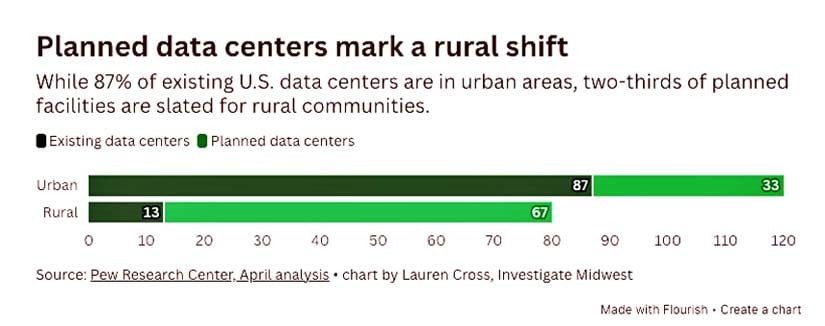
More than 1,500 data centers are planned across the country, according to the Pew Research Center. While 87% of existing U.S. data centers are in urban areas, two-thirds of planned facilities are slated for rural communities.
In a survey of 1,000 U.S. adults, rural residents expressed the highest average level of concern overall. Their greatest concern was rising electricity costs, followed by the use of agricultural land for data centers and overuse of water.
5. AI is expanding faster than regulations
Since 2013, the technology industry has invested more than $1.6 trillion in AI. In many cases, companies have relied on regulatory gaps or avoided traditional permitting requirements to speed up construction.
In Oklahoma, data centers do not need to apply for water permits because they typically buy water from municipal utilities. In Memphis, Tennessee, Elon Musk’s xAI installed nearly 20 natural gas turbines to power a data center without first obtaining air permits.
Originally published by Investigate Midwest.
Juan Vassallo covers agribusiness and the meat industry in Oklahoma for Investigate Midwest.