Login
Login
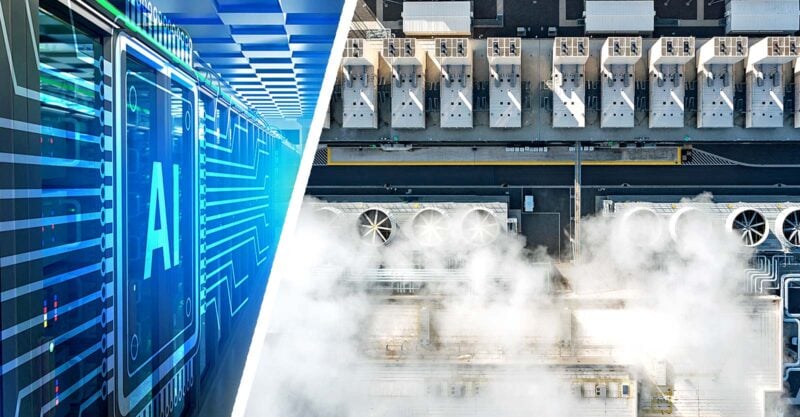


In the race to build infrastructure for artificial intelligence (AI), companies are constructing massive data centers that could have devastating consequences for the environment — all while sidestepping water pollution permits and exploiting air pollution permitting loopholes, according to separate investigations by Politico and Floodlight News.
Environmental advocates say regulatory changes and permitting strategies are letting projects move forward with minimal oversight and no input from the communities where they’re built.
A 2023 U.S. Supreme Court ruling eliminated federal permitting requirements — and with them, the public consultation those permits required — for many streams and wetlands that were previously protected, according to Politico.
A separate Floodlight investigation found that developers in Texas — where roughly 300 data centers already operate and 200 more are in development — have used “minor” air permits intended for small-scale polluters to build large-scale gas turbine and diesel generator operations with far less environmental review than the major permits they should be applying for would require.


The new regulatory landscape for data centers and waterways
The Clean Water Act requires federal water pollution permits for construction projects in areas under its jurisdiction. The permits regulate the amount of pollutants that can be discharged into a waterway and require the developer to conduct ongoing monitoring and reporting of all water pollution.
However, in May 2023, the Supreme Court ruled that the Clean Water Act extends only to wetlands that qualify as a “relatively permanent body of water” that has a continuous surface connection with “waters” of the U.S., defined as traditional interstate navigable waters.
As a result, many data centers that previously would have fallen under the U.S. Environmental Protection Agency’s (EPA) jurisdiction — and thus would have required permits — can now be built without those permits. This allows the projects to fill in or pollute streams and wetlands that were previously protected.
But even data centers built in areas that are protected under the law are getting rapid approval with minimal requirements, thanks to recent Trump administration mandates, according to Politico.
Rather than having site-specific reviews, many data centers can now apply for a “nationwide permit,” typically given to projects anticipated to have “minimal” impacts on waterways. The Trump administration opened AI data centers to this type of permitting earlier this year.
Environmental advocates have long opposed nationwide permits because they eliminate the requirements for any meaningful review of the potential impacts of an individual project.
Meta, Google, Amazon, QTS and DAMAC Digital, a subsidiary of DAMAC Group in Dubai, have recently received nationwide permits for data centers, according to Politico.
Politico found at least 26 data centers in the U.S. using streamlined water pollution permits for projects being built in sensitive streams and wetlands, and 27 that would previously have required permits — but no longer do, because they are now excluded from the EPA’s jurisdiction.
Cutting the public out of the process
Data centers in areas excluded from the Clean Water Act, or eligible for streamlined permits, are still subject to local regulations. However, they aren’t required to undergo the more stringent environmental review previously required by the EPA.
Part of that review required public consultation — without which, the public may never learn about a project until it is already under construction, making it impossible to mount a challenge.
For example, in Ohio’s Adams County, residents were organizing for a local moratorium on all new data centers. However, without their knowledge, the U.S. Army Corps of Engineers granted a permit for a massive Amazon data center.
“It’s not even about data centers anymore at this point,” local resident Nikki Gerber told Politico. “It’s like, what’s happening to our democracy and what’s happening to our right to clean water and clean air.”
In the past, applications for permits under the Clean Water Act often triggered the need for review under the National Environmental Policy Act, or NEPA. NEPA is the foundational environmental protection legislation that requires a substantial environmental assessment of a project’s environmental impacts and an outline of possible mitigation strategies before a project can move forward.
That means many data center projects are moving forward without any assessment of their possible environmental impacts — even though data centers are known to negatively affect water, air, land and human health.


This article was funded by critical thinkers like you.
The Defender is 100% reader-supported. No corporate sponsors. No paywalls. Our writers and editors rely on you to fund stories like this that mainstream media won’t write.
Data centers in Texas exploiting an air pollution loophole
Floodlight News found that in Texas, which is on track to become the nation’s leading data center market by 2030 — developers are exploiting regulatory loopholes to advance projects that emit harmful air pollution.
Rather than applying immediately for permits covering the full scale of planned emissions, some developers have moved their projects forward by first seeking “minor source” permits intended for smaller polluters like dry cleaners or gas stations. They do this by getting a permit for one piece of infrastructure at a time.
Major air permits include extensive environmental review — but the minor source permits generally involve less public review and fewer regulatory requirements.
The permits, along with nondisclosure agreements developers often require from municipalities and local residents, allow them to evade public scrutiny. Most people don’t find out that the centers will be built until construction begins.
One of the highest-profile examples is OpenAI’s Stargate project in Abilene, Texas.
Stargate obtained minor permits to operate on-site power sources, according to Floodlight. The company applied for a permit for a couple of turbines or generators at a time.
The investigation found that the complex strung together those minor source permits to install 10 gas turbines and 62 backup diesel generators, with plans to expand further by adding 41 more turbines and 18 more generators. If completed as planned, the facility could become one of the state’s largest gas-powered industrial operations.
Together, those new generators emit toxic gases associated with severe respiratory illness and premature death at levels more than triple those of the state’s newest coal-fired power plant.
If they had been forced to obtain the appropriate major permit for the Abilene campus, Stargate would have needed to go through a substantial environmental review and outfit the turbines with highly effective emissions-reduction technology.
According to the Floodlight investigation, at least 38 Texas data centers have used this approach while installing extensive natural gas turbines and diesel generators needed to power AI computing facilities.
Former regulators told Floodgate the move likely violates EPA policy. They also said that resolving the problem is not as simple as mandating the major permits: Even if Stargate were to get the major permit, the EPA is not equipped to enforce its requirements because the data center industry is expanding faster than the agency can process the permits, they said.
According to Floodlight, AI developers are attracted to Texas because its gas reserves and friendly government also allow for the development of massive fossil-fuel power plants needed to power the centers.
“You haven’t seen anything like that since the fracking boom,” Jenny Martos, a researcher at Global Energy Monitor, a nonprofit that tracks energy infrastructures worldwide, told Floodlight.
The gas plants will emit massive quantities of greenhouse gases. A recent analysis of project emissions from new gas plants tied to data centers in Texas estimated that nine of them could emit more than 130 million tons of greenhouse gases each year. Fifteen gas plants tied to data centers are planned.
Related articles in The Defender
- Watch: AI Data Centers ‘Spreading Like an Aggressive Cancer’
- Survey: Rural America More Concerned About Data Centers Than People Who Live in Cities or Suburbia
- ‘The New Enemy’: Noise Pollution From AI Data Centers Causing Nausea, Insomnia
- Will Maine Become First State to Block Data Centers?
- Noise, Heat, Depleted Water Reserves — How to Protect Your Town From Unwanted AI Data Centers