Login
Login
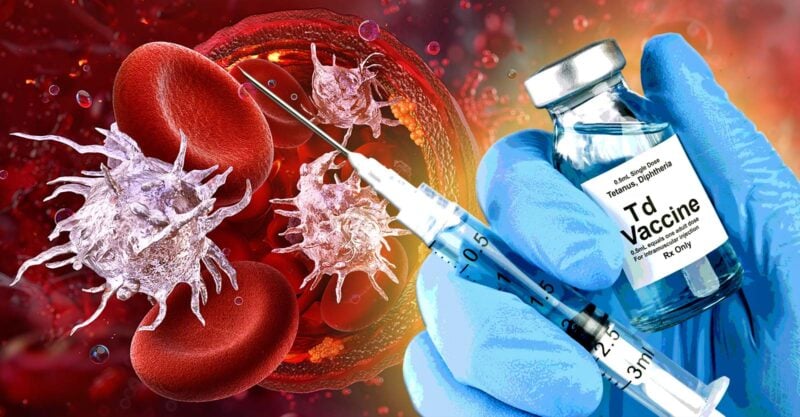


A new study linking the tetanus-diphtheria (Td) vaccine to a rare autoimmune disorder raises questions about the risk the vaccine may pose to adults.
The study, published Jan. 16 in Cureus, focuses on a single case study: a previously healthy 48-year-old woman who developed immune thrombocytopenia (ITP) one week after receiving the Td shot following a traumatic injury at home.
The woman was hospitalized twice within a month of receiving the vaccine to treat the vaccine injury.
ITP is a rare disorder that occurs when a low blood platelet count prevents the blood from clotting. People with ITP may bruise more easily, bleed more when they get bruised, or may start bleeding for no apparent reason.
For some people, ITP becomes a chronic condition.
“ITP occurs when the immune system is tricked into seeing platelets as a foreign invader, and destroys them,” said Karl Jablonowski, Ph.D., senior research scientist for Children’s Health Defense (CHD). “Platelets are how we stop from bleeding, and there is no redundant backup if we don’t have them.”
According to the researchers, prior research has shown that Td vaccines may, “in extremely rare cases,” cause ITP, primarily in children.
“Clinicians should be aware” that ITP “represents a very rare but potentially life-threatening adverse reaction,” the study authors wrote.
The Td vaccine is commonly administered as a booster dose for adults and teenagers every 10 years. It is also frequently given following injuries that pose a risk of infection.
Several other vaccines, including the flu, hepatitis B, herpes zoster and the Pfizer and Moderna mRNA COVID-19 vaccines, have also been linked to the onset of ITP.
“ITP can be triggered by any vaccine,” Jablonowski said. “The immune system is so complex. We can only comprehend its basics. Every vaccine meddles with that system in ways we cannot control nor anticipate.”
The study also noted that non-mRNA adenoviral COVID-19 vaccines, including Johnson & Johnson (Janssen) and AstraZeneca, were associated with a related condition, thrombotic thrombocytopenia. Thrombotic thrombocytopenia occurs when blood clots form in small blood vessels throughout the body.
Barbara Loe Fisher, co-founder and president of the National Vaccine Information Center, said the study “points out the shocking gaps in foundational scientific knowledge about the biological mechanisms of vaccine-induced immune dysfunction that can cause serious health outcomes like thrombocytopenia.”
Study highlights ‘difficulties’ in diagnosing and treating ITP in adults
The authors of the case study said their work highlights the “difficulties encountered in the diagnosis and treatment” of ITP in adults.
Other than her injury, the patient had an “unremarkable medical history” and had not previously received the Td vaccine. She underwent surgery and received the Td vaccine one day later.
One week after her vaccination, she developed “severe thrombocytopenia,” or a dangerously low platelet count, petechiae — small spots of bleeding — on her skin and “a sensation of tachycardia,” or an elevated heart rate.
Testing ruled out other causes of her injuries and other possible conditions. The patient’s condition improved after three to four weeks of treatment.

Vaccine safety studies have ‘not been made a research priority’
The 48-year-old woman’s injuries suggest the need for more research into a possible link between the Td vaccine and the onset of ITP in adults, the study authors said.
Vaccine-induced ITP from the Td booster shot “is a well-documented phenomenon in children yet rare among adults,” the researchers wrote.
They noted that there are only two published studies on the link between the Td vaccine and ITP in adults.
Fisher said the small number of studies on the possible Td vaccine-ITP link is part of a broader trend in which the scientific and medical communities have not prioritized studying vaccine safety.
“After two centuries of mandating the use of vaccines, studies examining the biological mechanisms for vaccine injury and death are almost non-existent — because it has not been made a research priority by those making, selling, regulating, promoting, administering and enforcing laws requiring use of vaccines,” Fisher said.
Fisher said that the Institute of Medicine — now known as the National Academy of Medicine — published reports in 1991, 1994 and 2012 warning of a potential link between several vaccines and the onset of thrombocytopenia.
The lack of research into the Td vaccine-ITP link in adults means we haven’t identified the possible mechanisms by which Td vaccination can cause ITP.
“Previous cases and current analysis of the literature suggest molecular mechanisms and genetic factors as probable causes for this outcome; however, detailed clinical history, together with environmental and clinical settings may allow for better characterization of this phenomenon,” the study authors wrote.
Jablonowski suggested that “the antibodies created to target the disease, as presented by the vaccine, bind to the person’s own platelets.” As a result, “those antibodies are tags for destruction, intended to flag the invading pathogen.”
The researchers noted that the link between several other vaccines and the onset of severe ITP “has been documented across a variety of vaccines, being COVID-19 the most recent and studied example.”
The researchers cited a peer-reviewed study published in 2011 in the journal Vaccine, on the case of a 15-month-old infant who developed ITP after receiving sequential doses of the measles-rubella, varicella (chickenpox) and mumps vaccines over four weeks.
This finding “is crucial for understanding that vaccine-induced ITP involves a distinct immunological component,” the study authors wrote.
According to Jablonowski, the 2011 study is “significant” because:
“The child was vaccinated with the measles and rubella vaccine at 12 months old, just like the current Centers for Disease Control and Prevention recommendation.
“At 15 months, the child developed thrombocytopenia symptoms, and 154 days after that onset, still presented with significant measles and rubella antibodies bound to platelets.
“It is a verified hazard of the measles and rubella vaccines currently administered in the U.S. to millions of children every year as the MMR.”
Several other studies have found an association between the measles-mumps-rubella or MMR vaccine and the onset of ITP in children.


This article was funded by critical thinkers like you.
The Defender is 100% reader-supported. No corporate sponsors. No paywalls. Our writers and editors rely on you to fund stories like this that mainstream media won’t write.
CHD Citizen Petition to the FDA seeks to raise awareness of vaccine injuries
Brian Hooker, Ph.D., CHD’s chief scientific officer, suggested that the 48-year-old woman’s case resembles that of Alexis Lorenze, who at 23 developed serious reactions, including temporary blindness, bruising, swelling and sores, all over her body. A California hospital required Lorenze to get the three vaccines before giving her a blood transfusion to treat paroxysmal nocturnal hemoglobinuria (PNH).
The tetanus shot was among the vaccines the hospital required Lorenze to receive, along with the meningitis (meningococcal) and pneumonia (pneumococcal) vaccines.
PNH is a rare autoimmune disorder that causes the immune system to attack and damage the body’s red blood cells.
Last month, CHD filed a Citizen Petition with the U.S. Food and Drug Administration (FDA), asking the FDA to revoke the licenses of the Pfizer-BioNTech and Moderna COVID-19 vaccines, in response to the public health risks posed by those vaccines and in an effort to raise public awareness of vaccine injuries.
Jablonowski said reports of thrombocytopenia filed with the U.S. government-run Vaccine Adverse Event Reporting System (VAERS) “were especially punctuated in 2021,” the first year that COVID-19 vaccines were widely available.
The number of VAERS reports filed was “nearly equivalent to the total number of reports over the previous 20 years,” Jablonowski said.
Related articles in The Defender
- CHD Asks FDA to Revoke COVID Vaccine Licenses, Calls on Public to Submit ‘Hundreds of Thousands’ of Comments
- Update on Alexis Lorenze, 23-Year-Old Severely Injured After Hospital Forced Her to Get 3 Vaccines
- Woman Died of Blood Disorder After J&J Vaccine. CDC Says the Disorder Is Rare — But Is It?
- Teen Hospitalized With Blood Clots in Brain After First Dose of Pfizer Vaccine
- Scientists Warn Pfizer, Moderna Vaccines May Cause Blood Clots, Too
- New Research Points to Link Between AstraZeneca Vaccine and Blood Clots