Login
Login
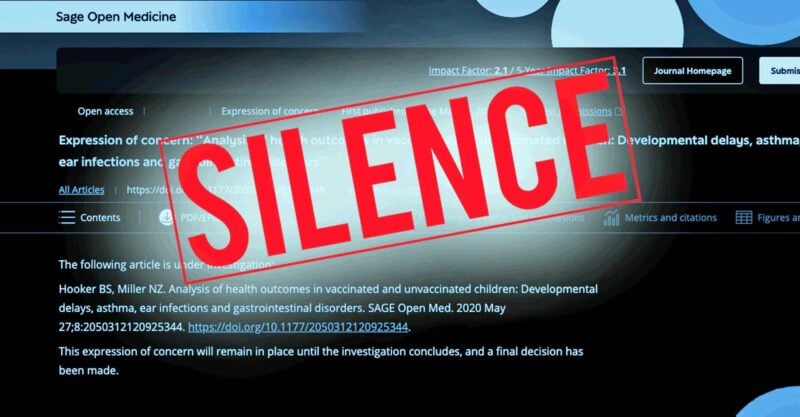


A scientific journal’s decision to flag a peer-reviewed study comparing health outcomes in vaccinated and unvaccinated children has ignited a debate over two online platforms that critics say have become tools for suppressing research that challenges mainstream vaccine science.
In April, the Research Integrity Team at Sage Journals notified Children’s Health Defense (CHD) Chief Scientific Officer Brian Hooker that it is investigating a 2020 article he co-authored with vaccine researcher Neil Miller comparing health outcomes between vaccinated and unvaccinated children.
The article, peer-reviewed and published in Sage Open Medicine, has been stamped with an “expression of concern” as Sage conducts its review.
According to Hooker, the investigation stems from conflict-of-interest allegations posted to the platform PubPeer by a handful of pro-pharma actors.
Hooker told Sage and The Defender that the allegations posted on PubPeer — that he and Miller used data from Dr. Paul Thomas’ Pediatric Health Outcomes Initiative without disclosing — aren’t true.
Hooker also said that even if they had used that data, he didn’t see why it would pose a conflict.
The attack on Hooker and Miller is one of the latest to come through PubPeer, a platform critics have nicknamed “PubSmear,” and another website, Retraction Watch.
The two platforms are the driving force behind many recent retractions of peer-reviewed scientific papers whose findings challenge the mainstream narrative on vaccines, COVID-19 treatments and aluminum, among others.


‘PubPeer posts take a fundamentalist attitude that is deeply unscientific’
PubPeer provides a platform for anonymous commenters — many of whom are single individuals with multiple usernames — to push for post-publication reviews of articles that have already passed peer review. The critiques are often combined with social media attacks to launch coordinated campaigns against individual researchers.
Retraction Watch reports on the retractions that result from those campaigns.
The two organizations share funders and board members.
Over the last two years, thousands of articles by renowned researchers have been attacked — many of them years, or even decades, after their initial publication.
PubPeer posters attacked Wafik El-Deiry, M.D., Ph.D., director of the Legorreta Cancer Center at Brown University — a physician-scientist and cancer researcher who has more than 30 years of experience studying the p53 tumor suppressor protein.
El-Deiry has published work that suggests a possible link between the COVID-19 vaccine and cancer.
They also targeted Dr. Sabine Hazan, a gastroenterologist and microbiome researcher and head of ProgenaBiome. Hazan’s research has contributed to the development of vaccines and antibiotics.
Two of her papers, published in BMC Cardiovascular Disorders and Gut Pathogens — both owned by Springer Nature — were recently retracted following complaints from PubPeer.
Both studies are related to clinical trials conducted by Hazan for the treatment and detection of COVID-19, TrialSite News reported.
Nobel Laureate Thomas Südhof’s Lab at Stanford Medicine launched an entire webpage and set of procedures to defend its publications against attacks posted on PubPeer.
The website states:
“Regrettably, PubPeer and other social media sites are non-transparent, censor responses, ‘flag’ as many papers as possible to force corrections and retractions, and use anonymous commentators.
“Moreover, PubPeer posts take a fundamentalist attitude that is deeply unscientific.”
COVID-19 researchers Jessica Rose, Ph.D., and Kevin McKernan, Ph.D., have also suffered what Rose called “relentless” attacks on PubPeer.
The platform was highlighted during a congressional hearing last week on the links between the COVID-19 vaccine and cancer. Doctors and scientists testified to Congress on how platforms like PubPeer have been instrumental in suppressing and discrediting evidence of any link between COVID-19 vaccines and cancer.
‘Vigilante science’
PubPeer was created as a nonprofit in 2012 to identify fraud and scientific misconduct.
Retraction Watch is a project of the Center for Scientific Integrity, another nonprofit whose mission is “to promote transparency and integrity in science and scientific publishing,” including by maintaining a database of retractions and expressions of concern.
Both are funded in part by billionaires Laura and John Arnold, through their foundation Arnold Ventures LLC.
PubPeer and Retraction Watch are also run by some of the same people. Journalist Ivan Oransky, executive director of the Center for Scientific Integrity, co-founded Retraction Watch and is a board member of the PubPeer Foundation.
Oransky publishes widely in mainstream outlets including The Washington Post, The Atlantic, Nature and Science, amplifying claims of alleged fraud flagged by PubPeer and Retraction Watch.
The Science Guardians Substack, which has extensively tracked how PubPeer and other organizations “conspired to manipulate science, rewrite reputations, and seize control of truth itself,” also links the Arnolds to two other organizations: Leonid Schneider’s For Better Science and Elisabeth Bik’s Science Integrity Digest, both of which amplify attacks made by anonymous commenters on PubPeer.
Bik also posts extensively on PubPeer.
The goal of the coordinated attack is to control academic science and shape scientific narratives, according to Science Guardians. To do this, a small group of individuals allegedly uses hundreds of fraudulent aliases to build dossiers to directly target dissenting scientists.
The group uses PubPeer to level accusations against published papers. Then, public figures, who are also PubPeer posters themselves, use their blogs to amplify the accusations, often engaging in personal smears and attacks.
Bik then repeats those accusations on her website. Then Retraction Watch writes it up as a story that can be disseminated for wider distribution in the media.
🚨BOMBSHELL SCIENCE INTEGRITY SCANDAL – 17 NOV 2025
Elisabeth M. Bik – the fake “science integrity consultant” who brags about >10,000 PubPeer comments – has spent years stalking, smearing, and destroying careers of researchers she targets.
But dare post a single critical… pic.twitter.com/9lr8tvVR0G
— ScienceGuardians (@SciGuardians) November 17, 2025
‘PubPeer is about policing, not discussion’
Bik is a “science integrity volunteer and consultant” at Stanford University. Targeted scientists allege that she incessantly publicly attacks them in an attempt to discredit them.
Meanwhile, a Science Guardians analysis has found Bik’s own work to be riddled with issues that merit retractions.
Bik posts both publicly and with aliases on PubPeer. However, most of her posts are anonymous.
Michael Blatt, editor-in-chief of Plant Physiology, cited concerns about the anonymous posting as early as 2015, noting that the posts are largely negative, often malicious and non-transparent.
“The self-assumed role of PubPeer is about policing, not discussion,” he wrote, and results in “vigilante science.”
An investigation by The Analytical Scientist found that just three people are responsible for over 52,000 entries on PubPeer — nearly a quarter of all postings on the platform. One of those individuals is reportedly a financial adviser with no scientific background.
PubPeer anonymous commentator Smut Clyde has been identified as psychologist David Bimler. Nature wrote an article celebrating Bimler, who said he used a “‘porn name’ generator” to create his pseudonym, under which he has made thousands of PubPeer posts.
Clyde said he likes “the mystique” of posting anonymously, and that critiques of science should not depend on credentials or qualifications.
Bik and Schneider both promote his posts.
Targeted scientists have a different take on anonymity on PubPeer.
“Unfortunately, the platform increasingly became weaponized against researchers whose findings challenged prevailing narratives,” El-Deiry told the congressional panel in a hearing last week.
“The platform permits anonymous accusations, without meaningful accountability. There’s no disclosure of conflicts of interest, no statute of limitations or citizenship requirements. These attacks are public, amplified through social media, and can continue indefinitely regardless of whether wrongdoing is even established.”
El-Deiry said that because of the sustained attacks, he remains in effect, “guilty until proven innocent.”


PubPeer targets minor errors, pushing for retractions
Scientists report that critics posting on PubPeer typically target minor errors that could be easily corrected and do not alter the underlying results or conclusions of the paper.
Blatt noted that most comments on PubPeer “relate to small errors and oversights, not the stuff of misconduct.” They focus on “the most petty kind of scientific criticism,” minor details — such as data presentation — that contribute to the development of scientific ideas, but not to the ideas themselves.
Stanford’s Südhof Lab analyzed all of the accusations lodged by PubPeer commenters and found that most errors are copy-paste mistakes or image aberrations. But commenters use them as the basis for fraud accusations and a call for retraction “although there is no reason to doubt the conclusions of the paper.”
Hazan’s team similarly reported that a clarification could have addressed the concerns raised about her paper, none of which were serious enough to warrant retraction.
In the case of Hooker’s paper, PubPeer raised concerns that the authors allegedly used data from Dr. Paul Thomas’ Pediatric Health Outcomes Initiative without disclosing that information.
PubPeer said there was a conflict of interest because Thomas had published another paper, later retracted, that used data from that cohort as well.
Similar to other PubPeer challenges, the accusation did not suggest that the data were compromised or that the conclusions were incorrect. Instead, they noted that the paper by Hooker and Miller, Thomas’ paper, and a third paper, also by Hooker and Miller, were “three of the most heavily downloaded papers for these journals — in the hundreds of thousands.”
“It is reasonable to assert that the main assertion of these papers (unvaccinated healthier than vaccinated) has played an important role in driving down vaccination rates in the US these last 4 years,” wrote an anonymous poster.
Hooker told The Defender he sees the coordinated attacks by PubPeer, Retraction Watch, and others as “a ‘Hail Mary’ pass by the losing team at the end of a football game. They know their days are numbered but they’re going to try to inflict as many casualties on their way out of blind power and abuse of science.”
Related articles in The Defender
- Sen. Ron Johnson: There Used to Be ‘Serious Journalism’ on Vaccine Injuries — But COVID Vaccine Cancer Risks Still Being Suppressed
- ‘Uncharted Territories’: Biologist Warns of Unknown Risks of COVID Vaccine DNA Contamination
- Groundbreaking Study Shows Unvaccinated Children Are Healthier Than Vaccinated Children