

 Login
Login
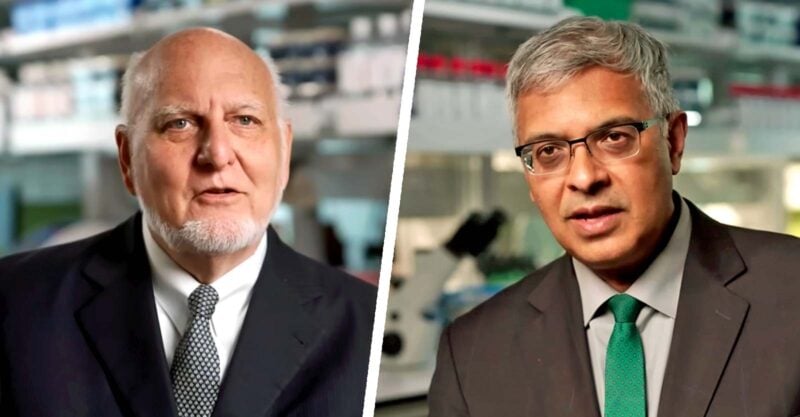


One of the most troubling legacies of the COVID-19 pandemic isn’t the virus itself — it’s the unprecedented suppression of debate that accompanied the public health response, according to National Institutes of Health (NIH) Director Jay Bhattacharya.
“The fact that it happened in this country where I’d never thought I would ever see suppression of free speech, and in such an insidious way behind closed doors where people didn’t even know they were being censored … still shocks me,” Bhattacharya said in a recent Wall Street Journal (WSJ) Opinion video, “The Lockdown Dissidents.”
Five years after the pandemic, a growing body of documents, court filings, internal communications, congressional investigations and whistleblower accounts has drawn attention to how scientists, physicians, journalists and ordinary citizens who challenged prevailing COVID-19 policies were disparaged and silenced.
Many faced censorship, professional retaliation, threats and exclusion from public debate.
The WSJ Opinion film follows Bhattacharya, former White House adviser Dr. Scott Atlas, former Centers for Disease Control and Prevention Director Robert Redfield and others who “opposed lockdowns and suffered the consequences.”
“If you don’t have free speech, you cannot have science,” Bhattacharya said. “Science depends on the ability for scientists to freely speak their minds.”
For Bhattacharya, the story has come full circle.
Once branded a fringe voice for challenging lockdowns and mandates, Bhattacharya now leads the NIH. Reflecting on his U.S. Senate confirmation, he noted the irony of his appointment.
“The previous NIH director tried to destroy me,” he said in a clip aired in the WSJ video. “If you’re writing a novel, this would be a hokey ending.”


‘It’s unethical … to use fear in an emergency to manipulate people’
The lockdown strategy that swept much of the world in 2020 emerged partly in response to dramatic images from China. WSJ clips show authorities in Wuhan sealing apartment buildings, building quarantine facilities and imposing sweeping restrictions on millions of residents.
“That experience in January 2020 in China misled the public health officials everywhere into thinking that the lockdowns were a way … to eradicate the disease,” Bhattacharya said.
In the U.S., public health leaders quickly embraced lockdowns, social distancing and masking as primary tools for controlling the virus.
At one point, then-director of the National Institute of Allergy and Infectious Diseases Anthony Fauci told Americans, “If it looks like you’re overreacting, you’re probably doing the right thing.”
Atlas recalled Fauci privately expressing frustration that more Americans weren’t complying with pandemic restrictions.
“The people are not afraid enough, so they won’t listen,” Atlas said Fauci told him.
Atlas criticized that approach in an interview with WSJ Opinion.
“That’s not the way public health is supposed to be done,” he said. “It’s unethical, in my opinion, to use fear in an emergency to manipulate people.”
At the same time, government officials and media outlets frequently cited worst-case projections forecasting millions of deaths if aggressive lockdowns were ignored.
Bhattacharya was unconvinced. Rather than relying primarily on predictive models, he turned to “data from actual people, not just models.”
In early April 2020, he and his colleagues studied residents in California’s Santa Clara County to determine how many people had already been infected with COVID-19. Their findings suggested the virus was far more widespread — and less deadly overall — than many policymakers believed.
Similar studies soon emerged around the world.
Yet journalist David Zweig told WSJ Opinion that few media outlets were interested in reporting evidence showing that lockdowns and widespread fear were unnecessary.
“I thought this would be on the front pages of every newspaper. This would be on every cable news network. This was the news we were waiting for,” Zweig said.
Instead, many outlets continued focusing on worst-case scenarios, rising death counts and the need for strict public compliance.
“Over and over again in these large features in The New York Times and other prestigious media outlets, there was zero questioning of what they were being told by health authorities,” Zweig said.
‘World’s public health establishments … decided that we were anathema’
The conflict reached a turning point in October 2020.
Bhattacharya joined Harvard epidemiologist Martin Kulldorff, Ph.D., and Oxford epidemiologist Sunetra Gupta, Ph.D., in drafting the Great Barrington Declaration, which called for protecting people most at risk from COVID-19 while ending widespread lockdowns.
“The harms of the closures was more damaging to the health and well-being of young people than the protection that those lockdowns afforded,” Bhattacharya said.
Nearly one million people eventually signed the declaration, but the pushback from public health leadership was swift.
He said former NIH Director Francis Collins called for a “devastating takedown” of the declaration and its authors.
For critics of the pandemic response, that phrase became a symbol of something larger: an effort to silence dissenting scientists rather than engage their arguments.
According to Redfield, government agencies, scientific journals, media organizations and social media platforms all played roles in suppressing alternative viewpoints.
Bhattacharya told WSJ Opinion that the backlash included censorship, professional attacks, public vilification and threats.
“It was as if the entirety of the world’s public health establishments and medicine decided that we were anathema,” he said.
Atlas said the consequences extended well beyond a handful of public figures.
“Cancel culture is effective,” he said. “In fact, I had hundreds of emails from scientists all over the country saying, ‘Scott, you’re 100% right. We agree, but we’re not going to speak. We’re afraid for ourselves and our families.’”
Critics say the result was a chilling effect throughout the scientific community, discouraging open debate during one of the most consequential public health crises in modern history.
‘They weaponized government’
The censorship debate expanded beyond academic circles, with the Biden administration intensifying efforts to control discussions surrounding COVID-19, according to Bhattacharya.
He told WSJ Opinion:
“They weaponized government, aiming to control the speech around the treatment for COVID, the effectiveness of lockdowns, the harms of lockdowns, school closures, masks, you name it. High government officials, including inside the White House itself, would go to social media companies and threaten them, telling the social media companies who and what to censor.”
Social media companies faced intense pressure from government officials, Bhattacharya said. He pointed to comments by former President Joe Biden in July 2021, when asked about Facebook’s handling of COVID-19-related content.
“They’re killing people,” Biden said. “Look, the only pandemic we have is among the unvaccinated. And they’re killing people.”
Government officials publicly blamed social media platforms for pandemic deaths while simultaneously urging them to police COVID-19-related speech, according to Bhattacharya. Under such pressure, “it’s almost impossible for these social media companies to resist,” he said.
The issue gained new attention after the publication of the “Twitter Files,” which documented communications between government officials and social media platforms over content moderation during the pandemic.
The debate also extended to individuals identified by the Center for Countering Digital Hate’s “Disinformation Dozen” report in 2021. The list of “leading online anti-vaxxers” was frequently cited by policymakers and media outlets as social media companies increased enforcement against COVID-19-related “misinformation.”
Many of those targeted told The Defender in March that they continue to face restrictions, personal attacks and professional consequences years later.


This article was funded by critical thinkers like you.
The Defender is 100% reader-supported. No corporate sponsors. No paywalls. Our writers and editors rely on you to fund stories like this that mainstream media won’t write.
‘My greatest fear is that we didn’t learn the lessons from COVID’
As additional emails, government records and internal communications continue to emerge, debates over censorship, scientific dissent and government transparency remain unresolved.
Recently released materials from Sen. Rand Paul’s (R-Ky.) ongoing investigation included a 2021 U.S. intelligence report that has reignited debate about the origins of COVID-19 and questions surrounding vaccine effectiveness.
Meanwhile, U.S. Senate hearings chaired by Sen. Ron Johnson (R-Wis.) have examined allegations that research involving vaccine safety, adverse events and potential cancer-related concerns has faced resistance, suppression and attacks.
Supporters of those hearings argue that scientists raising uncomfortable questions deserve scrutiny and debate — not censorship.
Many also argue that censorship didn’t disappear after COVID-19.
In April, authors of a peer-reviewed study comparing health outcomes among vaccinated and unvaccinated children were notified that their work was under investigation.
Last week, U.S. Health Secretary Robert F. Kennedy Jr. demanded the editors of Toxicology Reports explain why the study was under investigation.
Critics described the complaints as part of a broader pattern aimed at discrediting researchers who challenge mainstream assumptions.
I sent this letter to the Editor-in-Chief of Toxicology Reports demanding a full explanation for the removal of a published article examining vaccines and sudden infant death.
Americans have a right to know why scientific papers are removed, who made those decisions, what… pic.twitter.com/RJnEATE8ri
— Secretary Kennedy (@SecKennedy) June 15, 2026
Others point to ongoing disputes over acknowledging vaccine injuries. Families and advocates argue that individuals reporting serious adverse events continue to struggle for acknowledgment and support.
Meanwhile, physicians and experts say medical school students receive little, if any, training on vaccines, vaccine-related adverse events and how to treat vaccine injuries.
For scientists who faced backlash for speaking out against lockdowns, the danger extends far beyond COVID-19.
“My greatest fear is that we didn’t learn the lessons from COVID,” Atlas said, adding that the lesson is about much more than any specific virus. He told WSJ Opinion:
“We’re a country founded on freedom. We are the world’s beacon of freedom. We have codified freedom of assembly, freedom of speech, freedom of worship. And we broke all of those guaranteed freedoms. And if freedoms can be taken away during any scenario, including emergency, then they’re not guaranteed freedoms.”
Watch the WSJ Opinion video here:
Related articles in The Defender
- Smoking Gun? Documents Suggest Fauci Knew COVID Was Created in Wuhan Lab, and mRNA Vaccines Wouldn’t Work
- The ‘Disinformation Dozen’: Targeted by Government, Maligned by Media. Where Are They Today?
- Sen. Ron Johnson: There Used to Be ‘Serious Journalism’ on Vaccine Injuries — But COVID Vaccine Cancer Risks Still Being Suppressed
- ‘Vigilante Science’: How Anonymous Critics Are Trying to Silence Peer-Reviewed Vaccine Research
- Confirmed: Bhattacharya to Lead NIH, Makary Wins Top FDA Post
- Mandating COVID Shots ‘One of the Greatest Mistakes,’ Former CDC Chief Says
