Login
Login
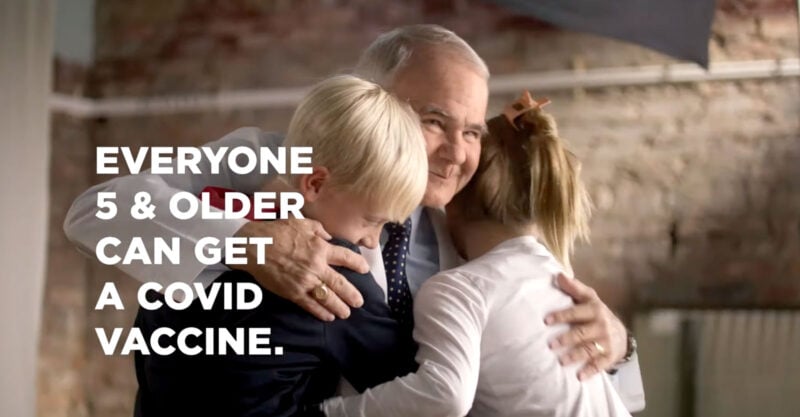


The Biden administration last week launched an advertising campaign urging parents to vaccinate their young children against COVID.
The campaign, funded by taxpayers through the U.S. Department of Health and Human Services, features emotional pleas from leaders of some of America’s largest professional healthcare associations.
The ads — a pair of 60-second spots titled “Oath” and “Trust” — were posted to social media March 18, and are scheduled to appear on TV screens beginning this week.
“You can trust us” is the underlying message of the campaign, which relies heavily on professional credibility and emotional appeal — rather than data — to make the case for childhood COVID vaccination.
The healthcare professionals offer heartfelt testimonials implying that because they trust the vaccines for their kids and grandkids, so should the viewer.
In one spot, the three doctors and one nurse state:
“COVID vaccines are safe and effective for kids … What’s not safe is getting COVID. So we want you to know we trust the COVID vaccine or ourselves, for our patients, for our kids. So should you.”
The ads also point out that some of the doctors are grandparents.
There is no mention in any of the ads of the potential risk of injuries or death associated with the vaccines.
Emotional claims versus factual data
One of the few factual claims used in the ads to support vaccination in pre-teens references raw case numbers:
“We know that millions of cases of COVID have been in kids … in kids … in kids,” says a chorus of three of the healthcare professionals.
While this statistical reference may technically be correct, it also may not give an accurate picture of the risks for children. That’s because the data on cases don’t differentiate between asymptomatic or mild cases and those that involved serious infection or hospitalization in children.
At the height of the Omicron surge, Professor Mark Woolhouse, an infectious disease expert at Edinburgh University, Edinburgh, Scotland, told The Guardian:
“This is a very discriminatory virus. Some people are much more at risk from it than others. People over 75 are an astonishing 10,000 times more at risk than those who are under 15.”
Research shows many cases of COVID in pre-teen groups are asymptomatic and the vast majority of children experience nothing more than mild symptoms.
Perhaps because of this, many parents have chosen not to vaccinate their young children. More than four months after the Centers for Disease Control and Prevention (CDC) first recommended the vaccine for children as young as 5, just upwards of a quarter of kids 5 to 11 have received both shots. Close to two-thirds of children 12 to 17 years old are “fully vaccinated.”
The latest data from CDC surveys show 33% of parents of children aged 5 to 11 said they would “probably [not] or definitely will not” vaccinate their children against COVID. Another 26% said they would probably get their children vaccinated or were still unsure.


Benefits don’t outweigh risks, data show
According to COVID-NET data, as of the end of 2021, the weekly rate of COVID-associated hospitalization in the 5 to 11 age group ranged from zero to a peak of 1.1 per 100,000.
However, as The Defender reported Monday, the CDC on March 14 removed from its data tracker website tens of thousands of deaths linked to COVID-19, including nearly a quarter of the deaths it had attributed to children.
In a statement to Reuters, the CDC said it made adjustments to the mortality data because its algorithm was “accidentally counting deaths that were not COVID-19-related.”
“Data on deaths were adjusted after resolving a coding logic error,” the CDC’s website states. “This resulted in decreased death counts across all demographic categories.”
At the time of the U.S. Food and Drug Administration’s (FDA) December 2021 risk-benefit assessment, used to recommend the vaccine for children 5 to 11, the overall weekly average COVID-associated hospitalization rate for this age group was approximately 0.4 per 100,000 children.
Before the CDC made its adjustments to COVID mortality rates, the total number of COVID hospitalizations for children under 18 in 2021 was 2,100. The total number of COVID-related hospitalizations for children under 5 was 920.
By comparison, the CDC reports that on average 58,000 children younger than 5 are hospitalized each year with respiratory syncytial virus.
The CDC also published a study on March 11 in its Morbidity and Mortality Weekly Report estimating that two shots of the Pfizer vaccine were only 31% effective against Omicron variant infections in children ages 5 to 11 in an analysis of data from July 2021 to February 2022.
This followed a study released February 28 that found the Pfizer vaccine was only 12% effective against Omicron in children 5 to 11 and adolescents 12 to 17 in an analysis of data from Dec. 13, 2021, to Jan. 30, 2022.
Despite the low numbers, there remains a strong push for the FDA to authorize COVID vaccines for the last remaining age group: infants and preschoolers.
Originally, Pfizer had expected to submit its authorization request for this group to the FDA as early as last month, but then delayed it until next month due to initial results showing no clear benefit for this group.
The lack of evidence proving the vaccines are of more benefit than risk was underscored by Pfizer’s latest trial for children 5 to 11, in which both the vaccinated and the placebo groups showed no incidents of hospitalization or death.
Last week, Florida followed Norway in recommending against COVID vaccines for young children.