Login
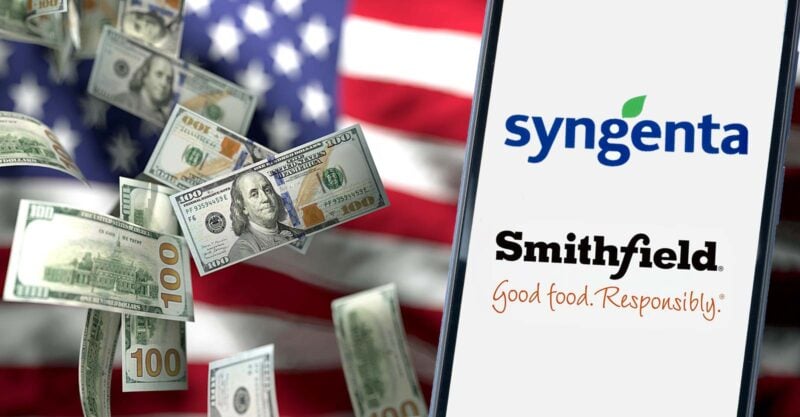


Two Chinese-owned agribusiness giants spent more than $24 million lobbying the federal government and nearly $2.5 million on political contributions while pushing industry-friendly policies on pesticides, food safety and American farmland, according to a new report.
The 31-page investigation by the Center for Responsible Food Business (CRFB) — “Pork, Pesticides, and the CCP: How China Buys Influence Over U.S. Farm Policy” — alleges that pesticide manufacturer Syngenta and pork producer Smithfield Foods repeatedly failed to disclose their Chinese ownership interests in federal lobbying reports.
“With help from lawmakers in both parties, China-owned Smithfield Foods and Syngenta want to block consumers’, neighbors’ and voters’ right to hold them accountable for poisonous pesticides and polluting factory farms,” Taylor Warren, president of the CRFB, told The Defender.
The report released today found that 139 current members of Congress received and retained political contributions from the companies’ political action committees (PACs).
At least 39 received money from both companies, including lawmakers responsible for legislation affecting pesticide regulation, agricultural production and food safety.
Among them were the Republican chairmen of the U.S. House of Representatives and U.S. Senate agriculture committees, who oversee legislation directly affecting Syngenta’s and Smithfield’s business interests.
The findings raise alarms for President Donald Trump’s Make America Healthy Again (MAHA) agenda, which promised to address environmental toxins and other potential contributors to chronic disease among American children.
“The MAHA movement is fighting to clean up our food, our water and our kids’ health,” Warren said. “CRFB’s new report exposes how China-owned Smithfield Foods and Syngenta are spending big in Washington to stop it.”

MAHA removed atrazine from agenda after Syngenta donation to Trump
The report highlights Syngenta’s atrazine, a widely used herbicide associated with endocrine disruption, cancer and drinking-water contamination.
Before he joined the Trump administration, U.S. Health Secretary Robert F. Kennedy Jr. was an outspoken critic of atrazine. Since then, MAHA has targeted the pesticide.
In a 2023 interview, Kennedy criticized atrazine’s endocrine-disrupting effects, citing research involving male frogs.
In 2025, the World Health Organization’s International Agency for Research on Cancer classified atrazine as probably carcinogenic to humans.
The U.S. Environmental Protection Agency (EPA) has identified potential exposure risks for children playing on treated lawns and workers handling the chemical.
A September analysis by the Center for Biological Diversity found atrazine contamination at concentrations considered harmful to aquatic wildlife in approximately 860,000 miles of rivers across the continental U.S.
According to the report released today, Syngenta donated $250,000 to Trump’s inaugural committee before his administration removed explicit references to the company’s atrazine from its final MAHA strategy and approved two new Syngenta pesticides that critics classify as “forever chemicals.”
The Trump administration’s initial MAHA assessment, released in May 2025, identified atrazine among chemical exposures of concern for children’s health.
Over the following quarter, Syngenta more than doubled its in-house lobbying expenditures to $420,000 and hired another firm to lobby the White House and federal agencies, according to CRFB.
The administration’s final MAHA strategy, released in September 2025, omitted atrazine by name.
In November 2025, the EPA also approved two Syngenta pesticides, cyclobutrifluram and isocycloseram, that environmental critics classify as per- and polyfluoroalkyl substances, or PFAS, commonly called “forever chemicals.”
The EPA could not be reached for comment.
The U.S. Department of Health and Human Services said in a statement:
“Secretary Kennedy came to Washington to challenge the special interests that have shaped federal health policy for decades. The Trump Administration does not let outside interests dictate decisions about Americans’ health.”


This article was funded by critical thinkers like you.
The Defender is 100% reader-supported. No corporate sponsors. No paywalls. Our writers and editors rely on you to fund stories like this that mainstream media won’t write.
Smithfield and Syngenta failed to disclose Chinese ownership while lobbying
Syngenta, one of the world’s largest pesticide manufacturers, was acquired in 2017 by Chinese state-owned ChemChina for approximately $43 billion. It is now owned through Sinochem Holdings, another Chinese state-owned enterprise.
Smithfield, the nation’s largest pork producer, was acquired in 2013 by the company now known as WH Group.
Since their acquisitions, the companies have spent a combined $24.2 million lobbying Congress and federal agencies, including $15.2 million by Smithfield and $9 million reported by Syngenta. They gave an additional $1.7 million to federal candidates, PACs and party committees and $530,000 to state candidates, according to the CRFB report.
The investigation identified lawmakers who received contributions from Syngenta’s PAC and subsequently challenged tighter EPA restrictions on atrazine.
Rep. Tracey Mann (R-Kan.) received $17,000 from Syngenta’s PAC after its Chinese acquisition. Reps. Randy Feenstra (R-Iowa) and Zach Nunn (R-Iowa) received $18,000 and $17,500.
All three supported a 2023 congressional letter challenging aspects of the EPA’s atrazine review.
House Agriculture Committee Chairman Glenn “GT” Thompson (R-Pa.) received $28,500 from Syngenta’s PAC and $3,500 from Smithfield’s PAC, according to CRFB.
Senate Agriculture Committee Chairman John Boozman (R-Ark.) received $25,000 from Syngenta and $7,000 from Smithfield.
None of the lawmakers could immediately be reached for comment.
Federal law generally permits political contributions from properly structured PACs affiliated with U.S. subsidiaries of foreign-owned companies, subject to restrictions on foreign-national participation.
The report alleges that the companies failed to properly disclose their Chinese ownership interests while lobbying on issues affecting their businesses.
Smithfield’s lobbyists omitted WH Group’s interest from 29 consecutive quarterly lobbying reports beginning in 2019, according to CRFB.
Syngenta’s lobbying reports similarly left foreign-interest disclosures blank beginning in at least 2017, the investigation found.
Neither company responded to requests from The Defender for comment.
Related articles in The Defender
- MAHA Report Falls Short on Pesticides, Experts Say
- RFK Jr.: MAHA Report a ‘Clarion Call’ to End the Chronic Disease Epidemic
- Pesticide-Spraying Trucks Cruising Neighborhoods, Helicopters Raining Down Pellets: Mosquito Control Is a $2 Billion Business in the U.S.
- For Millions of Kids, Back to School Means Back to Pesticide Exposure
- 6 Children in 1 Town Developed Rare Cancer. After Teen Dies, Families Demand Answers About Routine Use of Pesticides
- ‘Deceptively Toxic’: How Regulators, Chemical Companies Get Away With Calling Glyphosate ‘Safe’