Login
Login


Florida mother Heather Ray heard a low-flying helicopter, looked out the window and saw it dropping small pellets onto her yard, cars, deck and on her daughter, who was playing outside.
The pellets contained a pesticide designed to kill mosquito larvae, routinely dropped across the region of the Florida Keys where Ray lives. Fog trucks also regularly drive through the streets spraying adulticides — pesticides that target adult mosquitoes when populations are high.
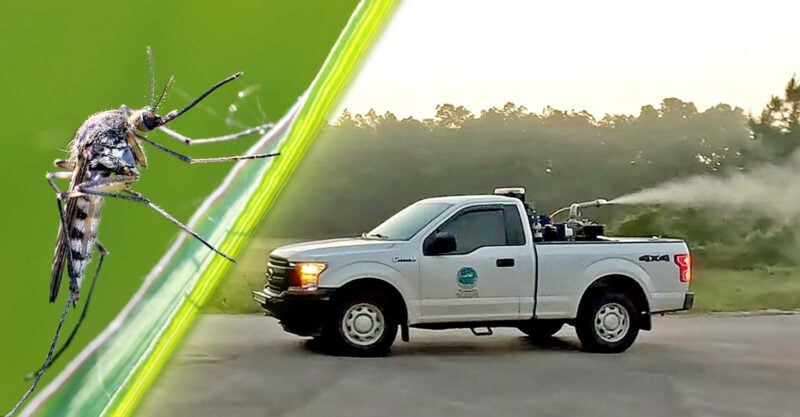
Over 700 miles away in Okaloosa County in the Florida Panhandle, The Defender’s Jennifer O’Brien sees a mosquito spray truck come by weekly, spraying Kontrol 4-4, a permethrin-based insecticide — the most commonly used chemical for mosquito control in the U.S. It is banned in Europe.
Both women asked their local mosquito control departments to exclude their homes from spraying. Ray, a member of the Children’s Health Defense Science Department, said pellets still fall regularly despite assurances her house would be part of a “no-fly zone.”
O’Brien was told there is “no opt-out option,” but people with chemical sensitivities can register to be notified before spraying. After she spoke with the local mosquito control department again, it agreed to skip her house.
O’Brien said having her house skipped was a small win, “but it is in the air all around us.”
Carolyn McCuan, co-founder of California advocacy group Toxic-Free OC, told The Defender that most communities don’t even know that this kind of spraying happens. Once they find out, she said, “the vast majority are opposed” — they support other, more holistic forms of pest control.
Who profits from the spraying? The global mosquito control market is estimated at $7.24 billion globally in 2026, approaching $2 billion — and growing — in the U.S.
Companies supplying U.S. mosquito-control agencies range from specialized manufacturers to some of the world’s largest pesticide companies. They generally don’t publicly report annual revenues from their mosquito control products.
Major manufacturers include pesticide giants like BASF SE and Syngenta, and Envu, the former Bayer Environmental Science business that Bayer sold to the private equity firm Cinven in 2022.
Is the cure worse than the disease?
For decades, health departments across the country have sprayed pesticides to curb vector-borne diseases. Vectors are living organisms, such as ticks and mosquitoes, that can transmit infectious pathogens between humans or from animals to humans.
But the spraying itself creates risks for wildlife, the environment and humans — especially children whose immune systems aren’t yet fully developed.
The pesticides typically target all mosquitoes — about 200 species in the U.S. — to control the few that can actually carry vector-borne diseases, called arboviruses.
In the Florida Keys, where Ray lives, pesticides target mosquitoes that carry yellow fever, Zika, chikungunya and dengue — diseases that are “extremely rare” in the U.S.
Elsewhere, most spraying targets West Nile virus — the most common mosquito-borne illness in the U.S., with roughly 2,000 cases reported annually.
Most people infected with West Nile virus remain asymptomatic, though about 20% develop a flu-like illness. Fewer than 1% develop serious neurological disease. However, the risk of severe illness increases with age and certain underlying conditions.
Spraying as it’s done today can also make the entire country more vulnerable to more disease outbreaks and insecticide resistance, according to the Journal of Medical Entomology, because mosquitoes have a short life cycle and rapidly mutate to become pesticide-resistant.
Mosquito control programs affect about 600 million acres in U.S.
Large-scale chemical mosquito control in the U.S. dates to the 1940s, after scientists identified DDT as a powerful insecticide. Widespread use helped establish chemical spraying as a central tool for controlling disease-carrying insects.
But growing concerns about DDT’s effects on human health and the environment eventually led regulators in the early 1970s to restrict use of the chemical.
Mosquito-control programs subsequently shifted toward what is now known as integrated pest management, or IPM. The approach combines mosquito and disease surveillance, elimination of breeding sites, biological controls and targeted pesticide applications, along with monitoring for insecticide resistance.
A 2026 industry survey by Kline & Company found there are 400 to 500 large vector control districts — which can cover towns, cities or counties — and an additional 1,000 to 2,000 smaller health departments and municipal agencies carrying out mosquito control operations on an estimated 600 million acres of land — more than a quarter of all land in the U.S. — most commonly in the South.
“Good mosquito control involves balancing all of the various risks. The objective is not simply to minimize pesticide use regardless of circumstances, nor is it to spray routinely without justification,” Daniel Markowski, Ph.D., technical adviser at the American Mosquito Control Association, told The Defender.
In integrated pest management, spraying is only one tool — and should be used when surveillance indicates it is necessary. However, in practice, most local programs continue to rely heavily on routine pesticide applications.
Mosquito control programs, typically run by local government agencies that manage pests in local regions, are piecemeal and decentralized.
In 2017, a National Association of County Health Officials assessment funded by the Centers for Disease Control and Prevention (CDC) surveyed nearly 2,000 of these publicly funded mosquito control programs.
The assessment concluded that 98% of surveyed vector control programs lacked basic pesticide-resistance training, and most applied chemicals were based on historical practices or citizens’ complaints — not the data-based approach recommended by integrated pest management.
A follow-up survey in 2020 found improvement in local mosquito surveillance and control capacity, and then a 2023 assessment noted another decline in that capacity.
Federal support for local programs ebbs and flows with disease outbreaks, contributing to the inconsistency of the programs. And coordination across federal and local agencies is nearly nonexistent.
Repeated spraying increases risks, especially for pregnant women and kids
Mosquito abatement programs vary, but most districts typically use two types of pesticides: larvicides, which target mosquitoes before they become adults, and adulticides, which kill adult mosquitoes.
Common larvicides include Bti, Lysinibacillus sphaericus, and methoprene, among others. Adulticides include synthetic pyrethroids such as permethrin, resmethrin and sumithrin, as well as organophosphates such as malathion and naled.
Health and environmental risks vary by chemical, dose and route of exposure. The U.S. Environmental Protection Agency and mosquito-control agencies maintain that pesticides are safe when used according to their labels and applicable regulations.
Critics counter that pesticides are designed to kill living organisms and that repeated, broad-area spraying can unnecessarily expose people and wildlife, particularly in communities where spraying occurs frequently.
Children and pregnant women can be more vulnerable to pesticide exposure. Organophosphates can affect the nervous system and, at sufficiently high exposures, can cause acute poisoning.
Synthetic pyrethroids generally pose lower acute toxicity risks to humans but can cause skin and eye irritation and respiratory symptoms. Research suggests longer-term exposure to the chemicals may be linked to endocrine disruption and breast cancer.
Some pesticides highly toxic to bees, others to fish
The potential impacts extend beyond human health. Many mosquito-control pesticides are toxic to aquatic organisms, bees and other beneficial insects.
Naled, for example, is highly toxic to honey bees and aquatic invertebrates, while synthetic pyrethroids can be toxic to aquatic life, according to labels.
Broad spraying can also kill insects that prey on mosquitoes, including dragonflies, potentially disrupting ecological controls that naturally help regulate mosquito populations.
These concerns are particularly relevant in areas where spraying occurs near wetlands, ponds and other sensitive ecosystems.
In Florida, where O’Brien lives, Kontrol 4-4 is routinely sprayed on or near bodies of water, even though the label specifies that it is “extremely toxic” to aquatic life and “highly toxic” to bees.
Pyrethroid-containing adulticides are also routinely sprayed in the Florida Keys, home to extensive sensitive wetlands.

Spraying programs are ‘of very limited efficacy’
One of the biggest issues with mosquito spraying programs, according to Beyond Pesticides, is that they are “of very limited efficacy,” particularly as a long-term strategy because they don’t eliminate eggs or breeding sites, allowing populations to rebound.
Spraying also kills other nontarget species, including mosquito predators. Because there’s no large-scale strategy, the spraying creates a mosaic of sprayed and unsprayed locations, which contributes to insecticide resistance.
If local abatement programs don’t monitor for insecticide resistance, they may end up spraying pesticides that are completely ineffective for controlling mosquitoes.
Instead, Beyond Pesticides advocates an approach centered on mosquito and disease surveillance, eliminating standing water and other breeding habitat, and targeting mosquito larvae before turning to adulticides.
The CDC says properly applied adulticides can quickly reduce adult mosquito populations and can be an important tool when mosquitoes are spreading disease.
But the CDC also doesn’t recommend relying exclusively on spraying. Instead, the agency calls for “integrated mosquito management,” combining surveillance for mosquitoes and mosquito-borne disease with removal of breeding habitat, larval control, insecticide-resistance testing and, when warranted, targeted spraying of adult mosquitoes.
Related articles in The Defender
- 6 Children in 1 Town Developed Rare Cancer. After Teen Dies, Families Demand Answers About Routine Use of Pesticides
- ‘Feeding America Safely’: Pesticides, Regulatory Failures, and America’s Chronic Disease Crisis
- MAHA Report Falls Short on Pesticides, Experts Say
- Booker Launches Bill That Gives Citizens Right to Sue Pesticide Makers as House Pushes Measure to Protect Big Chemical
- 11 Pesticides EPA Should Ban or Restrict to Protect Infants and Children