Login
Login
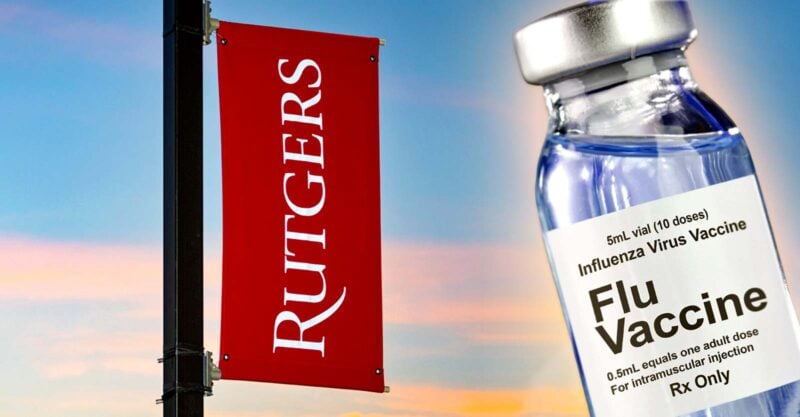


A former Rutgers University employee who challenged the institution’s flu vaccine mandate on religious grounds and was subsequently fired can challenge her termination under binding arbitration, according to a ruling last week by a New Jersey appeals court.
Rosemary Herrschaft worked as a secretary at Rutgers’ John H. Cronin Dental Center. In 2023, she requested a religious exemption from the university’s flu vaccine mandate, citing her beliefs as a “baptized Catholic.”
Later that year, Rutgers rejected the request and ordered Herrschaft to get vaccinated. In March 2024, the university fired her after she refused to comply.
Herrschaft’s union, Teamsters Local 97, filed a grievance on her behalf, seeking binding arbitration under the terms of its collective negotiation agreement (CNA) with Rutgers. The university alleged arbitration would impede its “managerial authority” to enforce its vaccination policy.
Last year, the New Jersey Public Employment Relations Commission ruled in Herrschaft’s favor. Rutgers challenged the decision, but last week’s ruling by the Superior Court of New Jersey Appellate Division rejected the university’s appeal.
Ruling doesn’t challenge Rutgers’ vaccine policy
According to the ruling, “Major discipline, like termination, is subject to the grievance procedures in the CNA.”
The court said that deciding what discipline to impose on an employee for violating vaccine policy doesn’t interfere with Rutgers’ right to have and enforce its policy.
The court also clarified that its ruling doesn’t challenge Rutgers’ vaccine policy but recognizes an employee’s right to challenge a disciplinary action.
Kim Mack Rosenberg, general counsel for Children’s Health Defense (CHD), called the ruling “a win for unionized employees.” She added:
“While not a direct challenge to Rutgers’ influenza vaccine mandate, it does allow the employee to exercise her rights under the CNA to arbitrate the ultimate outcome of that policy — her termination when her religious exemption request was denied.
“It is clear that Rutgers — even in a non-emergency environment — wanted unfettered authority with respect to vaccine mandates, and the court denied Rutgers’ attempts.”
Michael Kane, CHD’s director of advocacy, applauded the support Teamsters Local 97 provided to Herrschaft.
“This is what happens when unions actually represent their members and don’t throw them under the bus because of political relationships,” Kane said.


Public Employment Relations Commission rejects Rutgers’ arguments
According to last week’s ruling, Rutgers first implemented its vaccination policy for employees in 2017. The policy covers certain communicable diseases, including flu, and applies to “covered individuals” — employees who work in areas where patients receive care.
Under the policy, covered individuals have until Nov. 1 of each year to submit a request for a medical or religious exemption for that year.
Rutgers alleged the policy applied to Herrschaft, who worked in a healthcare environment. The university first notified Herrschaft of her noncompliance with its flu vaccine mandate in January 2023.
Herrschaft requested a religious exemption. However, Rutgers didn’t process her request by the end of that year’s flu season and accordingly took no further action.
In October 2023, Herrschaft again submitted a religious exemption request in the lead-up to the upcoming cold and flu season. She argued that while the Catholic Church does not prohibit the use of any vaccine, it did recognize a moral right to refuse “a medical intervention, including a vaccination, if [her] informed conscience comes to this sure judgment.”
Rutgers denied Herrschaft’s request in December 2023 and gave her seven days to provide proof of vaccination. When she didn’t comply, Rutgers issued her a counseling notice in early January 2024 and later followed up with a pre-termination notice and order to attend a conference to discuss her noncompliance.
The conference took place later that month. Herrschaft attended and provided statements in support of her religious exemption request and her contention that she was not a “covered individual” under Rutgers’ policy.
On March 1, 2024, Rutgers rejected her arguments. Teamsters Local 97 filed its grievance that day.
According to the ruling, Rutgers filed a petition with the New Jersey Public Employment Relations Commission. The petition outlined three arguments in support of its vaccine policy and its contention that the policy was not subject to binding arbitration. However, the commission and the appeals court rejected the university’s arguments.
The Defender is 100% reader-supported. No corporate sponsors. No paywalls. Our writers and editors rely on you to fund stories like this that mainstream media won’t write. 

This article was funded by critical thinkers like you.
Ruling shows importance of union support for workers who challenge mandates
Herrschaft’s case now appears headed to arbitration, although no information is available on when this will be scheduled.
Kane said arbitration “can work well” for employees challenging administrative decisions and firings, and “remain binding, especially when the union actually represents its members, as opposed to selling them out.”
However, unions “behave so differently from state to state, even town to town,” he added.
Either way, Kane said last week’s ruling represents a positive first step for union protection of workers who may challenge their employers’ vaccine policies.
Unions are “representatives of their members,” so last week’s ruling is “a win,” Kane said.
Related articles in The Defender
- 10 Ex-Employees Sue Hospital Over COVID Vaccine Mandate, Alleging Civil Rights Discrimination
- Oklahoma Company to Pay $4.25M After Firing Workers Over COVID Vaccine Mandate
- Mayo Clinic Joins List of Employers Sued for Denying Religious Exemptions to COVID Vaccine Mandates
- Breaking: CHD Asks Supreme Court to Hear Rutgers COVID Vaccine Mandate Case
- RFK Jr. to Rutgers President: COVID Vaccine Mandate Violates Federal Law
- Rutgers University to Enroll Children in Pfizer Lyme Disease Vaccine Trial