Login
Login
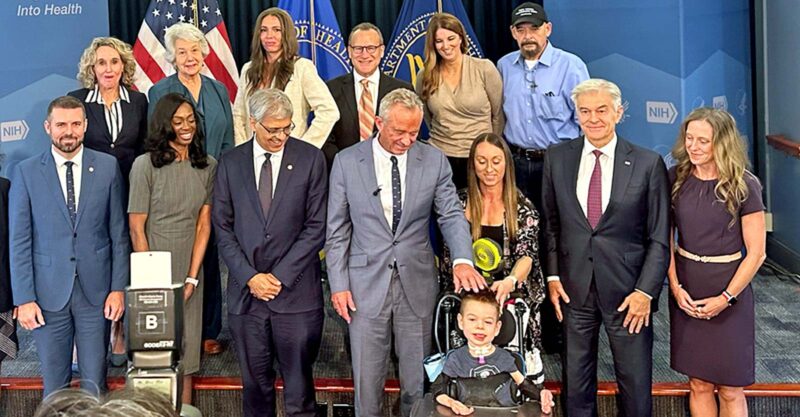


The U.S. Department of Health and Human Services (HHS) today publicly confirmed the creation of a new clinic — run by the National Institutes of Health (NIH) — to study vaccine injuries and treat vaccine-injured people.
The NIH will also oversee plans to modernize the federal vaccine injury reporting system — the Vaccine Adverse Event Reporting System (VAERS) — “to make reporting simpler and improve the tools available to researchers and medical professionals investigating potential safety signals.”
Other new initiatives include:
- A proposal to reimburse doctors for reporting suspected vaccine injuries.
- A new requirement that electronic health records “capture vaccine-related adverse events so that information can follow patients across the health care system.”
- A new billing code to reimburse doctors who file vaccine injury reports.
- Funding for outside researchers to study vaccine-related adverse events.
“We must listen to patients and families who report vaccine injuries — not dismiss or gaslight them,” said U.S. Health Secretary Robert F. Kennedy Jr. in a statement released today.
On Monday, Kennedy attended a closed-door ribbon-cutting ceremony and roundtable at the NIH campus in Bethesda, Maryland, to launch the clinic.
NIH Director Jay Bhattacharya, Acting U.S. Food and Drug Administration (FDA) Commissioner Kyle Diamantas, Centers for Disease Control and Prevention (CDC) Director Erica Schwartz, Centers for Medicare & Medicaid Services Administrator Mehmet Oz, and parents of vaccine-injured children participated in the event.
View this post on Instagram
Polly Tommey, Children’s Health Defense (CHD) senior director of digital media who also attended Monday’s event, called the initiative “a massive step forward in acknowledging vaccine injury.”
Tommey, whose son was injured by the measles-mumps-rubella (MMR) vaccine and who has interviewed thousands of parents of vaccine-injured kids on CHD’s Vax-Unvax Bus, said it was “surreal” that all of the leaders of federal health agencies “were joined together on the issue of vaccine injury.”
“Never, ever before have we, the parents, been in a position like this,” Tommey said. She called the initiative a “small but cautious step forward.”
A September 2025 strategy report by the White House’s Make America Healthy Again (MAHA) Commission proposed that NIH “investigate vaccine injuries with improved data collection and analysis, including through a new vaccine injury research program at the NIH Clinical Center that may expand to centers around the country.”
‘It was nice to feel validated’
Other parents who attended Monday’s events also expressed support for the new initiatives.
Krystle Cordingley, whose son Corbyn died after receiving the quadrivalent flu vaccine, also attended Monday’s event. She said she’s “hopeful” that the initiative “will allow a broader narrative to begin where people will feel comfortable talking about vaccine injury and realize that it is real, that it’s an actual thing that happens.”
Jordan Grim, whose son, Nash, contracted vaccine-induced polio and was paralyzed after getting the diphtheria-tetanus-acellular pertussis (DTaP) vaccine, said she’s “excited” about the new initiative.
“It was nice to feel validated that they do see us, they do believe us, and they actually do want to help in any way that they can,” Grim said.
Tommey said that Schwartz, confirmed as CDC director in August after facing criticism from some MAHA activists for her past support of vaccines, appeared moved by stories she heard Monday from the parents of vaccine-injured children.
“Schwartz cried while listening to Krystle and Nash’s story. She went over to them after the event finished. She genuinely cared. This gives me hope,” Tommey said.
New vaccine-injury initiatives get thumbs up from doctors, scientists
But it wasn’t just parents of vaccine-injured children who expressed a positive take on the new developments.
Speaking Wednesday at a Wall Street Journal Future of Health event, Schwartz said doctors shouldn’t treat parents who question vaccines with “a paternalistic way of thinking.” Kennedy “does represent the voices of a number of Americans who are asking questions about certain vaccines,” she said.
Pediatrician Dr. Elizabeth Mumper, a member of the HHS Interagency Autism Coordinating Committee, told The Defender she is “delighted” to see “such concrete action being taken” on behalf of the vaccine-injured.
And several mainstream scientists and physicians said the clinic and other initiatives are a positive step.
Yale University cardiologist Dr. Harlan Krumholz told Science that the vaccine-injured have long been ignored. “The path forward has to be to avoid the politics and simply pursue the science,” he said.
Daniel Salmon, Ph.D., director of the Institute for Vaccine Safety at the Johns Hopkins Bloomberg School of Public Health, told The New York Times that “more research in vaccine safety would be very helpful.”
Initiative aims to advance ‘scientific understanding’ of vaccine injuries
According to HHS, the new NIH clinic aims to advance “scientific understanding of health problems reported following vaccination.”
“The clinic brings specialized patient care and scientific investigation together, allowing NIH clinicians and researchers to evaluate patients, study their experiences, investigate potential causes, and identify better approaches to care,” HHS stated.
The Times reported that two “little-noticed” NIH documents published online in June hinted at the initiative’s launch and its focus on studying vaccine injuries.
One document related to an NIH grant titled “Epidemiological Studies of Vaccination and Health Outcomes Across the Lifespan.” The grant’s description states that while short-term vaccine safety has been extensively studied, the study of “long-term health outcomes across the lifespan remains limited.”
The second NIH grant, “Using Clinical Studies and Human-Based Models to Understand Vaccine Mechanisms Impacting Efficacy and Safety,” relates to a study of the “biological mechanisms underlying vaccine efficacy, safety, non-target effects, and susceptibility to adverse events.”
Science cited an August presentation by the National Institute of Allergy and Infectious Diseases, in advance of today’s announcement, that focused on post-vaccination syndrome and its “myriad reactions.”
Reactions frequently include fatigue, neurological symptoms and inflammation — and are often similar to the symptoms of long COVID.
Initiative includes plans to ‘overhaul’ VAERS
In today’s announcement, HHS said the new initiatives include an “overhaul” of VAERS — including upgrades that have already been made or are currently underway.
The CDC last month announced its “Modernized VAERS Reporting Application,” to make VAERS accessible on mobile devices and improve “the tools available to researchers and medical professionals investigating potential safety signals.”
Earlier this year, the CDC added VAERS QR codes to vaccine information statements provided to parents and patients for each vaccine administered.
Grim said the discussion referenced a 2011 Harvard report finding that less than 1% of all adverse events are reported to VAERS, which “gives a very false flag of vaccines being safe and effective when they, in fact, are not.”
She said this statistic reflects her own experience, as she was unsuccessful in getting physicians to report her son’s vaccine injury to VAERS. “I can vouch for that myself. My own child, they didn’t report it,” she said.
It remains unclear how the initiative will be funded. According to Science, the level of funding for the new initiative “has not been determined,” though portions of the initiative “may tap into money NIH set aside for research on Long Covid.”
New initiatives part of broader government actions on vaccine safety
The new NIH initiatives are the latest in a series launched by Kennedy and federal health agencies relating to vaccine safety and adverse events.
Last year, HHS announced it would study all possible causes of autism. This included the launch of a $50 million NIH initiative to study autism, though NIH has been accused of sidestepping any examination of a possible vaccine-autism link.
In May, the Times reported that Kennedy was leading an “intense” effort to study childhood vaccine safety. In August, President Donald Trump signed an executive order to reduce the number of childhood vaccines. Last month, Trump said he would demand that drugmakers split some routine childhood vaccines into five doses.
The Times reported Wednesday that officials at the National Institute for Environmental Health Sciences — under NIH — proposed funding a “broad-based initiative to examine chemical exposures in the environment,” including aluminum and “aluminum-containing compounds.”
The Times cited a person familiar with the effort, who said vaccine research might be part of this initiative. Several vaccines contain aluminum, which HHS has classified as a neurotoxin and which is linked to brain injury and neurological damage.


This article was funded by critical thinkers like you.
The Defender is 100% reader-supported. No corporate sponsors. No paywalls. Our writers and editors rely on you to fund stories like this that mainstream media won’t write.
‘I actually want to see’ change
Cordingley said she remains wary of government promises to study vaccine injuries.
“I want to wait to see what comes of it before I get excited. I’ve been in this for 13 years now. This has been something that, every once in a while, we’ll get thrown a nugget here and there … but then nothing really ever comes of it,” she said.
Documents CHD obtained in 2023 through a Freedom of Information Act lawsuit revealed that NIH officials under the Biden administration corresponded with people injured by the COVID-19 vaccines throughout 2021 and launched a study of such injuries — but slow-walked the investigation before pulling the plug in early 2022.
“While they talk about all of this change, I actually want to see it,” Grim said, adding that she felt the officials who attended Monday’s event “believe us and actually do want to help in any way that they can.”
Mumper said she plans to offer her services to the new initiative. “We must act now” to “help patients who have suffered adverse reactions from vaccines.”
Related articles in The Defender
- MAHA Commission Outlines Sweeping Agenda to Target Chronic Disease
- Trump Says He Will Demand Drugmakers Split Some Routine Vaccines Into Five Doses
- Trump Signs Executive Order Aimed at Reducing Number of Childhood Vaccines
- Reuters Ran a Hit Piece on RFK Jr. — and Revealed How Hard He’s Worked to Reform Vaccine Policy
- RFK Jr. Leading ‘Intense,’ Multi-Agency Study on Childhood Vaccine Safety, New York Times Reports
- NIH in Early 2022 Abruptly Stopped Responding to People Injured by COVID Shots