

 Login
Login
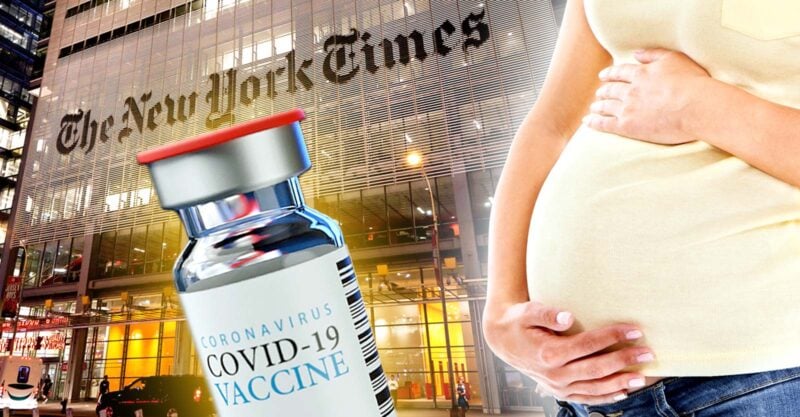


By Children’s Health Defense Science Team
On Oct. 2, New York Times journalists Maggie Astor and Theodore Tae, neither of whom has any scientific or medical credentials, posted a video on the “safety” of the COVID-19 vaccine for pregnant women.
The 2-minute-and-15-second video opened with: “The science is clear: the COVID vaccines are safe for pregnant women.”
Astor, who narrates the video, laments the “confusion” she believes the Centers for Disease Control and Prevention (CDC) created when it recently updated its COVID-19 vaccine recommendations, including for pregnant women.
“The change in federal guidelines has created a great deal of confusion, both for pregnant women and for the pharmacist,” Astor tells viewers.
This should come as no surprise. The scientific, medical and health apparatuses have lied about the safety of vaccines for years. So, when the perpetuated myth of safety meets the rigor of the scientific method, it’s sure to be awfully confusing.
About 30 seconds into the video, Astor says, “Here’s what you need to know about why the COVID vaccine is safe and effective during pregnancy.”
She follows this statement not with evidence-based facts about vaccine safety, but with a solid minute of fearmongering, telling viewers:
- COVID-19 is dangerous for pregnant woman and fetus.
- Pregnancy suppresses the immune system.
- Respiratory infections are more dangerous during pregnancy.
- The effects of COVID-19 infections can linger.
- Infection can affect the development of the placenta, which can hurt the fetus.
- Vaccines reduce all these risks.
- Newborns can’t get the vaccine until they are 6 months old.
- COVID-19 is especially dangerous to infants, increasing hospitalization risk.
None of these statements has anything to do with the safety of COVID-19 vaccines — the statements merely realign fears to make women more willing to take a dangerous product.
Video cites irrelevant study to claim COVID Shots are safe for pregnant women
After the fearmongering ends, The New York Times video finally presents a study, published in October 2021, in the American Journal of Infectious Control — but the study has nothing to do with pregnancy.
The authors, led by Dr. Amninder Singh, added up reports in the Vaccine Adverse Event Reporting System (VAERS) of different adverse events associated with a given COVID-19 vaccine and divided that number by the total doses given of that vaccine, comparing outcomes for the Pfizer-BioNTech, Moderna and Janssen (Johnson & Johnson) vaccines.
Even if the overly simplistic method were valid, which it isn’t, the paper could speak only to the difference in the reported number of adverse events associated with each vaccine, but nothing about the vaccines’ overall safety.
To support claims that the COVID-19 vaccine is safe specifically for pregnant women, Singh deferred to an article published in April 2021 in the New England Journal of Medicine (NEJM).
Lead author Dr. Tom Shimabukuro, then-director of the CDC’s Immunization Safety Office, conducted an analysis of the data on COVID-19 vaccine adverse event outcomes during pregnancy, using data from the agency’s V-safe and VAERS systems.
His “preliminary findings did not show obvious safety signals” for pregnant women who got the mRNA shots, but he concluded that more research was needed.
Side note: Shimabukuro is on the short list of bad actors during the COVID-19 era targeted by Sen. Ron Johnson (R-Wis.) for investigation. Johnson, chairman of the Permanent Subcommittee on Investigations — which operates under the U.S. Senate Committee on Homeland Security & Governmental Affairs — has asked the U.S. Department of Justice, the FBI and the Office of Inspector General of the U.S. Department of Health and Human Services to investigate Shimabukuro for possibly deleting or destroying official agency records pertaining to COVID-19 vaccines, and to determine if he did so specifically to avoid or subvert congressional oversight or the Freedom of Information Act.
The New York Times video also references a June 2023 meta-analysis on pregnancy, published in Vaccine. Ideally, this would be the publication that collates other publications and distills a consensus of evidence.
However, scientific censorship was in full swing during the COVID-19 era. Only studies that align with the “safe and effective” pledge of allegiance made it into print. A meta-analysis of those publications, without consideration for the context, is going to distill a consensus of censorship-tainted evidence.
The meta-analysis, by lead author Agustín Ciapponi, was the only actual pregnancy study cited by The New York Times video. The study is an example of what you would expect to see as a result of scientific censorship. Even bad outcomes that are typically associated with pregnancy went unreported, which made the outcomes for women who got the shot appear shockingly good.
For example, Table 3 of the paper shows that women who got the shot showed a reduction from established historical levels of:
- 50% for spontaneous abortion, or miscarriage, (from 10% in clinically recognized pregnancies to 4.97%).
- 98% for stillbirths (from 3.0% in the US to 0.05%).
- 98% for fetal growth retardation (from 23.8% to 0.49%).
- 76% for hypertensive disorder (from 10% to 2.37%).
- 44% for preterm births (from 10% to 5.61%).
- 88% for neonatal death (from 3.6% in the US to 0.43%).
- 94% for antenatal bleeding (from 6% to 0.37%).
A naive reader may conclude from this study that the COVID-19 vaccine is the greatest obstetric innovation in modern medicine, greatly reducing pre-COVID-19 rates for miscarriage, hypertensive disorders and preterm births, and making stillbirths, fetal growth retardation, neonatal death, and antenatal bleeding a thing of the past.
However, the study is an end-product of one of the greatest scientific censorship campaigns ever waged. If scientists can’t report when they identify a hazard, no one can read about those hazards — then the meta-analysis can conclude “we found no evidence of safety concerns for currently used COVID-19 vaccines during pregnancy.”
Pregnant women weren’t included in COVID vaccine clinical trials
Historically, clinical research trial protocols excluded pregnant women due to ethical considerations and the potential risk to a developing fetus. This cautious approach stems from the aftermath of tragic incidents involving pregnant women who were given untested medications that caused serious birth defects.
In 1977, the U.S. Food and Drug Administration (FDA) issued a policy prohibiting Big Pharma from including pregnant women and women of childbearing age in clinical research studies. The FDA reasoned that early stages of these clinical trials were rarely beneficial and, in certain situations, could cause dangerous harm to a growing fetus.
These early fears of the risks were justified because often researchers exaggerated the benefits of the product while minimizing or failing to disclose the potential harms. Moreover, the Nuremberg Code declares that research subjects, particularly the most vulnerable, must be protected from medical exploitation.
Curiously, both Pfizer and Moderna heeded these warnings, at least initially. According to internal documents, the vaccine makers purposefully excluded or released pregnant women from initial vaccine trials, thus precluding all or nearly all safety or efficacy data for pregnant women.
Instead, to support and promote the use of COVID-19 vaccines in pregnant women and those of childbearing age, Pfizer’s scientists conducted a reproductive toxicity study in 44 female rats.
According to the FDA’s emergency use authorization documents for the Pfizer-BioNTech, Moderna and Janssen (Johnson & Johnson) COVID-19 vaccines, the nonclinical toxicology studies “showed no significant safety issues to report.”
Yet, scientists knew, on or about Dec.16, 2020, that “the S1-subunit of the COVID-19 viral spike protein” could cross the blood-brain barrier of mice and later be deposited in peripheral tissue, including the brain.
Specifically, if the spike protein could pass the blood-brain barrier, there is a high probability that it could also transfer through a pregnant woman’s placenta and flow directly into the growing fetus.
Scientists also knew, by March 2021, that the spike protein could trigger severe lung damage in male mice. And by July 2021 and again in August 2021, scientists found that the COVID-19 vaccines could cause major liver and heart damage in mice.
Despite mounting evidence that COVID-19 injections during pregnancy were unsafe, on April 21, 2021 — after VAERS data showed with a 99.9% confidence, and before the CDC would admit the risk of myocarditis for mRNA shots — Shimabukuro published his “Preliminary Findings of mRNA Covid-19 Vaccine Safety in Pregnant Persons” in the NEJM, finding no “obvious safety signals.”
According to the paper, the study included 827 completed pregnancies, with a total of 712 live births (86.1%) and only 104 spontaneous abortions (12.6%), which the authors said is consistent with expected outcomes.
However, the study failed to disclose that approximately 114 women were vaccinated during their first trimester, 13 women were vaccinated during the second trimester, and 700 of the pregnant participants were vaccinated during their third trimester. All 104 miscarriages occurred during the first or second trimesters.
Failure to disclose the true incidence of spontaneous abortion is at best gross incompetence and at worst malfeasance. The true incidence of spontaneous abortion is alarming, ranging between 82% (104/127) to 91% (104/114).


This article was funded by critical thinkers like you.
The Defender is 100% reader-supported. No corporate sponsors. No paywalls. Our writers and editors rely on you to fund stories like this that mainstream media won’t write.
What the video didn’t tell viewers about COVID vaccine risks for pregnant women
If The New York Times were serious about providing truthful information to pregnant women about the risks of COVID-19 vaccines, Astor and her colleagues would have included the following facts and study results in their video:
1. In November 2021, Science, Public Health Policy, and the Law published “Spontaneous Abortions and Policies on COVID-19 mRNA Vaccine Use During Pregnancy,” a critique by lead author Aleisha R. Brock of Shimabukuro’s NEJM study.
Brock and her colleagues reviewed the data presented and found it highly misleading and questionable at best. They also reanalyzed the CDC’s VAERS as and V-safe registry data from Dec. 14, 2020, through Feb. 28, 2021, and cautioned that documented cases reported on both sites indicated that recently vaccinated mothers can and do shed the COVID-19 mRNA vaccine and spike protein into breastmilk, causing potentially serious adverse reactions to the nursing infant. These included blood clots, anaphylactic shock and even death.
The authors demanded the immediate withdrawal of Shimabukuro’s NEJM study until proper long-term safety studies could be conducted.
2. On Sept. 19, 2023, The Lancet published “Biodistribution of mRNA COVID-19 vaccines in human breast milk.” In that study, scientists found, “the COVID-19 mRNA is not confined to the injection site but spreads systemically and is packaged” into breast milk.
In other words, the risks of COVID-19 vaccine shedding are real. To make matters worse, Pfizer knew as early as April 20, 2021, but tried to hide its data. In a confidential document, “Pregnancy and Lactation Cumulative Review,” Pfizer had been tracking the serious adverse events of babies breastfeeding from mothers who had received the COVID-19 vaccine after giving birth.
According to various reports, Pfizer had documented cases of breastfeeding babies who had developed facial paralysis, strokes, convulsions and respiratory failure. (Also see: evidence of antibodies passed to infant; adverse events through breastmilk; Pfizer’s confidential update; Dr. Pierre Kory’s assessment of shedding risks; risks of shedding.)
However, rather than exercise precautionary measures to protect vulnerable infants from the harmful effects of the COVID-19 vaccine shedding, Big Pharma ignored the mounting clinical evidence and instead insisted that the COVID-19 injections were safe and effective.
Under normal circumstances, breast milk provides many positive health benefits to an infant, including proper nutrients and maternal antibodies that provide passive immunity to various infections. However, the opposite is true for infants born to mothers who received the COVID-19 injection during pregnancy and/or while lactating.
3. On Jan. 24, 2024, a group of independent scientists published a peer-reviewed paper, since retracted (a tool of science not always wielded for good), for reasons unknown but pending appeal. The paper called for a “global moratorium” on all COVID-19 vaccines.
In the article, “COVID-19 mRNA Vaccines: Lessons Learned from the Registrational Trials and Global Vaccination Campaign,” published in the medical science journal Cureus, the authors outlined their exhaustive review and reanalysis of the Pfizer and Moderna COVID-19 clinical trial data and discovered a significant underreporting of severe adverse events, including cardiac events, neurological disorders, cancer, reproductive issues, autoimmune disorders and death.
The researchers found that the clinical trials failed to follow previously established scientific standards, such as proper safety and toxicology testing. Instead, the trials were rushed due to financial and political incentives. The authors also argued that the COVID-19 mRNA products are gene therapy products, not vaccines, and were never safe or effective.
The scientists demanded that the federal agencies take these dangerous products off the market immediately — that was 21 months ago. Their criticisms join a cacophony of publications stemming from those who have the courage to cry foul: “Epistemic Corruption, the Pharmaceutical Industry, and the Body of Medical Science”; “Corruption in global health: the open secret”; “The Illusion of Evidence Based Medicine“; “Medical Journals Complicit in Corruption of Medicine”; “Big Pharma Is Hijacking the Information Doctors Need Most.”
4. On Feb. 23, 2024, the CDC released VAERS data showing that there had by then been a total of 1,630,913 reports of adverse events following COVID-19 vaccination, including 37,321 deaths.
Included in the list of adverse events are the following: myocarditis (with analyses published by ACIP, Clinical Infectious Disease, and Pharmacoepidemiology & Drug Safety), pericarditis, seizures, convulsions, stroke, heart attack, blood clots, anaphylaxis, narcolepsy, encephalitis, transverse myelitis, Guillain-Barré Syndrome, autoimmune disease, arthritis, Kawasaki disease, systemic inflammation, as well as birth defects post vaccination.
Each of these adverse events can, in and of itself, be debilitating and even life-threatening. Further, it is well documented that fewer than 1% of all adverse events are actually ever reported to VAERS. This means that the number of people injured or who died following COVID-19 injections is several magnitudes greater than what is reported in VAERS. Tragically and inexcusably, the government appears to have failed to investigate many of these reported injuries, despite its legal obligation to do so.
Pharmacovigilance during the COVID-19 era was at best dysfunctional, and on the whole, a betrayal. Per the VAERS standard operating procedure (SOP), the FDA and CDC were to conduct different data-mining methods to look for “safety signals.” For 18 months, during one of the most important and reckless pharmaceutical rollouts in human history, the FDA conducted regular Empirical Bayesian data mining. It was heralded as “the most intensive safety analysis in U.S. history,” yet found merely three clinically relevant signals for the mRNA platform: a rash; “drug ineffective”; exposure via breast milk.
The CDC, which initially refused to abide by VAERS SOP, did perform an abbreviated proportional reporting ratio analysis, finding 743 clinical safety signals, including death, stroke, heavy menstrual bleeding and myocarditis.
5. In 2023, the Journal of American Surgeons and Physicians published a study, led by Dr. James A. Thorp, that examined VAERS data for pregnancy-related adverse events and produced relative risks and confidence intervals to show that VAERS reporting for COVID-19 vaccines relative to historic influenza vaccines.
The study found a statistically significant relative risk for menstrual abnormality, miscarriage (spontaneous abortion), fetal cardiac disease, fetal growth abnormality, fetal abnormal surveillance, low amniotic fluid volume and fetal death.
6. A study published in 2025 in Autoimmunity found DNA contamination in the mRNA vaccines to be 371-1,548 ng/dose for Pfizer and 1,130-6,280 ng/dose for Moderna products. The FDA guidelines for viral vaccines are to allow no more than 10 ng/dose. That standard is set for naked DNA, quickly degraded and with almost no chance of entering a cell.
The study, by lead author David J. Speicher, found 123,000,000 to 160,000,000,000 plasmid DNA fragments per dose encapsulated in lipid nanoparticles — with its free pass into every cell. The appropriate and safe levels for lipid nanoparticle encapsulated DNA contamination is ZERO.
Even worse was the nature of the DNA contamination, which for Pfizer’s product includes the highly bioactive SV40 promoter, which Pfizer hid from the FDA. Pfizer now states “[n]on-infectious fractions of a SV40 sequence are present in the starting material used by Pfizer and BioNTech.”
Threats to human health are also, and especially, relevant threats to pregnant women and unborn fetuses. Those threats, put to print, could fill a library. There is a reason pharmaceutical development takes decades. In the last few months alone, we have seen reports of lower conception rates among vaccinated women in the Czech Republic and a higher incidence of cancer among the vaccinated in Italy and South Korea.
Who knows what the next few years of uncensored rigorous science will reveal? It’s a good bet that you won’t find it in the “Well” section of The New York Times.