Login
Login
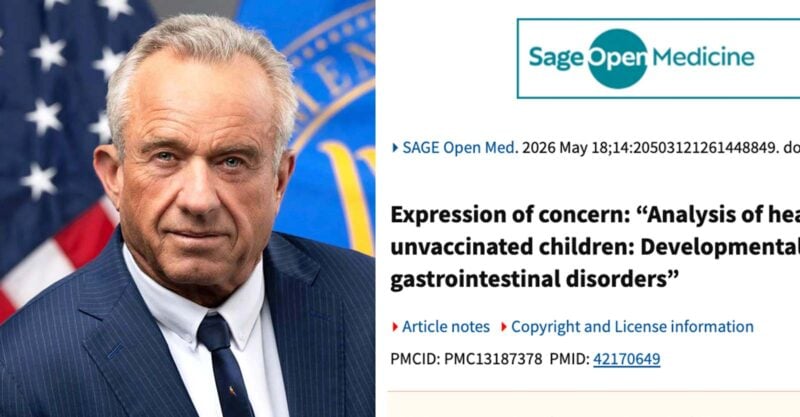


U.S. Health Secretary Robert F. Kennedy Jr. is demanding to know why the editors of Sage Open Medicine have raised concerns about a peer-reviewed study, published in May 2020, comparing health outcomes between vaccinated and unvaccinated children with a message of concern.
In a letter dated July 29, Kennedy wrote to Managing Editor Prajakta Mane concerning the study by Children’s Health Defense (CHD) Chief Scientific Officer Brian Hooker and Neil Z. Miller, a medical research journalist.
Hooker and Miller found that partially vaccinated infants were more than twice as likely as unvaccinated infants to later be diagnosed with developmental disabilities and ear infections. They were also more than four times as likely to develop asthma.
The authors also found a statistically significant association between vaccines and gastrointestinal disorders. The study was based on anonymized medical chart data from three U.S. pediatric practices with over 2,000 total patients in the cohort.


Sage placed an “expression of concern” on the article on May 18, indicating that the article was under investigation. The editors provided no further details.
In his letter, Kennedy noted that publishers have many ways to foster debate about a study’s findings, including letters to the editor or publishing peer reviewer comments.
Expressions of concern may be appropriate, he said, but should be accompanied by an explanation for the action, according to journal ethics guidelines.
Kennedy asked the editors of Sage Open Medicine to respond by Aug. 15, providing a full accounting of what led to their decision.
“Scientific journals have a responsibility to uphold transparency, protect research integrity, and defend academic freedom. The American people deserve a scientific process that is open, accountable, and worthy of their trust,” Kennedy wrote in an X post, where he shared the letter.
Today, I sent a letter to SAGE Open Medicine requesting an explanation for its decision to append an expression of concern to the article, “Analysis of health outcomes in vaccinated and unvaccinated children: Developmental delays, asthma, ear infections and gastrointestinal… pic.twitter.com/9d6TnrIvKH
— Secretary Kennedy (@SecKennedy) July 29, 2026
Miller told The Defender that he believes the journal challenged the paper because its findings raise questions about vaccine safety.
“Before publication, our paper underwent three rounds of peer review,” Miller said. “After it was published, it came under sustained criticism, and efforts were made to persuade the publisher to remove it. The expression of concern is the latest development in that process.”
The journal did not respond to The Defender’s request for comment on Kennedy’s letter.
Authors say criticism reflects broader fight over vaccine research
Kennedy and Hooker are co-authors of The New York Times bestseller “Vax-Unvax: Let the Science Speak,” which addresses some issues similar to those analyzed in the article.
Hooker told The Defender that the attack on their study is part of an attack on research providing evidence that contradicts the claim that all vaccines are “safe and effective.” Recently, other articles that initially passed rigorous scrutiny under the peer review process have been challenged or retracted by the journals that published them.
Critics say many of these retractions are part of a coordinated campaign, fueled in part by anonymous posters on PubPeer, to discredit researchers who challenge mainstream vaccine science.
“This is the first and only remaining ‘vax-unvax’ study that is in a PubMed-indexed journal. That’s why the pro-pharma crowd wants it retracted,” Hooker said.


This article was funded by critical thinkers like you.
The Defender is 100% reader-supported. No corporate sponsors. No paywalls. Our writers and editors rely on you to fund stories like this that mainstream media won’t write.
PubMed Central, a free and publicly available resource provided by the National Library of Medicine, is considered an authoritative source for archived biomedical research.
After an 11-month rigorous review process, the article was published in May 2020. It has since been downloaded nearly 300,000 times.
“The journal has forwarded concerns raised anonymously twice before regarding the methods/results of the paper, and the authors have addressed those concerns without any issuance of an official notice of concern,” he said.
Hooker said several months ago, the journal contacted them with new allegations of data impropriety. The allegations originated from an anonymous post on PubPeer.
“There was no basis to the allegations, and I was able to address them directly with the journal to show that they were false,” he said.
The journal continued to lodge complaints against the authors, repeating earlier complaints that had already been addressed, Hooker said. He said he had heard nothing from the journal since the expression of concern was posted.
“I’m extremely grateful for Secretary Kennedy’s investigation into this matter,” he said. “This type of censorship hinders the advancement of the best care for our children.”
Related articles in The Defender
- Decade-Old Studies Linking Aluminum and Vaccines Come Under Fire After Anonymous PubPeer Complaints
- Exclusive: Clinical Trial Doctor Published Studies Showing COVID Treatments Worked. Pharma Investors Got The Studies Retracted.
- ‘Vigilante Science’: How Anonymous Critics Are Trying to Silence Peer-Reviewed Vaccine Research