Login
Login
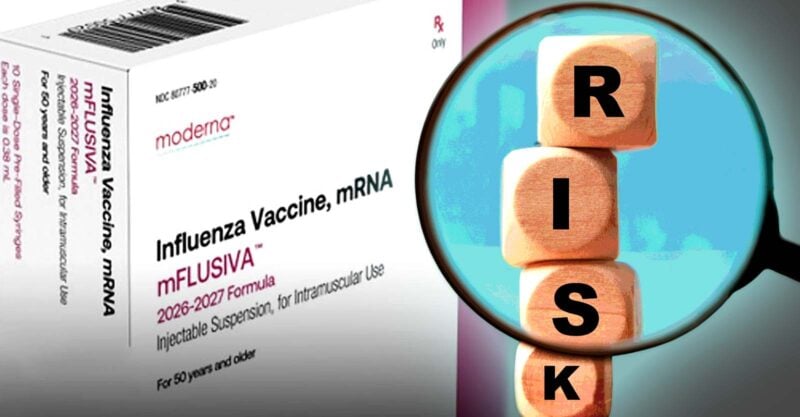


Moderna’s mRNA flu vaccine should be immediately withdrawn from the market due to the shot’s huge risks and small benefits, according to a reanalysis of the U.S. Food and Drug Administration’s (FDA) own data on the vaccine’s risk-benefit profile.
The authors — cardiologist Dr. Peter McCullough, epidemiologist Nicolas Hulscher and natural medicine physician John Catanzaro, Ph.D. — on Wednesday published their results on the preprint server Zenodo.
They reanalyzed clinical data on the safety and efficacy of Moderna’s mFLUSIVA (mRNA-1010) flu vaccine from an FDA briefing document that the FDA’s vaccine committee reviewed at its June 18 meeting. During that meeting, the committee unanimously voted to endorse Moderna’s mRNA flu vaccine for people 50 and older.
The briefing document, which reported results from safety and efficacy studies conducted by Moderna, was prepared by the FDA’s Division of Clinical and Toxicology Review, part of the agency’s Office of Vaccines Research and Review.
According to the reanalysis by McCullough’s team, Moderna’s mRNA flu vaccine showed abysmal efficacy in preventing hospitalization. It also showed a higher risk of adverse events, including death, compared with a non-mRNA standard-dose flu vaccine
For example, their analysis of data from one of the shot’s main trials revealed that, to prevent a single hospitalization, 5,017 adults had to receive the mRNA flu vaccine, the authors said.
Meanwhile, the mRNA shot had roughly 1,454 additional solicited adverse reactions, 233 additional Grade 3 systemic reactions severe enough to prevent normal daily activity, and approximately two excess unexplained deaths, compared to the non-mRNA shot.
Additionally, neither of the two main trials for the mRNA shot used a placebo or looked at whether the shot prevented flu-related deaths.
According to the report, “A vaccine licensed in large part to prevent severe influenza outcomes was never tested against influenza death; no influenza-mortality endpoint appears anywhere in its development program.”
The authors sent a letter about their findings to U.S. Health Secretary Robert F. Kennedy Jr., calling on him to remove the shot from the market.
They asked Kennedy to “direct the appropriate HHS and FDA officials to reexamine this approval, initiate withdrawal proceedings, and halt distribution before widespread administration begins during the 2026-2027 season.”
Hulscher wrote on Substack, “The government has been given the data. It now has the responsibility to act.”


FDA claims shot has ‘superior’ efficacy and ‘acceptable’ number of adverse reactions
According to McCullough’s report, the FDA’s data on Moderna’s mRNA flu vaccine showed that the shot’s risk-benefit profile is “extremely unfavorable.”
Yet the summarizing text of the FDA’s briefing document tells a different story. The document’s “Summary of Benefit-Risk” (page 27) states that the mRNA vaccine showed “superior” relative vaccine efficacy compared with the non-mRNA standard-dose vaccine.
For instance, in one trial, the mRNA shot was linked to 27% fewer confirmed flu cases than the current standard vaccine.
The summary acknowledged that the number of adverse reactions to the mRNA shot was “elevated” compared to the non-mRNA shot, but added that the number “appears acceptable.”
After the FDA’s Vaccines and Related Biological Products Advisory Committee greenlit the vaccine, the FDA licensed it on Aug. 5.
Moderna’s mFLUSIVA is expected to be available for the 2026-2027 respiratory illness season, ABC News reported.
mRNA shots faster to produce — but carry higher safety and efficacy risks
Proponents of the mRNA version of the flu vaccine claim the mRNA platform allows vaccine makers to cut down development time from six months to six weeks. That could mean there’s a better match between the circulating flu strain and the vaccine developed by companies.
However, critics of the mRNA platform cite efficacy and safety concerns that outweigh the platform’s possible benefits.
In August 2025, Kennedy canceled nearly $500 million in contracts and grants to develop mRNA vaccines. In a press release, he cited data on mRNA vaccines showing they lack efficacy in protecting against upper respiratory infections like COVID-19 and the flu.
“We’re shifting that funding toward safer, broader vaccine platforms that remain effective even as viruses mutate,” Kennedy said.


This article was funded by critical thinkers like you.
The Defender is 100% reader-supported. No corporate sponsors. No paywalls. Our writers and editors rely on you to fund stories like this that mainstream media won’t write.
FDA reverses course after refusing to review Moderna’s mRNA flu vaccine
The FDA initially refused to consider Moderna’s application for its mRNA flu vaccine. In a Feb. 3 letter, Dr. Vinay Prasad, then-director of the FDA’s Center for Biologics Evaluation and Research, told Moderna the FDA would not review the company’s application for mRNA-1010 because Moderna’s clinical trial wasn’t “adequate and well-controlled.”
Specifically, the clinical trial’s control group was not given the “best-available standard of care in the United States at the time of the study,” Prasad said.
Moderna officials were “shocked” at the FDA’s decision to not consider licensing its mRNA flu shot, The Washington Post reported.
Two weeks later, the FDA reversed course by accepting the company’s application for licensure of mRNA-1010.
Leadership shake-ups at the FDA soon followed. In March, Prasad resigned — for the second time in less than a year. On May 12, Dr. Marty Makary resigned his FDA commissioner post, following rumors that he would be fired.
On May 15, the FDA fired Tracy Beth Høeg, M.D., Ph.D., the agency’s top drug regulator and a staunch advocate for vaccine safety.
On Wednesday, President Trump nominated Dr. Heidi Overton, a White House domestic policy official, as the FDA’s next commissioner. She has yet to be confirmed by the U.S. Senate.
Also on Wednesday, Moderna announced “positive” results in its Phase 3 clinical trials for an mRNA cancer vaccine.
Related articles in The Defender
- Breaking: Moderna’s mRNA Flu Vaccine Gets Unanimous Thumbs-Up Despite Risks, Low Efficacy
- Moderna ‘Shocked’ After FDA Scuttles Review of New mRNA Flu Vaccine
- ‘Not Ready for Prime Time’? FDA Approves First mRNA Flu Vaccine Despite Safety Concerns
- ‘Step in the Right Direction’: RFK Jr. Cancels $500 Million in mRNA Vaccine Contracts