Login
Login


Two Democratic lawmakers are calling on the Centers for Disease Control and Prevention (CDC) to begin tracking how often parents decline vitamin K injections for newborns, saying the absence of national data is hindering efforts to prevent a rare but potentially fatal bleeding disorder.
In a letter sent to CDC Acting Director Jay Bhattacharya, Rep. Kim Schrier (D-Wash.), a pediatrician, and Sen. Angela Alsobrooks (D-Md.) urged the agency to establish surveillance for vitamin K shot refusals, cases of vitamin K deficiency bleeding (VKDB) and related infant deaths.
The request follows a ProPublica investigation that raised concerns about increasing refusal rates and gaps in public health monitoring.
“The CDC has the tools to better understand the burden of vitamin K shot refusal, VKDB and VKDB-related deaths,” the lawmakers wrote. “We urge you to use them, and to share that data with the public, so that we can prevent tragic illness and death in infants.”
Though a database would compile patient information, experts suggest that federal and state privacy laws prohibit the disclosure of any personal details.
Deven McGraw, chief regulatory and privacy officer at Citizen Health, said routine data collection is used to monitor tracking and deployment of recommended public health interventions.
“Typically data like this are reported in a de-identified way, or with identifiers removed, as the purpose is for surveillance and to inform policy and not for punishment,” McGraw told The Defender.
‘There is no such thing as zero risk’
Vitamin K injections have been recommended for newborns in the U.S. for decades to help prevent dangerous bleeding during the first months of life.
The shot is not a vaccine, but it has increasingly become caught up in broader debates surrounding childhood immunizations and medical misinformation, according to pediatricians and public health experts.
Physician and researcher Dr. Suzanne Humphries recently told CHD.TV’s “Good Morning CHD” that media coverage of the issue relies more heavily on fearmongering than empirical data.
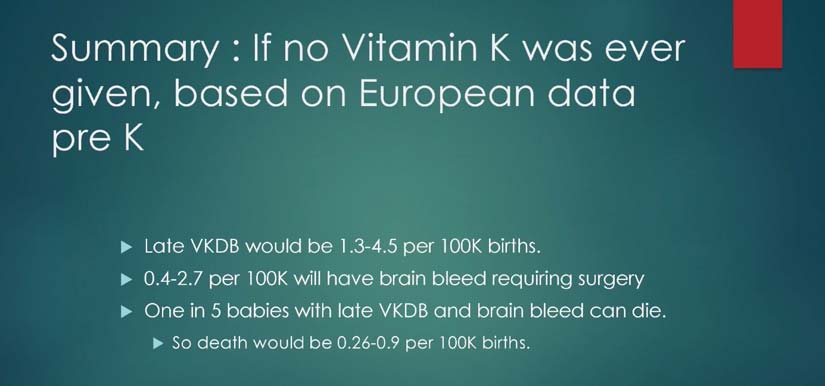
Citing figures extrapolated from European populations, Humphries stated that if babies were not given the vitamin K shot, their death from brain bleeding would occur at a rate of approximately 0.26 to 0.9 per 100,000 births.
Humphries said that because studies of carcinogenicity, genotoxicity and fertility impairment have not been conducted for the vitamin K shot, “there is no such thing as zero risk.”
“We don’t have safety studies that can assure us that there’s going to be no long-term problems,” she said.
Researcher Marcella Piper-Terry told CHD.TV last year that both available options for vitamin K shots administered in the U.S. are problematic.
For example, Hospira has a black box warning due to its 9 milligrams of benzyl alcohol, which can damage the liver and may contribute to jaundice and gasping syndrome.
Phytonadione, the other vitamin K shot used in the U.S., contains polysorbate 80. Piper-Terry pointed to a statement by the American College of Pediatricians citing concerns that the use of polysorbate in the HPV vaccine may lead to infertility from premature ovarian failure.
In a Substack post, Piper-Terry wrote that parents must decide themselves whether to give their children the vitamin K shot.
“Those parents who want to make the best decisions for their children need to research this issue from all points of view in order to make informed choices and birth plans,” she wrote.

More parents refusing vitamin K shots
The lawmakers’ request comes as fewer parents are likely to consent to the vitamin K shot for their babies.
A study published in the Journal of the American Medical Association (JAMA) found that the share of U.S. newborns who did not receive routine intramuscular vitamin K at birth nearly doubled between 2017 and 2024, rising from 2.92% to 5.18% among more than 5 million births at 403 hospitals nationwide.
After adjusting for demographic and clinical factors, the rate increased from 2.57% to 4.62%, suggesting the trend was not explained by changes in patient characteristics.
The researchers wrote that routine vitamin K prophylaxis has “nearly eliminated vitamin K deficiency bleeding” in the U.S. since universal use began in 1961. They also noted “reports of increasing parental vitamin K refusal and resultant bleeding.”
They concluded that “a multipronged approach” involving public health policies and standardized clinician communication is “urgently needed to improve rates of highly effective prophylactic intramuscular vitamin K administration to prevent bleeding and its associated morbidity and mortality.”
A Swedish study found newborns who did not receive an intramuscular vitamin K shot at birth had higher odds of bleeding complications, including nearly three times the risk of intracranial hemorrhage, compared with those who received the standard preventive treatment.
The nationwide study of more than 2 million live births from 2003 to 2021 found infants who skipped the injection had 52% higher odds of bleeding within the first 6 months of life, according to findings published in JAMA Pediatrics.
“Our findings have important clinical implications, highlighting the ongoing need for communication between healthcare practitioners and parents about the vital role of vitamin K prophylaxis in preventing potentially life-threatening bleeding in newborns,” lead author Dr. Eleni Simatou and colleagues wrote.
The proportion of Swedish newborns who did not receive the vitamin K shot more than doubled between 2006 and 2021, according to the study.
Additional research cited by the lawmakers and pediatric experts indicates infants who do not receive the injection face a substantially higher risk of developing late VKDB, a condition that can cause internal bleeding, including hemorrhages in the brain.
However, attorney Greg Glaser, who helped with a peer-reviewed paper published in the International Journal of Vaccine Theory, Practice, and Research, stated the study’s data confirmed with “99% statistical significance” that “those who avoid the Vitamin K shot and vaccines are over 10-times (1,000%) healthier than the population injected with these pharmaceuticals.”
“Rather than focusing on a database (as ProPublica pushes) to monitor parents who chose to decline these interventions, we should be asking why there is such a desperate attempt to suppress independent comparative data,” he said.
Glaser added:
“The push to track these families looks less like a public health initiative and more like an attempt to discourage bodily autonomy and lifelong good health as unvaccinated Americans. Fortunately, the future is bright, and more families than ever are choosing to join the excellent health enjoyed by the uninjected control group.”


This article was funded by critical thinkers like you.
The Defender is 100% reader-supported. No corporate sponsors. No paywalls. Our writers and editors rely on you to fund stories like this that mainstream media won’t write.
Government agencies steadfastly support the shot
According to the CDC, approximately 1 in 5 infants who develop VKDB die from the condition.
The U.S. Department of Health and Human Services (HHS) said the CDC continues to recommend that newborns receive vitamin K shortly after birth. The agency blamed the Biden administration’s handling of the COVID-19 pandemic for public mistrust in health agencies writ large.
In a statement sent to The Defender, HHS wrote:
“CDC recommends that parents give newborns a vitamin K injection within 6 hours of birth to prevent vitamin K deficiency bleeding (VKDB). Uptake of the birth dose has declined in recent years as public trust in health care institutions has fallen, particularly during the COVID-19 pandemic amid heavy-handed mandates and inconsistent messaging during the Biden administration. Rebuilding that trust requires honesty, informed consent, and respect for individual choice.”
The American Academy of Pediatrics (AAP) has also called for stronger public education about the injection, arguing that better surveillance would help physicians identify emerging trends and respond more quickly to prevent avoidable illnesses.
The AAP quoted Karen Puopolo, M.D., Ph.D., who chairs the Committee on Fetus and Newborn in its website materials:
“Because all babies are born with low levels of vitamin K in their bodies, they are more susceptible to developing dangerous bleeding disorders like vitamin K deficiency bleeding, an uncommon but life-threatening condition.
“The good news is that there is a proven way to keep newborn babies safe and healthy: an injection of vitamin K administered after birth gives babies the protection they need until they can develop sufficient stores of this vitamin on their own. Parents and caregivers with questions or concerns should talk with their OBGYN and child’s pediatrician about the benefits of vitamin K.”
In a recent Substack post, Sayer Ji, founder of GreenMedInfo, acknowledged that “vitamin K deficiency bleeding is a real neonatal condition” and that evidence supports prophylaxis against late VKDB.
However, Ji contended that the debate should also account for differences in birth settings, informed consent and manufacturers’ prescribing information.
“The real question is not whether vitamin K matters — it plainly does — but whether every newborn requires the same intervention, in the same form, by the same route,” he wrote.
Related articles in The Defender
- Watch: Parents Aren’t Getting Full Story on Newborn Vitamin K Shots, Researcher Says
- Attorney Calls for Sweeping Vaccine Reforms, Citing ‘Useless’ Safety Studies
- Whooping Cough Can Be ‘Terrifying’ — But Are Vaccines the Answer?