

 Login
Login
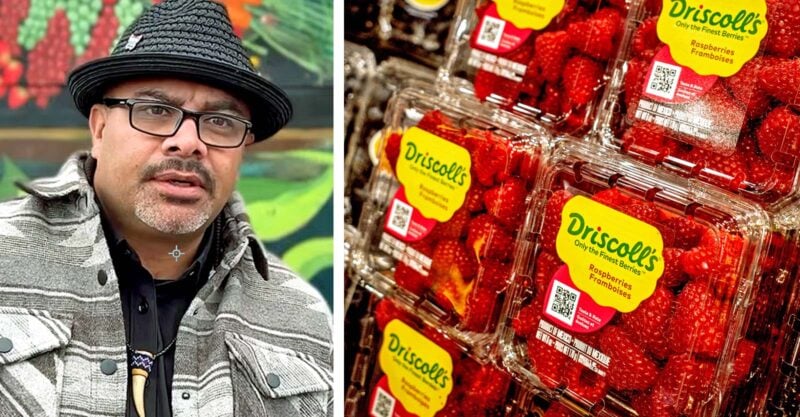


Omar Dieguez spent 30 days on a hunger strike to protest pesticide spraying in California’s berry-growing region and pressure berry giant Driscoll’s to convert fields surrounding schools to organic.
“It’s … hard to run into somebody that’s not suffering from pesticides,” Dieguez told the “Real Organic Podcast.”
The Watsonville resident said he has watched children in his community struggle with attention-deficit/hyperactivity disorder (ADHD), learning disabilities and childhood cancer as chemicals were applied to nearby fields.
“Our district has over 13 schools where pesticides are being sprayed, either right in their backyards or across the street,” Dieguez said. “It’s a real, serious problem, and that’s why I chose to do the hunger strike.”
Watsonville, where Driscoll’s is based, sits near the border of Santa Cruz and Monterey counties. Dieguez said those counties have some of California’s highest rates of childhood cancer and learning disabilities.
“We’re asking for Driscoll’s to stop spraying near our schools,” he said. “We’re asking for about 20 fields around our schools to be converted to organic. It’s not a big ask. They can do it.”


Chemical used on berries — and in nerve gas — ‘scrambles the brain’
Dieguez singled out organophosphate pesticides, which have the same chemical origins as lethal nerve agents developed by Nazi Germany.
“Organophosphate is so dangerous because … it scrambles the brain,” Dieguez said.
He said Driscoll’s uses “about 50 harmful pesticides,” but organophosphates are “one of the most dangerous ones.”
During the 1930s and 1940s, German scientists developed some organophosphate compounds into chemical warfare nerve agents, including sarin.
According to the Centers for Disease Control and Prevention, nerve agents are “chemically similar to organophosphate pesticides,” and both attack the nervous system.
Organophosphate poisoning — whether caused by agricultural products or nerve agents — can damage nerves and interfere with muscles and organs, potentially causing respiratory distress and death.
Pesticides are ‘landing on everything’
Dieguez said pesticide drift can contaminate “our water,” “our land” and “the air that we breathe.”
“Watsonville is about a 10-mile radius,” Dieguez said. “So if they’re spraying chemicals, and they’re traveling up to a seven-mile radius, more than half of Watsonville is being exposed to these harmful chemicals.”
He said pesticides used on the field can drift onto school grounds and into classrooms.
“These chemicals. They’re landing on everything — on the playground, they’re landing on their books, on whatever is outside,” he said. “If the doors are open, they’re drafting into the class.”
Dieguez said hearing about a farmworker who developed cancer and “had her stomach removed” after pesticide exposure convinced him he needed to act.
“I said, ‘We have to do something.’ That’s when I decided to do the hunger strike. The goal was to bring awareness to as many people as possible.”
Organic fields surrounded by ‘fields where they’re using pesticides’
Driscoll’s, headquartered in Watsonville, is a major presence in the community.
Dave Chapman, host of the “Real Organic Podcast,” said the company sells about 70% of the organic berries in the U.S., although organic production accounts for about 20% of its business.
Dieguez questioned how meaningful that organic production is when conventional fields sit alongside organic ones.
“They have a field that’s certified organic, but on the side of each of those organic fields, there are fields where they’re using pesticides,” he said. “So how organic is it? Not very organic, in my opinion, because we know that the chemicals drift.”
Dieguez said Driscoll’s should invest in “safer and better ways to farm in our communities” rather than what he described as efforts to silence criticism through community donations.
He said his local school district stopped him from giving student presentations about pesticides, calling the subject too controversial. And when he asked the cancer organization, Jacob’s Heart, for childhood cancer data, the group refused. Driscoll’s provides financial support to the organization.
Dieguez said donations to local schools and organizations can discourage people from speaking publicly about pesticide use. “The way we see it is, it’s a way of them silencing the people — buying their silence,” he said.
‘I just fell to the ground right there in front of the students’
Dieguez said he weighed nearly 280 pounds when he began the 30-day fast. By the end, he’d lost 52 pounds.
Despite six months of preparation, he said the physical toll caught up with him.
While giving a presentation on pesticides at an area school, his legs gave out. “I didn’t have the energy. I just fell to the ground right there in front of the students.”
Near the end of the fast, Dieguez was hospitalized with an infection he attributed to malnourishment. Doctors gave him an IV and antibiotics, but Dieguez said he insisted on finishing the 30-day commitment.
On the final day, Dieguez encountered Miles Reiter, Driscoll’s executive chairman and a member of the family that founded the company, at a hotel and asked him to talk.
Reiter declined, saying, “I’ve talked to some of your people. I’m very aware of who you are.”
Dieguez said Reiter has indicated the company is working on changes, but he remains skeptical about how quickly those changes will come.
“Basically, it felt like it was just a way of saying, ‘We’ll get to it when we have time,’” Dieguez said.
Boycott, lawsuit and leadership change come amid growing scrutiny
Dieguez’s hunger strike ended, but pressure on Driscoll’s has continued.
Activists launched a Driscoll’s boycott to stop pesticide spraying near schools and homes and convert more fields to organic production.
In August, three national environmental and health groups sued Driscoll’s in Washington, D.C. The lawsuit alleges the company misled consumers with environmental and sustainability claims, including that its production practices are “in harmony with the environment.”
Also in August, Soren Bjorn stepped down as CEO after less than three years in the position. Driscoll’s replaced him with Brie Reiter Smith, daughter of Miles Reiter.
According to Santa Cruz Local, Smith has engaged with activists in recent months following heightened criticism over pesticides. The outlet called it “an unusual move for leaders of the tightly guarded company.”


This article was funded by critical thinkers like you.
The Defender is 100% reader-supported. No corporate sponsors. No paywalls. Our writers and editors rely on you to fund stories like this that mainstream media won’t write.
‘That was the whole purpose — to get the youth … to want to make change’
For Dieguez, the most important result of the hunger strike was how it motivated local students.
“After I gave my presentations, there were always one or two young people who would come up to me and say, ‘Thank you for what you’re doing. My grandmother died from pesticides. My dad died from pesticides,’ or ‘I’m suffering from childhood cancer,’” he said.
Students at schools where Dieguez said he was not allowed to speak eventually organized their own town hall for him. They also made social media videos about ways to wash produce and created an Instagram page focused on pesticide awareness.
“That was the whole purpose — to get the youth to do something about it and to awaken them to want to make change in their communities,” he said.
Watch Dieguez on the ‘Real Organic Podcast’ here:
Related articles in The Defender
- For Millions of Kids, Back to School Means Back to Pesticide Exposure
- Watch: Tennessee Teen Drenched in Glyphosate Spent Next 7 Years Fighting ‘Massive Alien’ Tumor
- 6 Children in 1 Town Developed Rare Cancer. After Teen Dies, Families Demand Answers About Routine Use of Pesticides
- What’s Behind Skyrocketing Autism Rates — Better Diagnostics? Or an Avalanche of Toxins?
- Young Children Exposed to Pesticides in Early Life More Likely to Develop ADHD
