Login
Login
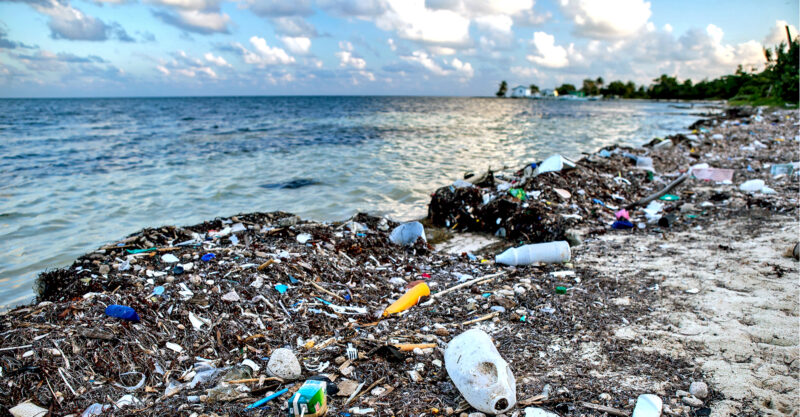


A new report out Friday from the Organisation for Economic Co-operation and Development (OECD) warns that the amount of plastic waste worldwide is likely to nearly triple over the next four decades, leaving the world with a terrible fate by 2060 if “radical action” is not taken to curb the level of pollution.
The report — titled “Global Plastics Outlook: Policy Scenarios to 2060” — predicts that nearly two-thirds of the estimated plastic waste polluting the environment by 2060 will come from short-lived and single-use products such as packaging, cheap toys, consumer goods, household items and textiles.
The report lays out projections of future plastic production and consumption as well as a set of policy scenarios that, if enacted, could drastically reduce the scale of the crisis humanity has created with its over-reliance on cheap plastics derived largely from fossil fuels.
“If we want a world that is free of plastic pollution, in line with the ambitions of the United Nations Environment Assembly, we will need to take much more stringent and globally coordinated action,” said Secretary-General Mathias Cormann, who heads the Organization for Economic Co-operation and Development.
“This report proposes concrete policies that can be implemented along the lifecycle of plastics that could significantly curb — and even eliminate — plastic leakage into the environment.”


According to an OECD statement:
“The report (available as a preliminary version ahead of its full publication later this year) projects global plastics consumption rising from 460 million tonnes (Mt) in 2019 to 1,231 Mt in 2060 in the absence of bold new policies, a faster rise than most raw materials.
“Growth will be fastest in developing and emerging countries in Africa and Asia, although OECD countries will still produce much more plastic waste per person (238 kg per year on average) in 2060 than non-OECD countries (77 kg).
“Globally, plastic leakage to the environment is seen doubling to 44 Mt a year, while the build-up of plastics in lakes, rivers and oceans will more than triple, as plastic waste balloons from 353 Mt in 2019 to 1,014 Mt in 2060.
“Most pollution comes from larger debris known as macroplastics, but leakage of microplastics (synthetic polymers less than 5 mm in diameter) from items like industrial plastic pellets, textiles and tire wear is also a serious concern.”
To avoid the worst-case scenarios, the report calls for a series of measures that include:
- Taxes on plastics, including on plastic packaging
- Incentives to reuse and repair plastic items
- Targets for recycled content in new plastic products
- Extended producer responsibility (EPR) schemes
- Improved waste management infrastructure
- Increased litter collection rates
The report also says that addressing the plastics crisis also has synergy with the effort to combat the planetary emergency of climate change.
“Identifying synergies between climate and plastics policies can enable countries to get closer to achieving their climate objectives,” the report notes, “while also reducing the environmental impacts of plastics.”
Originally published by Common Dreams.