

 Login
Login



“Do your job!”
That’s the message to the Food and Drug Administration (FDA) from Public Citizen, the consumer advocacy group fighting to get warning labels updated on selective serotonin reuptake inhibitors (SSRIs) and serotonin-norepinephrine reuptake inhibitors (SNRIs).
The popular antidepressants, which are known to have a numbing effect on people, can sometimes result in persistent sexual dysfunction, even after stopping the medication — leading to a rare condition called post-SSRI sexual dysfunction (PSSD).
For some sufferers, PSSD symptoms can be severe, long-lasting, irreversible and life-altering — See Rosie’s story.
Dr. Josef Witt-Doerring, a psychiatrist and former U.S. Food and Drug Administration (FDA) medical reviewer says he has spoken to dozens of patients with the condition who describe it as “torture.”
“It’s not just the sexual dysfunction that persists for years after stopping the drug, they also feel totally dissociated from life, almost as if they’re watching their life play out on a screen. They can’t feel anything,” explained Witt-Doerring.

In 2018, a group of physicians and researchers petitioned the FDA to “immediately require the addition of boxed warnings and precautions” on the drug labels and asked that “Dear Doctor” letters be issued to prescribers to warn of such risks.
“Even though the risk of PSSD may be rare, the condition is severe enough to sway someone’s decision to take the drug,” said Witt-Doerring.
“They might have mild depression and decide they’ll do talk therapy instead of taking the small risk of permanent sexual dysfunction. It’s important for people to have informed consent,” he added.
While the true rate of harm is unknown, a 19-year retrospective cohort analysis published last year, found 1 in 216 males taking a serotonergic antidepressant (80% took an SSRI) experienced erectile dysfunction long after discontinuing the drug.
Calling on FDA to act
U.S. law requires the FDA to respond within 180 days of receiving a petition, but it has been six years and the agency has remained silent.
This week, Public Citizen filed a lawsuit, on behalf of Dr. Antonei Csoka, PSSD researcher and scientific advisor for the PSSD Network, which alleges the FDA has behaved unlawfully in failing to act on the petition, and it asks the court to order the FDA to issue a decision.
“The FDA needs to act in a timely way to inform the public about the risks associated with use of these drugs,” said Michael Kirkpatrick, an attorney with Public Citizen and lead counsel. “The FDA’s failure to act exposes consumers to potentially life-long harm.”
It’s not the first time the FDA has been sued for failing to grant or deny a petition.
In 2021, Public Citizen sued the FDA for ignoring a petition that called for the withdrawal of a popular hair-loss drug, finasteride, after it was linked to depression, anxiety and suicidal ideation.
The FDA sat on the petition for four years.

Nine months after being sued, the FDA ruled on the petition — while it rejected the request to remove finasteride (and its generic versions) from the market, the regulator did require that patients be notified about reports of suicidal behavior in men taking the drug.
Witt-Doerring said it’s “unacceptable” that the FDA has failed to act in the case of antidepressant labeling. As a former FDA drug reviewer with insight into how the agency operates, he speculates the hold-up may be due to legal reasons.
“Given that other regulators in Canada and Europe have acknowledged the problem, perhaps there’s some legal reason for not acting. They don’t want to be on the wrong side of history with this decision,” speculated Witt-Doerring.
In 2019, the European Medicines Agency updated the “Special Warnings and Precautions” section to warn that sexual dysfunction can persist even after treatment stops.
And in 2021, Health Canada updated the product label for Canadians, after it reviewed the evidence and found “rare cases of long-lasting sexual symptoms persisting after stopping SSRI or SNRI treatment.”


The FDA must be aware of the problem because the regulator has already been alerted to the risk of PSSD by at least one drug company manufacturing antidepressants.
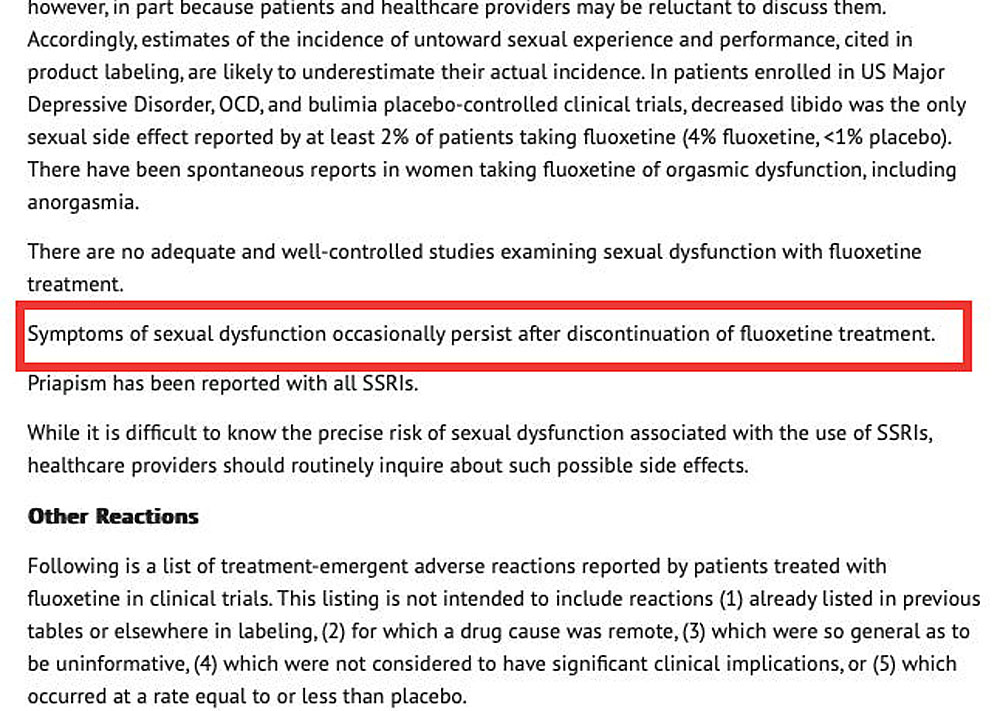
In 2011, Eli Lilly asked the FDA to include warnings on its own drug Prozac (fluoxetine), after reports of the condition had emerged in post-marketing surveillance. The FDA agreed and granted a label change.


Do you have a news tip? We want to hear from you!
Other antidepressants in the U.S., however, do not carry the warning. They include; citalopram (Celexa), escitalopram (Lexapro), paroxetine (Paxil), sertraline (Zoloft), vortioxetine (Trintellix), desvenlafaxine (Pristiq), duloxetine (Cymbalta), venlafaxine (Effexor).
“It’s incredibly disappointing that despite having several years to act, the FDA has neither acknowledged nor made any proactive efforts to further investigate PSSD,” said Witt-Doerring.
“The FDA could’ve conducted patient surveys or reached out to patients who submitted case reports, but they didn’t. They’re sticking their heads in the sand, and the public is paying the price,” he added.
The FDA was approached for comment, but a spokesperson stated, “The FDA does not comment on possible, pending or ongoing litigation.”
The PSSD Network promotes the scientific interest in PSSD to stimulate research projects that will work towards an in-depth, biological understanding of the condition.
Originally published on MaryAnne Demasi’s Reports Substack page.
