Login
Login
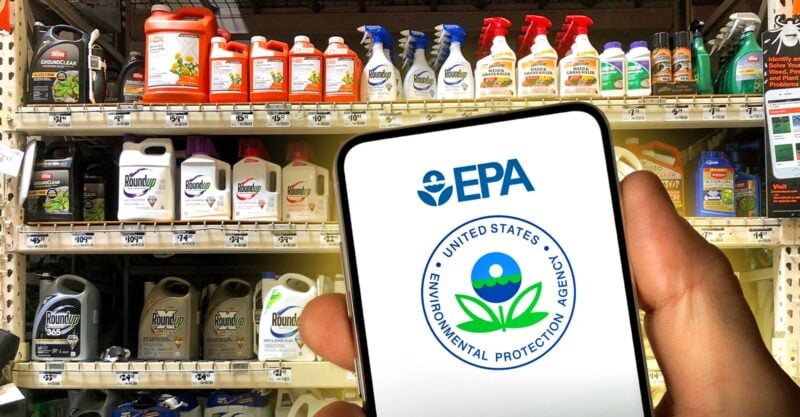


Thirty national and regional organizations sent a letter to Congress on Thursday opposing a provision in the Republican Farm, Food, and National Security Act (H.R. 7567) that would extend until 2031 all statutory deadlines for the U.S. Environmental Protection Agency (EPA) to complete hundreds of overdue pesticide safety reviews.
Under the Federal Insecticide, Fungicide and Rodenticide Act, within 15 years of the initial approval for every pesticide in current use, the EPA must review whether it is causing unreasonable environmental harms.
Section 10204 of the bill would delay this mandate without any preconditions. If enacted, the legislation would delay for many more years virtually all new restrictions and safeguards on pesticide products to protect people’s health, address impacts of endocrine disruptors and limit pesticide exposure to endangered wildlife.
“Republicans want to give the pesticide industry a get-out-of-jail-free-card by allowing the EPA to keep procrastinating in its review of the most dangerous pesticides on the market like atrazine, glyphosate and paraquat,” said J.W. Glass, senior EPA policy specialist at the Center for Biological Diversity.
“The EPA has never taken bold action to protect Americans from pesticides without a real deadline staring them in the face. If Congress extends this deadline five years, everyone knows that the agency will simply never come to grips with the pesticides that are making Americans sick. And you can be sure the EPA and industry will be back again in 2031 asking for another five-year extension.”
The current pesticide review cycle began shortly after 2007, and the deadline to complete these pesticide registration reviews ends on Sept. 30. Of the 726 total pesticide review packages covering more than 1,100 pesticide active ingredients, the EPA has only completed final registration review decisions for roughly 150 pesticide packages, most of which are for antimicrobial pesticides as well as low use and low toxicity products such as mosquito repellants.
The EPA has failed to complete registration for nearly all of the high-volume, conventional chemical pesticides due to systemic failures to comply with Congress’ mandates to address endocrine disruptors and to protect endangered wildlife.
The letter explains that the EPA’s pesticide office staff has steadily declined over the past 20 years, from more than 900 full-time equivalents in 2004 to just 520 this year. The loss of staffing has left the pesticide office unable to meet these statutory mandates designed to protect people’s health and the environment.


The groups recommend that deadlines should only be extended on a yearly basis and must be conditioned on substantial progress by the EPA in addressing the most dangerous pesticides on the market, including completing vital safety and environmental reviews for organophosphates, atrazine, paraquat and neonicotinoids.
To achieve these important conservation and environmental protections as quickly as possible, the letter also recommends that Congress condition any extension of EPA’s deadlines to review pesticides on new congressional legislation designed to achieve the following:
- The EPA must complete the registration review process for no fewer than 100 pesticide active ingredients per year.
- Congress must provide full funding to the EPA pesticide office of at least $400 million per year and provide an additional $50 million per year each to the U.S. Fish and Wildlife Service, National Marine Fisheries Service, and U.S. Department of Agriculture to fully protect endangered species from pesticides and to help farmers put in place any new safeguards required for pesticide applicators.
- The EPA must ensure that the pesticide office hires sufficient staff every year through 2031 to rebuild the office and there must be a prohibition on any workforce reductions such as those implemented by the U.S. Department of Government Efficiency or DOGE.
“The EPA needs the resources and staff to do what Congress and the law have told it to do,” said Glass.
“People shouldn’t suffer for years or decades from unsafe pesticide exposure just because the pesticide industry likes the status quo of a broken EPA. If Congress want to truly fix this problem, there are easy and straightforward ways to do so.”
Originally published by the Center for Biological Diversity.