

 Login
Login
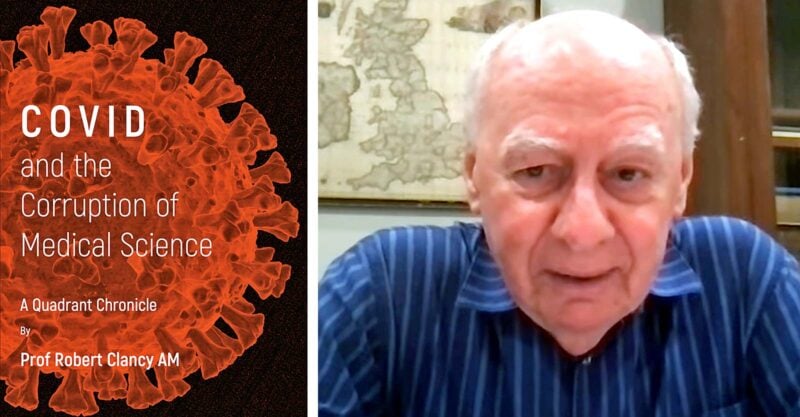


The future of patient care is at stake when scientists are discouraged from challenging prevailing views, immunologist Robert Clancy, Ph.D., told medical commentator John Campbell, Ph.D.
“Who would want to go into medicine today?” Clancy asked during an interview last week. “It’s been so controlled, and the bureaucracy is suffocating.”
Clancy, an Australian medical researcher, author of more than 300 peer-reviewed papers, and University of Newcastle emeritus professor, said the pressure extends beyond COVID-19 studies. Medical journals sometimes reject work unrelated to COVID-19 if the researchers have a history of challenging the mainstream pandemic narrative.
“It’s not just that they’re blacklisting articles related to COVID. They’re blacklisting people who [were] foolish enough to write on these topics,” he said.
Clancy’s new book, “COVID and the Corruption of Medical Science: A Quadrant Chronicle,” examines what he sees as the pandemic response’s lasting damage to scientific independence.
The book collects 14 essays he previously published in Quadrant, an Australian literary, cultural and political journal. Clancy said he turned to the publication during COVID-19 because “it tells things as it is.” Other journals and media outlets “would not publish the data and the evidence and the truth,” he said.
Campbell agreed, saying some mainstream medical journals “have been infiltrated by … this dominant narrative that only one way of thinking is allowed. It’s quite an alarming situation,” he said.
Clancy added, “It’s happening … in a not-so-subtle way right across the medical profession.”

‘It’s channeling the minds of young people’
Clancy said the COVID-19 pandemic fundamentally changed scientific research and publishing.
“There was a narrative which was all-engrossing,” he said. “It had political and strong medical overtones that essentially bought the major journals.”
Today, the problem begins long before a researcher submits a paper, according to Clancy. He said funding priorities can shape which scientific questions researchers pursue in the first place.
“It’s as easy as pie to get funding if you want to do [research] on messenger RNA vaccines or … the narrative-positive topics because there’s a lot of money around,” he said.
Clancy criticized the quality of some of those projects, calling them “just total rubbish.” But he said an equally significant problem is how funding incentives can influence which questions go unasked.
“It’s not just giving money for pretty crappy research projects,” he said. “It’s channeling the minds of young people.”
“Money is essential,” he added. “Young people say, ‘This is where the money is. This is where my research will go.’”
For example, researchers who want to investigate potential problems with mRNA vaccines may struggle to obtain funding. Even if they conduct the research, they may be unable to publish the results, Clancy said.
Campbell summed up the consequences: “So who controls the money is controlling what research is done and, more importantly, what research is not done.”
That can affect medical guidelines, which often rely on published research. Questions that never receive funding — and findings that never reach journals — may never factor into patient care.
“That leaves science and medicine in a really bad place,” Campbell said.
Government funding adds another layer of influence, Clancy said. He pointed to the millions of dollars governments have invested in mRNA research.
“It completely clouds the decision-making of … the research institutions [and] the universities,” he said. “This becomes a very, very big problem.”
Medical journals ignored ‘immunology 101’
Clancy said the pandemic also exposed the failure of medical journals, the media, governments and public health agencies to apply basic immunological principles.
Injected vaccines were not expected to reliably prevent infection or transmission of respiratory viruses such as flu, COVID-19 and respiratory syncytial virus (RSV), he said.
“Injected vaccines … were never going to stop people getting [inhaled virus] infections or stop them transmitting it to someone else,” he said. “And I think this was one of the great lies that was told early on and that is unforgivable.”
Clancy was particularly critical of the argument that vaccinating children would prevent them from bringing COVID-19 “home to grandpa” and infecting other family members.
“People should have known,” he said. “My students would have told you that you inject a vaccine, you’re not going to stop that person getting infected or transmitting it to someone else. … That’s immunology 101.”
‘Messenger RNA now has been inserted into our society’
Clancy said public health decisions during the pandemic were too often presented as settled science, which excluded dissenting voices and left little room to examine evidence that emerged later.
He pointed to what he considers persistent warning signs about mRNA vaccine safety. “No one can deny that there have been a forest of red flags raised over … the toxicity of the messenger RNA vaccines,” Clancy said.
He said the technology also raises fundamental immunological questions.
“Immunology is all about sensitivity, specificity,” he said. But with the mRNA vaccines, “you can’t control the dose.”
The vaccines put “a message into the body that goes to every cell. Every cell says, ‘Oh, we’ll make this antigen, this spike protein,’ and the body gets flooded with it,” he added.
Clancy linked mRNA vaccines to potential damage to blood vessels and organs, including the heart and brain, as well as strokes, heart attacks and cancer. He also suggested they may be a major cause of rising death rates.
Despite those concerns, Clancy said the technology continues to expand while public health messaging presents mRNA vaccines as safe. The technology is now being developed or used for additional diseases, including flu and RSV.
“The problem is that messenger RNA now has been inserted into our society,” he said. “Absolutely appalling.”


This article was funded by critical thinkers like you.
The Defender is 100% reader-supported. No corporate sponsors. No paywalls. Our writers and editors rely on you to fund stories like this that mainstream media won’t write.
‘Free thinking is becoming compromised’
For Clancy, the consequences extend beyond flawed pandemic policies to the future of medicine itself. He said the pandemic exposed a collapse of medical leadership and the growing influence of pharmaceutical companies.
“I think what COVID did is it made very clear the disintegration of leadership within medicine and the politicization and the substitution by aggressive big pharmaceutical companies, where the dollar is king,” he said.
Clancy worries that young researchers will avoid difficult questions if challenging accepted views threatens their funding or publication prospects. Over time, that could leave critical gaps in medical knowledge and weaken the evidence guiding future public health decisions.
Clancy acknowledged that reversing these trends will be difficult. “I don’t know what the answer is,” he said. “I’m certainly not going to be around long enough to make the changes that are needed.”
But he warned that the problem is ongoing, with consequences for the research being conducted today and the questions scientists are willing to ask.
“COVID’s been around a long time … but remember, COVID has not gone away,” he said. “Your institutions are being paid by money out of COVID. … Young people are being directed towards research programs that are not necessarily aligned to the best interests of the population. Lots of things are not being done … and free thinking is becoming compromised.”
“So, it’s a very practical thing,” he added. “It’s not just a word.”
Watch Clancy discuss the future of medicine here:
Related articles in The Defender
- ‘Muzzled and Muted’: Epstein, Gates Financed Research Portal to Control Scientific Discourse
- ‘Epic Scandal’: Bill Gates Donated Hundreds of Millions to NIH to Influence Research Priorities That Benefited His Foundation
- John Campbell: Excluding Dissenting Voices Is ‘Intellectual Fascism’
- Investigative Journalist Documents Shaping of COVID Narrative: ‘Censorship Begins From the Beginning’
- ‘First Do No Pharm’: New Documentary Exposes Big Pharma Corruption
- Significant Increases in Cancer Mortality After COVID mRNA Vaccination, Japanese Researchers Find
- Dr. Pierre Kory: New York Times Guide to Fall Vaccine Shots Is ‘Disinformation’
