Login
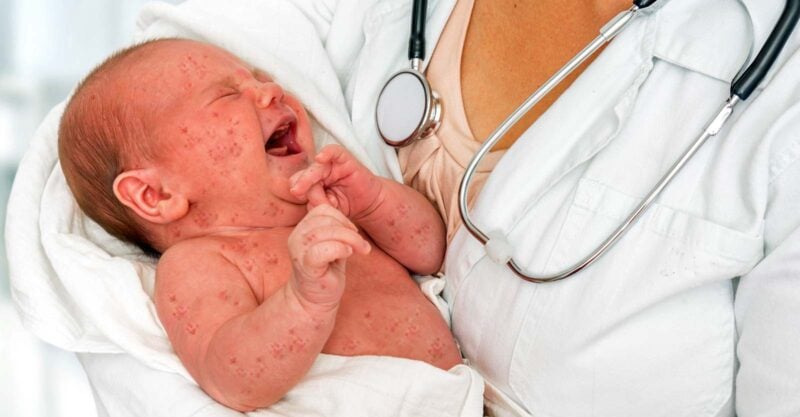


Congenital measles — when a baby contracts the virus in utero from the mother — has been making headlines since the Pennsylvania Department of Health (DOH) on Oct. 19 issued a health alert warning doctors about an increase in measles cases during pregnancy.
DOH’s alert provided clinical guidance on how healthcare providers can identify and treat measles in pregnant women and newborns.
The day after Pennsylvania released its alert, media outlets including NBC News reported that the U.S. historically rarely, if ever, sees cases of congenital measles. But now that appears to be changing. At least six babies in Pennsylvania have been born with measles so far this year, Pennsylvania doctors told NBC.
Pennsylvania health officials stress that the best way to prevent congenital measles is for the mother to get the measles-mumps-rubella (MMR) vaccine before pregnancy.
“Getting vaccinated before becoming pregnant is the best way to prevent measles and newborn measles,” the DOH said in an Oct. 19 press release. “The MMR vaccine should not be administered during pregnancy and pregnancy should be avoided for 28 days after receiving the MMR vaccine.”
However, doctors who spoke with The Defender said that decades of studies have shown that vaccine-induced measles immunity is weaker and fades faster than natural immunity — so women who had a natural measles infection as a child are better protected against giving birth to a baby with congenital measles than women who got the MMR vaccine.
“For the first time in a generation, American babies are being born infected with measles and the science told us this was coming,” said Michelle Perro, a pediatrician. “The vaccine program didn’t eliminate measles — it shifted the risk to the most vulnerable: newborns and the pregnant women carrying them.”
Dr. Ben Edwards, an integrative medicine family practitioner who successfully treated over 300 cases of measles during the West Texas measles outbreak and runs a private practice serving roughly 2,000 patients, said that before the MMR vaccine, measles was a “routine childhood illness” in which over 99% of children overcame it with “no problem, resulting in robust, permanent and life-long immunity.”
During that era, “practically all pregnant mothers had measles in their youth,” he said. The mothers passed along protective antibodies to their babies in the womb, which protected the babies during the “more vulnerable first year of life.”
As the baby grew up and the level of maternal antibodies faded, the child would get measles sometime in the first decades of life and develop its own robust, lifelong immunity.
“It’s really a beautifully designed natural immunization process — but we’ve lost that because of the measles vaccine program,” Edwards said.
Children’s Health Defense (CHD) Senior Research Scientist Karl Jablonowski agreed. “The natural course of measles pre-vaccine was to infect practically every immunologically-naive school-aged child every two years, imparting life-long immunity.”
The measles vaccine wiped out that natural cycle and brought with it inferior protection compared to naturally acquired protection, Jablonowski said.
The American Academy of Pediatrics (AAP) acknowledges that congenital measles was exceedingly rare before the introduction of the MMR vaccine. On Sept. 8, the AAP published new guidance on congenital measles so that doctors know how to identify and treat it.
“Many providers who have never seen measles except in textbooks are now having to learn what to do, how to look out for measles in their patients and how to manage them,” said Dr. Pia S. Pannaraj, a member of the AAP Committee on Infectious Diseases and professor of pediatrics at the University of California, San Diego.
The AAP defines congenital measles as an infection acquired before birth in which a newborn tests positive for measles or develops symptoms within the first 10 days of life.
If a pregnant woman gets measles, there’s about a 25%-30% chance she will transmit the virus to her baby, the AAP said.
A congenital measles infection is typically confirmed via clinical or laboratory testing. It’s different from neonatal measles, in which babies contract the virus after birth from close contact with people who have measles.
The rule of thumb is that if the baby develops a measles rash 10 days or more after birth, it’s likely neonatal measles. If the rash develops less than 10 days after birth, it’s likely congenital measles, the AAP said.
There is no national database on congenital measles, “likely because the disease hasn’t been routinely seen in the United States for decades,” the University of Minnesota’s Center for Infectious Disease Research and Policy (CIDRAP) reported.
“The same institutions that assured us measles was gone are now scrambling to count cases of a disease they never built a surveillance system for,” Perro said. “That’s a policy failure and babies are paying the price.”
CDC says it is providing guidance to doctors
So far this year, there have been at least 66 diagnosed measles cases in Pennsylvania among pregnant women, Pennsylvania DOH officials told NBC News on Oct. 20.
The DOH did not immediately respond when The Defender asked for the most recent data on the state’s number of measles cases in pregnant women and cases of congenital measles.
The Centers for Disease Control and Prevention (CDC) scientists are working to inform doctors on the risks of measles during pregnancy, including congenital measles, according to U.S. Department of Health and Human Services (HHS) Press Secretary Emily G. Hilliard. She told The Defender today:
“CDC is closely tracking measles and pertussis and providing clinicians and public health officials with guidance to protect mothers and babies. These reports are moving through CDC’s scientific review and clearance process, which informs publication decisions and timing.”
HHS declined to clarify how the CDC is currently providing guidance to doctors or what specific reports are moving through its scientific review and clearance process.
The agency’s measles webpage for clinical providers has not been updated since Aug. 5.
On Oct. 30, The Washington Post, citing anonymous internal sources, reported that CDC scientists tried to notify clinicians about a month ago through its Health Alert Network but failed to get the alert approved.
HHS declined to confirm or comment on the Post’s report.
‘Vaccinated pregnant women can also get a measles infection’
The Pennsylvania DOH emphasizes MMR vaccination as the best way to prevent congenital measles. However, it glosses over the fact that there are sometimes breakthrough infections among those who received the MMR vaccine, said CHD Chief Scientific Officer Brian Hooker.
“Because of the waning effectiveness of the MMR vaccine, vaccinated pregnant women can also get a measles infection during pregnancy, as can unvaccinated pregnant women,” Hooker said. “Both can also transmit it to the developing fetus.”
The chances of congenital measles are higher among unvaccinated women who did not previously have the virus, as the MMR vaccine does provide some protection against a measles infection, Hooker said. “However, the MMR vaccine is not guaranteed protection for the mother and fetus.”
A 2022 systematic review and meta-analysis in The Journal of Infectious Diseases found that protective antibodies for measles waned after vaccination — but not after a natural measles infection.
Studies differ on how quickly MMR vaccination protection against measles wanes, Perro said. Because vaccine-induced measles immunity is weaker and fades faster than natural immunity, infants of vaccinated mothers may have “almost no passive protection” against measles by their first month of life, she said.
In other words, babies born to mothers who received the MMR vaccine may be more susceptible to measles than babies born to mothers who had a natural measles infection during their childhood.
Congenital measles can be potentially life-threatening, said Jablonowski. “The hazard comes mostly in the narrow window before birth, where the infected mother has not yet produced the antibodies against the measles virus and therefore cannot pass them onto the child.”
In these instances, newborns can be given immunoglobulin and vitamin A, Jablonowski said.
According to the AAP’s FAQ, newborns who contract measles congenitally are at greater risk of brain swelling than children who contract the virus when older.
The Defender is 100% reader-supported. No corporate sponsors. No paywalls. Our writers and editors rely on you to fund stories like this that mainstream media won’t write. 

This article was funded by critical thinkers like you.
Have any of Pennsylvania’s ‘measles-associated deaths’ been congenital measles?
Pennsylvania has the highest number of measles cases, with 1,487 confirmed cases and six measles or “measles-associated” deaths as of Nov. 6. At least two of those were infants, but it is unknown whether they had congenital infections, according to CIDRAP.
Pennsylvania’s count included a stillborn baby, Ivan Miller, who tested positive for measles, suggesting a case of congenital measles. However, the coroner, Dr. Stephen Diamantoni, told the Philadelphia Inquirer the child died of a ruptured spleen — not from measles.
Diamantoni said in an Aug. 30 interview on WGAL8 that a measles infection can sometimes cause inflammation of the spleen, but there was no evidence that this was the case with the infant boy who died.
“The spleen was neither enlarged nor inflamed, and our forensic pathologist thought that, as that was the case, the laceration to the spleen was not related to the measles,” Diamantoni said.
The other infant, Mary Stoltzfus, died at 6 weeks after she was born with Amish lethal microcephaly, a condition that typically causes infants to die within six months of birth.
According to the coroner’s report, causes of death included cardiac arrest resulting from hypoxemic respiratory failure, measles infection and Amish lethal microcephaly, the Philadelphia Inquirer reported.
Strong immune system important for mother and baby fighting measles
Women who choose not to get the MMR vaccine and did not have measles as a child should be sure they build up a strong immune system in case they get measles while pregnant, Edwards said.
A strong immune system nourished by real, whole foods will help mothers and babies — whether in the womb or outside the womb — overcome measles symptoms and reduce the chances of negative outcomes.
“In my clinical experience treating over 300 cases of measles in 2025,” Edwards said, “I observed patients who were well nourished — with real food instead of processed food, including breastfed instead of bottle-fed — overcome measles much easier, most likely because their bodies had higher levels of vitamin A, vitamin C, minerals and various micronutrients that are found in real food diets.”
Related articles in The Defender
- Coroner Confirms 7-Month-Old Is New York’s ‘Measles-Associated’ Death — Health Officials Mum on Details
- Pennsylvania Coroner Investigating Death of Second Child With Positive Measles Test
- 6-Week-Old Amish Infant With Fatal Genetic Condition Died From Measles, Coroner Confirms
- Exclusive: Most Kids Can Fight Measles Naturally — and Having the Virus May Even Make Them Stronger
- Exclusive: ‘Just Normal Doctoring’ — a Texas Doctor’s Eyewitness Report on Measles Outbreak