Login
Login
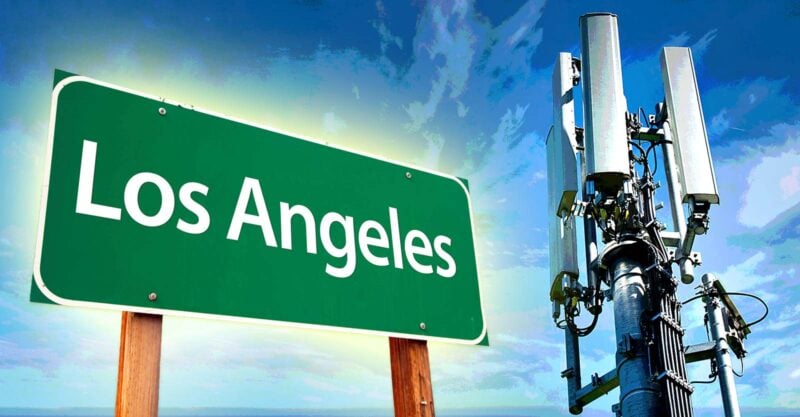


Los Angeles County officials must ensure that new cell towers and 5G antennas meet strict fire risk safety standards and that residents are given a two-week notice and comment period before the county approves new tower applications, according to a legal settlement released last week.
The settlement, filed Dec. 4 in the Superior Court of the State of California for the County of Los Angeles, is the culmination of over two years of litigation by Children’s Health Defense (CHD) and a coalition of community and environmental groups advocating for safe technology. CHD funded the suit.
CHD and the other plaintiffs didn’t get everything they wanted, but the settlement was “overall a success,” according to Miriam Eckenfels, director of CHD’s Electromagnetic Radiation (EMR) & Wireless Program.
“We won some, lost some, but negotiated a settlement that protects people better than had we not brought the suit.”
In March 2023, the groups sued Los Angeles County and its leaders after county officials passed two ordinances allowing wireless companies to install wireless infrastructure without environmental review or public input.
The terms of the settlement, which outline changes to the Los Angeles County ordinances opposed by the groups, are still confidential and awaiting final approval by the county board of supervisors.
However, those who reviewed the document told The Defender it provides several key wins for county residents and is likely to be approved.
The successful settlement underscores the importance of “hashing things out” at the local level, Eckenfels said. “If a county decides not to protect its residents, communities can sue and push for more protective ordinances,” she said.
Currently, the Federal Communications Commission (FCC) and federal lawmakers are pushing to streamroll local control by making it easy for telecom companies to install cell towers in communities without residents’ consent.
If either the agency or Congress succeeds, communities will lose the right to keep unwanted towers and other wireless infrastructure away from their homes and schools.
“That’s why we are opposing the federal power grab,” she said. CHD launched a “Light It Up For Local Control!” campaign so residents can take flyers and go downtown to spread the word about mounting massive opposition.
Plaintiffs secured better fire risk protections, public notice
CHD obtained a settlement that requires wireless companies that want to install new cell towers or 5G small cells to provide county officials with four engineering documents, signed and sealed by a California-licensed professional electrical engineer.
“When a professional electrical engineer signs and seals his or her name on a document, they are certifying that it is safe,” said Susan Foster, a fire and utility consultant who co-founded the nonprofit California Fires & Firefighters, one of the groups in the suit.
Los Angeles “desperately” needs that kind of fire risk protection, Foster said.
She pointed out that just north of Los Angeles, telecommunication equipment in Malibu sparked two “devastating” fires — the Malibu Canyon Fire in 2007 and the Woolsey Fire in 2018.
The settlement also ensures that residents won’t just wake up one morning to find a work crew outside their home installing a wireless tower. The county agreed to a two-week notice period during which residents can comment on the proposed plans.
“This is important because it gives residents a chance to organize and push back against proposed towers they don’t want in their neighborhood,” Eckenfels said.
W. Scott McCollough — CHD’s chief litigator for its EMR cases, who works on lawsuits like this one across the country — recently appeared on a Florida news station, where he discussed how important it is to fight an unwanted cell tower before it’s approved by local officials. “It is very, very difficult to get something removed that is already started.”
The settlement also awarded the plaintiffs roughly $400,000 for attorney fees and affirmed that new towers or antennas proposed on scenic highways or historic buildings must first undergo the environmental review process required by the California Environmental Quality Act.


Cell towers could still be ‘dangerously close’ to homes
However, the settlement didn’t give the plaintiffs everything they pushed for.
“We did not achieve setbacks, which are key to the protection of people’s homes,” said Julie Levine, a member of Fiber First LA and 5G Free California.
Los Angeles County allows towers and antennas to be only 20 feet away from homes, Foster said. “That might be 20 feet from a child’s bedroom window. That is dangerously close.”
It’s best if the towers are at least 1,640 feet from homes, businesses and schools, according to New Hampshire’s Commission to Study the
Environmental and Health Effects of Evolving 5G Technology, a team of independent experts convened by the state to answer questions about the impacts and safety of cell towers and wireless radiation.
In addition to CHD, plaintiffs in the suit included Fiber First LA, Mothers of East LA, Boyle Heights Community Partners, United Keetoowah Band of Cherokee Indians in Oklahoma, Union Binacional de Organizaciones de Trabajadores Mexicanos Ex Braceros 1942-1964, California Fires & Firefighters, Malibu For Safe Tech and 5G Free California.
Related articles in The Defender
- ‘Huge Win’: Court Rules Big Telecom Must Comply With State Environmental Laws
- ‘Historic Day’: Judge Hears Arguments in CHD Lawsuit Challenging Fast-tracking of 5G Infrastructure in Los Angeles
- CHD, California Groups Sue Los Angeles County to Stop Fast-Track Proliferation of Wireless Towers
- CHD Plans Lawsuit After Los Angeles County Approves Fast-Tracking of Wireless Towers
- ‘Democracy at Work’: L.A. County Delays Decision on Fast-Tracking Wireless Towers After Public Outcry