
 Login
Login
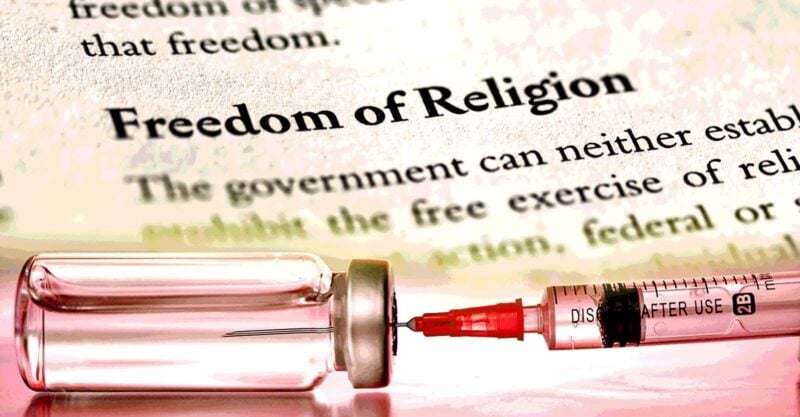


Children’s Health Defense (CHD) this week filed an amicus brief in a key West Virginia vaccine exemption case before the U.S. Supreme Court — a case that may have broader implications for the future of religious exemptions in the U.S.
The case involves a child who was disenrolled from the West Virginia Virtual Academy, an online public school, after school officials discovered she was not fully vaccinated.
West Virginia law requires students who attend public or private schools to be vaccinated but exempts students who are homeschooled or attend microschools or learning pods. The state does not offer religious exemptions.
Anthony and Krystle Perry argued that vaccinating their child conflicted with their Christian beliefs and sought a religious exemption, which was denied.
In its brief, CHD argued that the case has constitutional implications because West Virginia’s law violates First Amendment free-speech protections and the 14th Amendment’s equal protection provisions.
In October 2024, a lower federal court sided with the family and issued a preliminary injunction allowing the child to return to school while the case proceeded.
However, the 4th U.S. Circuit Court of Appeals reversed the decision in April. In its 2-1 ruling, the appeals court ruled that the parents are unlikely to succeed on their constitutional claim. The court found that West Virginia’s failure to allow religious exemptions doesn’t violate the First Amendment’s protection of religious freedom.
CHD said the 4th Circuit’s ruling “has grave implications for parental rights and religious liberty” — and violates Supreme Court precedent. CHD cited its “substantial interest in the standards governing religious exemptions from vaccination requirements” in weighing in on the case.
CHD General Counsel Kim Mack Rosenberg told The Defender that “both religious freedom and parental rights are under attack” in the Perry case.
Other health and medical freedom advocates have also sought to intervene, including Physicians for Informed Consent, which also filed an amicus brief this week.
West Virginia is one of only five states that prohibit religious exemptions from school vaccine mandates. The others are California, Connecticut, Maine and New York.
Federal appeals court ‘impermissibly impinged’ on constitutional rights
The case is part of a broader legal battle over religious exemptions in West Virginia.
In January 2025, Gov. Patrick Morrisey issued an executive order on his first full day in office, allowing religious exemptions from mandatory school vaccinations.
However, the West Virginia Department of Education directed the state’s schools to ignore Morrisey’s order and instead follow existing vaccine laws, which don’t recognize religious exemptions.
Writing for the majority in the 4th Circuit’s April ruling, U.S. Circuit Judge Harvie Wilkinson argued that states have broad authority to protect public health, including through mandatory vaccination laws that prohibit religious exemptions.
In its brief, CHD said the appeals court ruling “has impermissibly impinged” on the Perry family’s constitutional free exercise rights, which Supreme Court precedent “directly forbids.”
CHD cited recent Supreme Court decisions in Mahmoud v. Taylor and Miller v. McDonald.
In its 2025 ruling in Mahmoud, the Supreme Court sided with parents who wanted to opt their kids out of LGBTQ-themed elementary school books on religious grounds. The court found that eliminating the opt-out would substantially burden the free exercise of religion.
In its March ruling in Mirabelli v. Bonta, the Supreme Court reinstated a lower court’s injunction barring California public schools from keeping a student’s gender identity or transition secret from parents. In this case, the court found that parents are free to raise their children according to religious belief.
CHD’s brief noted that in both rulings, the Supreme Court found that strict scrutiny must be applied “in analyzing government interference with parental rights.”
Under strict scrutiny, the highest standard of judicial review, a government action — such as denying a religious exemption — is presumed unconstitutional. To justify the action as constitutional, the government must clear a high bar.
The brief cited U.S. Circuit Judge Paul Niemeyer’s dissenting opinion, which argued that the majority failed to apply relevant Supreme Court precedent when it overturned the injunction. According to the dissent, West Virginia’s policy unfairly burdens religious families and should have been reviewed on the basis of strict scrutiny.
“CHD took the opportunity to bring to the Supreme Court’s attention the long history of protecting parents’ First and 14th Amendment rights, beginning in the 1920s with Meyer and Pierce and culminating most recently with strong decisions favoring parental rights in Mahmoud and Mirabelli,” Mack Rosenberg said.


This article was funded by critical thinkers like you.
The Defender is 100% reader-supported. No corporate sponsors. No paywalls. Our writers and editors rely on you to fund stories like this that mainstream media won’t write.
CHD previously intervened in cases challenging West Virginia’s law
Other ongoing cases also challenge West Virginia’s failure to recognize religious exemptions.
In a 2025 lawsuit, Guzman v. West Virginia, a mother whose religious exemption request for her daughter was denied, argued that West Virginia violated a 2023 state law — the Equal Protection for Religion Act (EPRA).
A November 2025 ruling by Raleigh Circuit Judge Michael Froble held that schools could no longer enforce policies that bar unvaccinated kids from attending classes or activities.
The state Supreme Court put that decision on hold in December 2025 and agreed to fast-track its review at the Board of Education’s request. The case remains pending.
In March, Morrisey told The Defender he was “disappointed” the board chose to challenge the decision “rather than stand up for the religious freedoms of our students and families.”
In May, Morrisey filed an amicus brief in the Guzman case, asking the state Supreme Court to uphold the ruling finding that the state’s school vaccine policy violates the EPRA because it doesn’t recognize religious exemptions.
CHD also intervened in that case. In its amicus brief, CHD noted that major medical organizations supporting West Virginia’s vaccine mandates for schoolchildren have extensive financial ties to Big Pharma.
CHD said the medical groups, which include the American Academy of Pediatrics (AAP), cannot be treated as neutral public health authorities because of their longstanding monetary and institutional relationships with vaccine makers.
Last year, AAP publicly advocated for the abolition of religious exemptions for schoolchildren.
Mack Rosenberg said that while CHD ultimately seeks the elimination of vaccine mandates across the U.S., its advocacy supporting the right to religious exemptions is a step toward that direction.
“While CHD continues to advocate for an end to vaccine mandates, it is critically important in the interim to fight to maintain religious exemptions in those states that recognize them and to fight for their restoration in states that have unconstitutionally stripped these rights,” she said.
Related articles in The Defender
- Children’s Health Defense Weighs in on West Virginia Religious Exemption Case
- Appeals Court Upholds West Virginia Vaccine Mandate, Rejects Religious Exemption for Online School
- West Virginia Governor Clashes With Education Officials Over Religious Exemptions
- West Virginia Supreme Court to Review Religious Exemptions Case
- ‘Huge Win’: West Virginia Governor Issues Executive Order Allowing Religious Exemptions
- West Virginia Schools Ordered to Defy Governor on Religious Exemptions