Login
Login
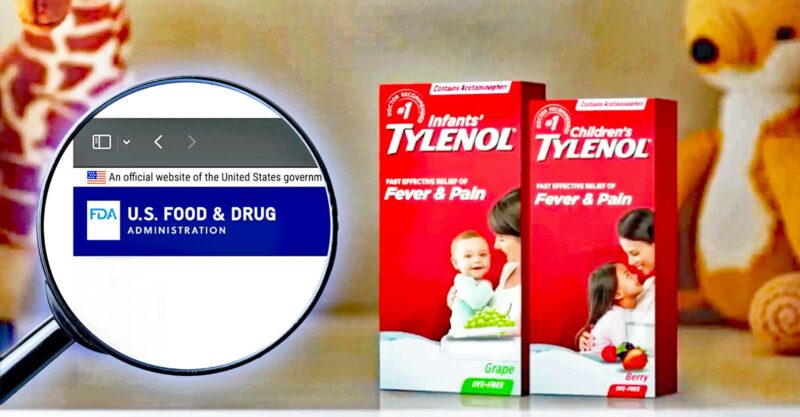


Children’s Health Defense (CHD) is asking the U.S. Food and Drug Administration (FDA) to ban over-the-counter Infants’ Tylenol from the market and require boxed warnings on acetaminophen products for children under 6.
CHD on Monday filed a Citizen Petition with the FDA, arguing that growing scientific evidence links Tylenol to autism spectrum disorder (ASD). CHD is urging the public to submit comments on the petition.
“To be blunt, for infants and young children, there is no safe dose of Tylenol products and, most particularly, there is no safe dose for neonates and infants under two,” the petition said.
Despite evidence of harm, “parents and doctors are not warned that Tylenol products pose a risk of ASD for infants and young children who take the drug even when administered in the recommended dosage,” the petition states.
The CHD petition outlines the science behind the claim that a significant portion of autism cases are the result of a chemically induced injury caused by exposure to acetaminophen in infancy and early childhood in children who are biologically susceptible because of genetic, metabolic or environmental factors affecting how they process the drug.
CHD is calling on the FDA to:
- Ban over-the-counter Infants’ Tylenol and similar acetaminophen products containing acetaminophen.
- Require boxed warnings on acetaminophen products intended for children younger than 6 warning of autism risk.
- Require boxed warnings advising against acetaminophen use during labor and delivery.
“Boxed warnings” are the FDA’s most serious warning label, used to indicate that a drug is associated with a serious hazard, often including death or life-threatening reactions.
“The evidence regarding neurological damage done by perinatal and postnatal use of acetaminophen is very clear as is a strong relationship with autism incidence, especially when used following vaccine administration,” CHD Chief Scientific Officer Brian Hooker, one of the petition’s signatories, said.
“Acetaminophen has never been appropriately tested for neurological harm in infants and small children and many of these individuals lack the capacity to appropriately detoxify this very widely used over-the-counter drug.”
A Citizen Petition is a formal request to the FDA to take regulatory action. Citizen Petitions, typically submitted by an organization, require extensive documentation of the issue and the legal basis for the claim.
Read the full petition and cover letter here.
Babies have reduced ability to detoxify acetaminophen
Acetaminophen, the ingredient found in hundreds of prescription and over-the-counter medicines — including Tylenol products — is routinely recommended for fever reduction and the relief of mild to moderate pain.
Pregnant women commonly take it, and it is often given to young children.
Although it is often given to children under age 2, Tylenol doesn’t provide a recommended dosage, instead directing consumers to ask their doctor. “This sets up a dangerous scenario for potential overdosing since a prescription is not necessary for purchase,” the petition stated.
More than 600 prescription and over-the-counter medications contain acetaminophen, according to the FDA.
The drug has long been linked to liver toxicity, and several studies over the last decade — including one published last year by researchers at Harvard Medical School — have found that children exposed to the drug during pregnancy may be more likely to develop neurodevelopmental disorders, including autism and attention-deficit/hyperactivity disorder or ADHD.
The Citizen Petition to the FDA incorporated research by William Parker, Ph.D., who worked as a researcher at Duke University for decades and today heads the WPLab.
Parker has spent more than a decade studying the effect of acetaminophen combined with oxidative stress on neurodevelopment, and published that research in top journals. He is the author of “Tylenol and Autism: Evidence, Scientific Blunders, and Medicine Gone Wrong.”
Parker’s research has shown that newborns and young infants have immature metabolic pathways that reduce their ability to detoxify acetaminophen, potentially increasing production of a toxic liver byproduct known as NAPQI. This biological vulnerability is greatest shortly after birth and gradually decreases until about age 6.
The petition describes “31 lines of evidence,” which, taken together, support that conclusion.
The evidence includes studies of acetaminophen metabolism, animal experiments, epidemiologic research and clinical observations that CHD says collectively demonstrate a causal relationship between acetaminophen exposure and autism.
According to the petition, existing warnings focus primarily on liver toxicity while failing to inform parents and healthcare providers about what the petitioners describe as neurodevelopmental risks.
President Donald Trump warned last year that pregnant women should not take Tylenol, and the FDA announced that it will add safety warnings to labels on products containing acetaminophen. Those warnings have not been implemented.
The key difference in this petition is that it doesn’t focus on pregnancy. The petition argues for labeling that distinguishes between prenatal exposure and exposure after birth.
According to the petition, many studies report associations between frequent acetaminophen use during pregnancy and autism. However, the greatest risk occurs after delivery, when newborns no longer benefit from maternal metabolism of the drug and have limited ability to process it themselves.
The Defender is 100% reader-supported. No corporate sponsors. No paywalls. Our writers and editors rely on you to fund stories like this that mainstream media won’t write. 

This article was funded by critical thinkers like you.
‘Scientific blunders’ obscured connection between Tylenol and autism
The authors also criticize several recent epidemiological studies that found little or no association between prenatal acetaminophen exposure and autism after statistical adjustment.
They argue those analyses improperly treated biological factors related to oxidative stress as confounding variables rather than part of the mechanism by which acetaminophen could contribute to autism risk.
Parker told The Defender the petition “deals very incisively with key scientific blunders responsible for obscuring the connection between acetaminophen and autism in the minds of many.”
Until now, a single line of evidence the petition calls “easily misconstrued” — one that concluded no risk between acetaminophen use in pregnancy and ASD — has dominated the discussion about the drug’s link to autism overall.
The petition provides an extensive analysis of errors in that line of thinking, and outlines countervailing evidence from many other studies that the petitioners argue provide sufficient evidence for concern.
CHD contends that waiting for definitive randomized clinical trials would be both impractical and unethical because, if the petition’s interpretation of the evidence is correct, intentionally exposing infants to the drug would pose unacceptable risks.
Instead, CHD urges regulators to apply the precautionary principle and act before definitive proof of causation becomes available.
The FDA will review the petition and determine whether regulatory action is warranted based on the available scientific evidence. It must typically respond within 150-180 days.
According to the Centers for Disease Control and Prevention, 1 in 31 U.S. children born in 2014 were diagnosed with ASD in 2022, and the numbers are rising dramatically.
Related articles in The Defender
- Tylenol Maker Pushes Back Against FDA Warning on Pregnancy Risks
- Tylenol, FDA Knew About Autism Risk For Years, Newly Surfaced Emails Show
- Tylenol Use During Pregnancy Linked to Delayed Language Development
- Tylenol Use in Babies, Children Raises Risk of Autism, New Review Shows
- The Latest on Tylenol and Autism: What We Know, How We Know It and What It All Means
- Texas AG Sues Tylenol Makers for Hiding Autism Risks, Misleading Pregnant Women
- RFK Jr. Blasts Tylenol-Chugging TikTokkers as Experts Explain Why Taking Acetaminophen During Pregnancy May Be as Risky as Drinking Alcohol
- Exclusive: Hundreds of ‘Tylenol Lawsuits’ Allege Retailers, Manufacturers Knew Acetaminophen During Pregnancy Could Cause Autism, ADHD
- Media Claims ‘No Science’ Linking Tylenol to Autism — But Studies by Major Medical Institutions Raise Red Flags
- HHS Will Link Autism to Tylenol Use During Pregnancy, Wall Street Journal Reports