

 Login
Login
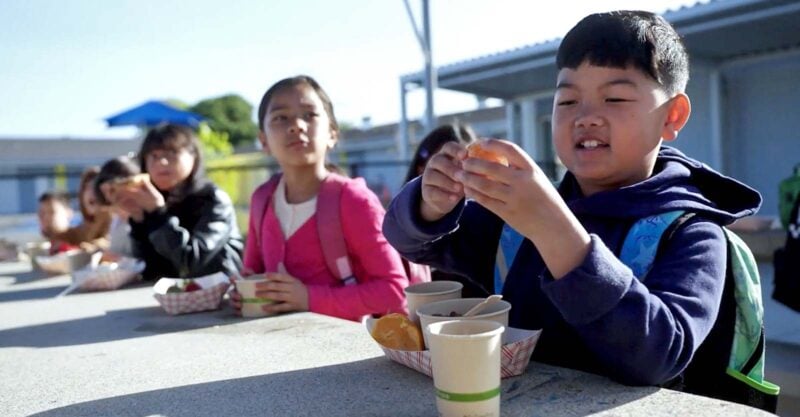


As students head back to classrooms this fall, the push to serve healthier school meals is gaining momentum. States are banning artificial dyes and other additives, federal officials are calling for more whole foods, and schools are looking for ways to improve nutrition without breaking already strained budgets.
Judi Shils, founder and executive director of the California nonprofit Conscious Kitchen, said those challenges are precisely why schools need new approaches.
“Where there’s a will, there’s a way,” Shils told The Defender.
Since 2013, Conscious Kitchen has worked to rebuild the school food system from the ground up by connecting school districts with local organic farmers, helping schools buy healthier food at scale and teaching children where their meals come from.
The Sausalito-based nonprofit’s long-term goal is to make organic food available to all 6 million students in California’s public schools while creating a blueprint that communities across the country can adapt.
The effort comes as federal officials and states push to limit dyes and other additives in school meals.
U.S. Health Secretary Robert F. Kennedy Jr. has urged schools to serve more whole foods and fewer artificial ingredients. States including Louisiana, Texas, Utah, West Virginia, Arizona and Virginia have approved restrictions on certain artificial dyes and processed foods in school meals.
But changing ingredient lists is only one piece of the puzzle. As Civil Eats reported in July, schools face challenges with purchasing systems, budgets, kitchen infrastructure and staff training — problems Conscious Kitchen has spent more than a decade trying to solve.
“It’s a very interesting, intricate, nuanced, incredible puzzle, and I think we’re getting to the other end, which is so fun,” Shils told Civil Eats. “Just knowing what levers we can pull to help everybody realize what they can do together and then doing it — not waiting, not thinking about it, but just diving in.”


From a one-week experiment to a statewide model
Conscious Kitchen began with a simple challenge.
Parents in one California school district told Shils their children were eating “horrible” food at school. Rather than accept that as inevitable, Shils proposed an experiment.
Drawing on a career in live television, where she learned “no” was not an option, Shils approached the superintendent at Bayside Martin Luther King Jr. Academy in Marin City with an idea: replace the school’s processed, heat-and-serve meals with fresh, local, seasonal organic food for one week.
Shils said she worked with a farm-to-table chef on entirely organic meals that “transformed that little school.”
“I realized we could do this,” Shils told The Defender. “We proved it in a tiny way, and then we proved it in a huge, massive way.”
Today, that one-week pilot has grown into a statewide effort.
Conscious Kitchen now works with more than 112 California school districts and over 59 organic farms, helping schools buy healthier food while building direct relationships with local growers.
COVID upended school meal programs throughout U.S.
The model faced its biggest test during the COVID-19 pandemic, when school closures upended meal programs across the country.
Working with California’s West Contra Costa Unified School District, Conscious Kitchen helped redirect procurement toward organic ingredients, investing $17 million into local food systems to purchase 10.7 million pounds of organic food for 18.7 million boxed meals.
The partnership continued after students returned to the classroom. Within a year, the district increased the share of organic ingredients in school lunches from zero to about 60%, according to Shils.
But success isn’t just about finding healthier ingredients, she said. It’s about making them practical for schools to buy.
The nonprofit helps districts combine their purchasing power, works with distributors to stock products schools need and partners with food companies to develop foods that meet nutrition standards while fitting the realities of large school kitchens.
“We are pushy,” Shils said. “We figure out how to get to the other end of the problem.”
That persistence has led to partnerships with companies including Nature’s Path, which worked with Conscious Kitchen to develop an organic cereal that met whole-grain requirements for school meals.
Ultimately, Shils said, the goal isn’t to create a system that depends on Conscious Kitchen. It’s to help schools, farmers and distributors build relationships that continue long after the nonprofit steps away.
Helping schools make healthier food work
Changing what’s on students’ lunch trays takes more than better ingredients, according to Conscious Kitchen. It also requires providing school nutrition staff with the training, recipes and support to prepare healthier meals that children will actually eat.
The nonprofit offers scratch-cooking training for cafeteria staff and recently launched The Conscious Kitchen Recipe Project, which adapts popular school meals using organic ingredients.
Introduced in July, the project draws recipes directly from participating school districts, reworking student favorites instead of asking schools to reinvent their menus.
The nonprofit also provides practical tips for making healthier foods more appealing to children, such as blending vegetables into familiar sauces, incorporating pureed beans into kid-friendly dishes and using “ugly” fruit in smoothies to reduce food waste.
Beyond the kitchen, Conscious Kitchen helps schools involve students in learning about the food they eat. Children serve as taste-testers for new recipes and explore composting, food waste, California agriculture and other topics through programs including Produce Pals, Produce of the Month and The Anatomy of a Sandwich.
The organization also brings together the adults responsible for getting healthier food onto students’ plates.
Since 2023, Conscious Kitchen has hosted 15 farm-to-school workshops that connect farmers, school nutrition directors and other partners to share ideas and build working relationships.
Those gatherings, Shils said, “have been one of the best things we’ve ever done.”
The relationships often lead to new purchasing partnerships, giving schools more access to locally grown organic food while creating dependable markets for farmers.
Building lasting partnerships between schools and farmers
Getting healthier food onto the menus is only part of the challenge. The harder question is how to build the supply chains, purchasing systems and relationships that allow schools to keep doing it.
Conscious Kitchen works with schools, farmers, distributors and food manufacturers to solve those logistical challenges.
For schools, it makes organic food easier to buy. For farmers, it creates reliable, long-term customers at a time when many small farms are struggling. About 15,000 farms closed or consolidated nationwide between 2024 and 2025, according to the U.S. Department of Agriculture.
By connecting growers with districts that serve thousands of meals each day, Conscious Kitchen can create stable markets that strengthen local agriculture.
Shils said the nonprofit’s role is to bring the right people together, then let those relationships grow on their own.
The organization has also worked to make organic food easier to buy through existing procurement systems rather than asking schools to start over.
In 2024, Conscious Kitchen helped expand access to organic products through the U.S. Department of Defense (DOD) Fresh Fruit and Vegetable Program, which schools across the country already use.
“All the school districts that we work with that want organic produce started pulling their money out of the DOD [program] because they wanted to buy direct and they wanted to buy organic,” Shils told Civil Eats. “And so we started working with … the two distributors in our state and we asked them to bring in some of the smaller farmers and see if that worked.”
The effort has since added more than 36 organic produce items from small- and mid-sized farms, making it easier for schools to buy organic produce through a familiar purchasing system.
For Shils, that’s exactly how lasting change happens — not by waiting for a perfect solution, but by improving the systems schools already use.
The key, she said, is “testing and trying and seeing that you really can do this.”


This article was funded by critical thinkers like you.
The Defender is 100% reader-supported. No corporate sponsors. No paywalls. Our writers and editors rely on you to fund stories like this that mainstream media won’t write.
A model other communities can build on
After more than a decade of refining its approach in California, Conscious Kitchen is beginning to look beyond the state.
Shils believes the ingredients for success already exist in communities across the country. Every state has farmers, school nutrition leaders, distributors and educators, she said. What many communities need is someone to help bring those groups together.
“For us, growth has never meant replicating a program,” Shils said. “It means helping communities discover what’s possible.”
That doesn’t mean exporting a California model.
Instead, Conscious Kitchen hopes to help each community build a school food system that reflects its own strengths.
“There is no one-size-fits-all model,” Shils said. “Every community’s journey looks different. Some begin with a single organic ingredient, others with one recipe, one partnership, or one district ready to take the first step.”
Related articles in The Defender
- He Walked Away From the World’s Best Restaurant. Now He’s Fixing School Lunch.
- Watch: He’s Getting Junk Food Out of Military Bases — and Says We Can Do the Same in Schools and Hospitals
- Dunkin’ Brings the ‘Joy’ of Junk Food to Sick Children in Hospitals
- California Lawmakers Move to Ban Ultraprocessed Foods From School Lunches
- ‘Shocking’: Heavy Metals, Nearly 50 Pesticides Detected in School Lunches
