Login
Login
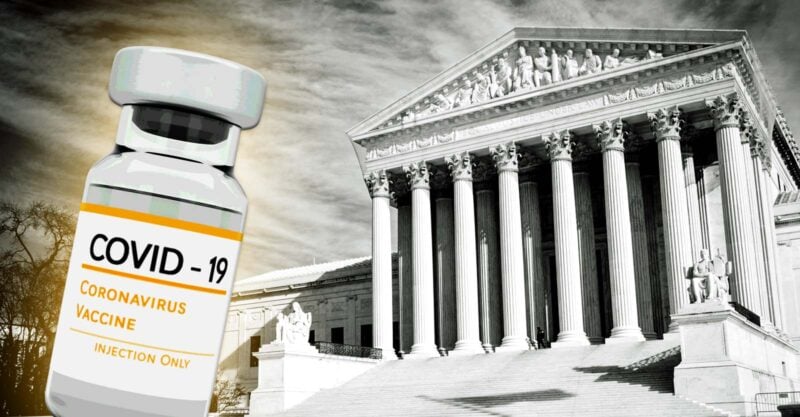


The U.S. Supreme Court on Monday declined to hear two COVID-19 vaccine mandate cases, sending mixed signals about the court’s stance on religious exemptions.
The decision not to hear a class action lawsuit against United Airlines for placing unvaccinated employees on unpaid leave favors those who support religious exemptions.
The decision in the United Airlines lawsuit preserves a March ruling by the U.S. Court of Appeals for the 5th Circuit that the airline’s employees have the right to pursue their religious-discrimination claims as a class.
The case now returns to the U.S. District Court for the Northern District of Texas, which yesterday ordered the case reopened.
However, in a second decision Monday, the Supreme Court signaled a lack of support for religious exemptions by declining to hear a case by eight firefighters against the Snohomish Fire Department in Washington.
The firefighters sued the department after it denied their religious exemptions and placed them on leave. By choosing not to hear the case, the Supreme Court effectively ended the firefighters’ lawsuit.
“We were honored to represent the Snohomish eight, and they were wrongly treated by the government and they deserve to have their day in court,” lead attorney for the firefighters Stephanie Taub told The Defender.
Over the last few years, the Supreme Court has declined to take up several COVID-19 vaccine mandate cases, including suits by New York healthcare workers, New York City public educators, and New Jersey nurses.
Taub said that when the courts uphold decisions against religious accommodation for COVID-19 mandates, “it could negatively impact not only people with religious beliefs about vaccines, but also people of faith who need other kinds of religious accommodations.”
“We’re concerned that negative cases or cases that watered down the religious accommodation standard could have lasting negative implications,” she added.
Declining to hear a case is not a ruling on the merits of a case and does not set a precedent. Children’s Health Defense General Counsel Kim Mack Rosenberg said it was not surprising that the court didn’t take up the cases, because it hears very few appeals.
United employees can pursue claims as a class, but case could drag on for years
The United dispute dates to United’s August 2021 requirement that U.S.-based employees receive COVID-19 vaccinations.
United was the first major U.S. airline to enact a COVID-19 vaccine mandate. The mandate took effect three months before the Biden administration, in November 2021, imposed a vaccine mandate for all private businesses with 100 or more employees.
According to the 5th Circuit ruling, 5,885 United employees requested religious accommodations. The airline granted 4,070 of them and placed others on unpaid leave.
A group of employees not granted exemptions sued under Title VII of the Civil Rights Act, arguing that unpaid leave was not a reasonable accommodation of their religious beliefs. The District Court in Texas certified a class of employees who received religious accommodations but were placed on unpaid leave.
United appealed, arguing in part that the employees’ claims could not be resolved collectively because determining whether each worker sincerely held a religious objection to vaccination requires an individualized inquiry.
In March, the 5th Circuit rejected that argument and affirmed class certification. The appeals court concluded that important questions could be resolved for the class as a whole, including whether unpaid leave constituted a reasonable religious accommodation and whether alternative accommodations would have imposed an undue hardship on United.
The appeals court also found substantial common evidence concerning religious sincerity because class members had submitted religious exemption requests, provided supporting information, received United’s approval, and accepted the financial consequences of unpaid leave rather than receive the vaccine.
Associate Justice Brett M. Kavanaugh indicated that he wanted to hear United’s appeal, but he was outvoted.
Attorney Ray Flores, who was not involved in the case, said: “The hard work is just beginning since the ‘class’ is made up of nearly 1,000 individuals with different facts for consideration.”
“After the district court rules on each of these individualized issues, the appellate court and then, possibly, the Supreme Court will need to review. This case will drag on several more years if it doesn’t settle.”
The Defender is 100% reader-supported. No corporate sponsors. No paywalls. Our writers and editors rely on you to fund stories like this that mainstream media won’t write. 

This article was funded by critical thinkers like you.
Washington can ‘celebrate’ it has ‘taken away the religious liberty rights of our clients’
In 2021, Washington Gov. Jay Inslee ordered the state’s firefighters and other employees to be vaccinated against COVID-19 by October 2021.
Eight firefighters at Snohomish Regional Fire & Rescue (SRFR) requested religious exemptions, saying vaccination conflicted with sincerely held religious beliefs. They proposed continuing measures such as masking, testing, personal protective equipment and other COVID-19 precautions that the department had previously used.
SRFR denied the accommodations and placed the firefighters on paid leave followed by unpaid leave “when that ran out.” Many were compelled to find other jobs.
SRFR said allowing them to remain unvaccinated would cause the department “undue hardship,” including increased COVID-19 transmission risks, staffing and operational difficulties, possible liability and possible problems with a $400,000 contract to provide emergency services at a state correctional facility.
In 2022, the firefighters sued, alleging their employer violated federal and state employment discrimination laws by not granting them the accommodations. They sought back pay and unspecified damages.
Because the Supreme Court declined to hear the case, a 9th Circuit ruling that found the agency was within its rights to deny their accommodation request remains in place.
“Washington can celebrate today that it has taken away the religious liberty rights of our clients,” First Liberty Senior Counsel Cliff Martin said in a press release. “But government officials should take notice that we will always fight for employees of faith to have equal opportunities in the workplace.”
Taub said that when cases involve factual disputes, the cases should go to a jury to decide whether accommodation would have caused undue hardship.
“The Supreme Court should have taken up the case to restore uniformity and to protect the rights of all Americans to have religious accommodations at work,” Taub said.
Mack Rosenberg said there is a split in the circuit courts over what an employer must assert to show undue hardship, after a 2023 Supreme Court decision in Groff v. DeJoy that raised the bar for employers. The Snohomish case was an important example of this issue.
“It will be interesting to watch whether the court takes on another case, creating an opportunity to resolve the split and clarify Groff.”
Related articles in The Defender
- United Airlines Asks Supreme Court to Block Class Action Over COVID Vaccine Mandate. Here’s What’s at Stake
- United Airlines Must Face Class Action Lawsuit Over COVID Vaccine Religious Exemption Policy
- Demonized and Ostracized’: Worker Fired Over COVID Shot Testifies Before Religious Freedom Commission
- Two New Wins in Religious Exemption Lawsuits Add to String of Recent Victories
- Woman Fired for Refusing COVID Shot Wins $12.7 Million in Jury Trial
- Jury Awards $4 Million to St. Louis School Employees Denied Religious Exemptions From COVID Vaccine