Login
Login
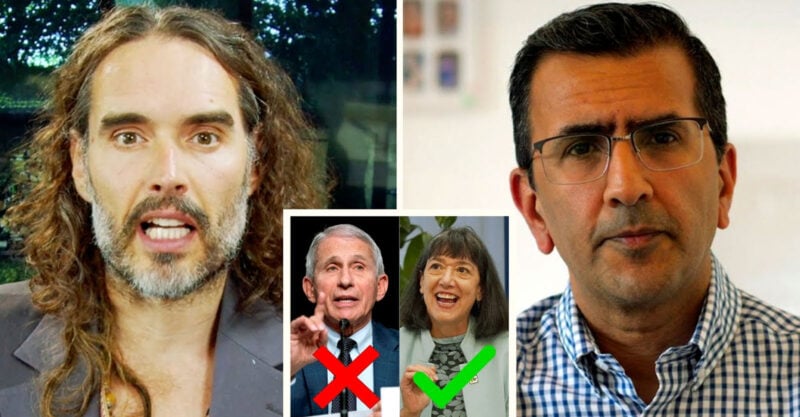


“There is a new Fauci in town,” comedian and political commentator Russell Brand said in a recent segment of “Stay Free with Russell Brand.”
“Is this new Fauci going to be any better?” Brand asked his guest, Dr. Bob Gill, a general practitioner in England’s National Health Service, adding, “How can they be when over their career they’ve accepted hundreds and millions of dollars of Pfizer funding?”
Brand was referring to President Biden’s recent nomination of Dr. Monica Bertagnolli to head up the National Institutes of Health (NIH), a position that has been vacant since Francis Collins, M.D., Ph.D., stepped down in December 2021.
If confirmed, Bertagnolli — who in October was named director of the National Cancer Institute — will replace Lawrence Tabak, DDS, Ph.D., interim director.
Documents revealed Collins and Dr. Anthony Fauci, who recently retired as director of the National Institute of Allergy and Infectious Diseases, a division of the NIH — and others coordinated with other influential figures to silence doctors and scientists who opposed the COVID-19 mainstream narratives.
Fauci told The Washington Post that he personally advocated for Bertagnolli as the next NIH director.
Brand said the first thing people should know about Bertagnolli is that she received more than $290 million in Pfizer funding.
Bertagnolli has also received $17.4 million in grant funding from Janssen Research & Development LLC, a subsidiary of Johnson & Johnson, Jordan Schachtel reported.
Brand asked Gill whether, given the way Fauci’s ties to Big Pharma led to his “mismanagement” of the pandemic and of the AIDS crisis 20 years earlier, Gill thought someone like her ought to be holding this position.
“I think it’s a very big problem,” said Gill, who also produced the documentary, “The Great NHS Heist.” “It doesn’t bode well.”
Gill added:
“The NIH should be acting in the public interest, but when you have people heavily sponsored or funded by private business and drug companies, well that raises the obvious question of conflicts of interest.”
He said Bertagnolli’s nomination continues the trajectory toward total corporate control of the U.S. healthcare system that began in the 1970s and has resulted in higher spending, worsening healthcare outcomes and lowered life expectancy.
The shift to the “managed care model” that exists today, Gill said, started under the Nixon administration, guided by the philosophy of “the less care you provide the more money you make.”
Also, he said, “The American system is extremely bureaucratic, up to one dollar in every three goes out in administration, management and, you know, shareholder dividend and CEO pay, so a lot of it is hemorrhaging. It’s not delivering any healthcare.”
The lack of regulation means Big Pharma “can profiteer and charge very high prices for drugs,” and “there’s also a perverse incentive — the more privatized the healthcare system is, potentially, the more unnecessary interventions.”
Rather than have a well-developed primary or family care focused on prevention, “They wait until the problems arise and then they come up with very expensive solutions.”
Brand said the problems are also related to Big Food, which knowingly pushes processed foods on people that make them sick.
“It seems sometimes like these companies are using human beings as a kind of chattel, sort of moving them from one market to another market, filling them up,” Brand said, “with bad food, giving us bad advice and health insurance companies are incentivized to make patients appear more ill than they actually are.”
Gill said charging for more severe conditions than a patient has, or “upcoding” is a common type of insurance fraud that allows for the extraction of a greater fee, particularly from Medicaid and Medicare, where the government is paying.
Private insurers are expanding their control over government-funded healthcare, he said, “because the insurance industry wasn’t interested in unprofitable patients, but now they’ve realized if we can get our hands on government funding as well, all the more profit for our shareholders. So they are expanding, rather than their control being limited.”
He added:
“If you look at the root cause of ill health, well it comes down to environment, it comes down to food, it comes down to pollution, it comes down to stress, and we are living in a neoliberal economic structure which makes all those problems worse …
“At the moment, our economic model allows corporations to walk away from their environmental impact and the public picks up the tab — this is called an externality. So the profits are theirs, and the downside we have to pick up.”
Watch here: