Login
Login
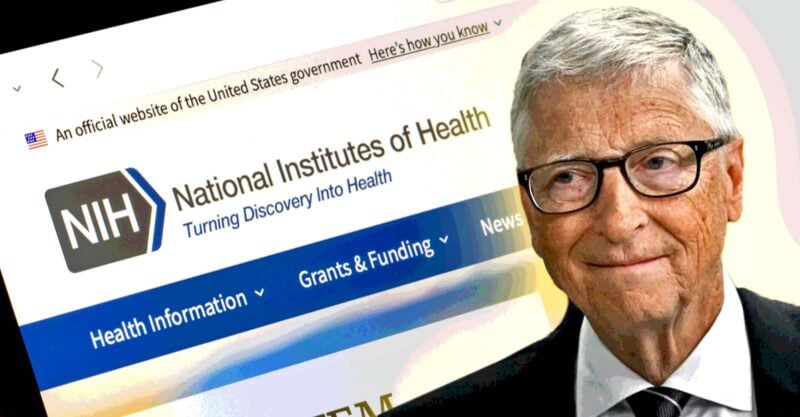


Bill Gates used his wealth and influence to partner with key National Institutes of Health (NIH) officials in an attempt to steer NIH research toward priorities favored by Gates and the Gates Foundation, an NIH whistleblower alleges.
As Gates cultivated these ties, the NIH, under the leadership of Drs. Francis Collins and Anthony Fauci gave Gates the red-carpet treatment at NIH events, the whistleblower alleged.
RealClearInvestigations and The Disinformation Chronicle published the allegations on Tuesday. The whistleblower, a former NIH official, asked to remain anonymous.
Illustrating the extent of Gates’ influence, the whistleblower told The Disinformation Chronicle that the combined funding of Gates and the NIH represents “57% of global health R&D” — or research and development.
“If you’re a researcher complaining about the two entities that control over half of the funding for public health, where do you then go to get funding for public health?” The Disinformation Chronicle wrote in a follow-up post today.
Paul D. Thacker, who authored the report for both outlets, said documents shared by the whistleblower show that Gates used his wealth to curry influence at NIH.
“What I found so interesting when reporting this piece is how nobody wanted to speak on the record,” Thacker said. “Nobody wants to get in crossways with either NIH or Gates by criticizing their cozy relationship.”
The whistleblower produced evidence of NIH-Gates partnerships in Africa to promote vaccines for Ebola and other diseases — partnerships that originated after substantial financial contributions by the Gates Foundation to the NIH.
According to the whistleblower, the partnerships also involved alleged conflicts of interest with McKinsey & Company, a private consulting firm that advised pharmaceutical companies and vaccine manufacturers while working with Gates and the NIH to promote vaccines in Africa.
The allegations follow the Trump administration’s announcement last week that it would reengage with the Gates-linked Gavi, the Vaccine Alliance, one year after ending its funding of the organization. The Gates Foundation funded Gavi’s launch in 1999 and holds a permanent seat on its board.
Gates testified today before the U.S. House of Representatives’ Committee on Oversight, as part of its investigation into disgraced financier Jeffrey Epstein. He told the committee that Epstein tried to use information about his marital infidelities to pressure him to “re-engage with him.”
Revelations contained in the Epstein Files showed that Gates and Epstein worked to finance “pandemic preparedness” initiatives and online research platforms to help influence scientific research.
Jeffrey Tucker, president and founder of the Brownstone Institute, said the whistleblower’s allegations are a “rare example of a fully documented case of agency capture.”
“Bill Gates had zero training in virology and no understanding. And yet he bought influence at NIH that fit with his investment interests,” Tucker said. “Thacker’s investigative reporting here is not only a bombshell, it reveals an epic scandal stretching back decades.”


Gates donated ‘hundreds of millions of dollars’ to NIH
According to Thacker’s report, the Gates Foundation has donated “hundreds of millions of dollars” to NIH in the last 25 years, allowing the billionaire “to shape the direction of the country’s health strategy in ways that have benefitted his own priorities and pet causes while polishing his image as a benevolent global do-gooder.”
Gates Foundation donations led to partnerships with “high-ranking NIH officials to steer taxpayer research funding and design scientific policies for several federal programs.”
The partnerships began soon after the Gates Foundation (then the Bill & Melinda Gates Foundation) was established in 2000 with an initial $20 billion endowment.
“Rather than working exclusively through non-governmental agencies, the Gates Foundation began contributing to the NIH through the agency’s own nonprofit, the Foundation for the National Institutes of Health (FNIH),” Thacker reported.
Established by Congress in 1990, the FNIH is intended to operate as a “firewall between NIH officials and outside donors seeking to influence federal research.” However, this firewall “is not ironclad,” Thacker wrote.
In 2003, the Gates Foundation launched its relationship with the FNIH by means of a $200 million donation, intended to fund NIH scientific programs. Thacker described this as “an unprecedented sum,” citing warnings by scientists and researchers that the donations were shifting the NIH’s research priorities.
In a 2008 editorial published in the journal EMBO Reports, a group of Rice University researchers warned that while the FNIH administers and manages Gates’ donations, the Gates Foundation’s scientific board “oversees and selects the projects.”
Despite those concerns, Gates’ influence within the NIH grew. In 2013, Gates delivered a lecture to NIH — the same year that the agency started hosting joint Gates-NIH workshops.
According to Thacker, the NIH began “synchronizing federal research programs with Gates, to include coordinating grant funding and science policies across 10 NIH programs.”
This included “dual workshops, joint clinical trials, combined research policies, and collaborative funding efforts.” Among the joint initiatives were clinical trials for tuberculosis treatment in Africa and a joint study, funded by the Chinese government, on tuberculosis.
“Bill Gates, along with the NIH, the Wellcome Trust, it was this cartel,” the whistleblower said. “This is a globalist movement. And that’s something that I don’t think the public knows.”
‘Incredible symbiotic relationship’ between NIH, Gates
In 2015, the Gates Foundation held its second annual meeting with the NIH, leading to an agreement for the two to cooperate on funding and research policies for global health initiatives — including initiatives involving Ebola research.
According to Thacker, as part of this alignment, “Gates routed money through the FNIH so that NIH employees could hire the McKinsey consulting firm.”
McKinsey & Company is a multinational management consulting firm, known for its “high-performance” corporate culture. Thacker reported that McKinsey’s high-profile clients include major corporations and foreign governments. He added:
“McKinsey’s study of the Ebola field found 20 therapeutics, eight diagnostics, and eight different vaccines, concluding that the Merck and GSK vaccines were the most advanced.
“At no point … did NIH officials appear to raise any concerns about conflicts of interest regarding their work with Gates, nor the hiring of McKinsey to shape federal research and development policies.”
In 2022, similar conflicts of interest caught the attention of Congress. That year, House Democrats published a report documenting McKinsey’s conflicts of interest in advising both the U.S. Food and Drug Administration and Purdue Pharma, maker of the widely used opioid OxyContin, in relation to the opioid epidemic.
Yet, in NIH’s summary of its 2015 meeting with the Gates Foundation, the two entities sidestepped such concerns, stating that they “have had a long history of interaction, particularly with respect to vaccines and drugs,” according to Thacker.
“What I saw, which really, I think, extends until this day, is a complete merging of NIH and Gates,” the whistleblower said. “And I’ve never seen that written anywhere. I don’t think people realize this incredible symbiotic relationship.”
Mathematician and economist Xavier Azalbert, editor of France Soir, a publication that has frequently taken a critical look at Big Pharma, previously worked for McKinsey. He told The Defender the company’s culture has shifted in recent years.
“When I was at McKinsey, I can say with confidence that we served our clients with positive intent. I did not observe any malicious traits in the work we did,” Azalbert said. “However, I am not surprised that in later years the firm took certain strategic directions that led to significant issues and a shift in its objectives.”
This shift moved McKinsey away from “serving clients for laudable causes” toward engagements that “may be questioned,” Azalbert said, citing McKinsey’s conflict of interest with Purdue Pharma and insider trading scandals involving key McKinsey figures.
“In my day, if we disagreed with a client’s intent, we could simply walk away from the engagement. I don’t know if that still holds,” Azalbert added.
Among the documents the whistleblower leaked was a 2016 meeting agenda, part of the Gates-NIH workshop series. The documents include a program of the 2016 meeting, which contained a panel on “the research response to Zika virus and research preparedness for future microbial outbreaks.”
The panel, moderated by Fauci, included a discussion on “industrial incentives to develop pandemic preventive vaccines” — a possible foreshadowing of Operation Warp Speed.


This article was funded by critical thinkers like you.
The Defender is 100% reader-supported. No corporate sponsors. No paywalls. Our writers and editors rely on you to fund stories like this that mainstream media won’t write.
Documents reveal NIH ‘deference’ to Gates
The whistleblower’s documents also showed that the NIH provided Gates with “first billing” — and a welcome usually reserved for heads of state — when Gates visited the agency in 2016 as part of the Gates-NIH workshop series.
The visit included a 45-minute teleconference 10 days before the meeting between Collins and Trevor Mundel, a former pharma executive who headed global health for the Gates Foundation, a reception and catered dinner paid for by the FNIH for nearly two dozen Gates executives at an exclusive mansion, and an elaborate protocol for welcoming Gates to the NIH’s headquarters.
“Such deference to power, said a senior Trump official when reading the Collins itinerary over the phone, is normally reserved for the president, first lady, or visiting dignitaries of state,” Thacker reported.
Later that year, the FNIH awarded the Gates Foundation and Pfizer multi-million-dollar prizes for supporting the NIH’s mission, while FNIH “continues to maintain close ties to pharmaceutical interests,” Thacker reported.
FNIH’s current CEO, Dr. Julie Gerberding, previously served as president of Merck Vaccines.
Related articles in The Defender
- Epstein Pitched JPMorgan Chase on Plan to Get Bill Gates ‘More Money for Vaccines’
- ‘Muzzled and Muted’: Epstein, Gates Financed Research Portal to Control Scientific Discourse
- Owners of OxyContin Maker Gave $19 Million to Institute That Shaped Federal Opioid Policy
- McKinsey Never Told FDA It Was Working for Opioid Makers Purdue and J&J While Also Working for the Agency
- Gates Pledges $1.6 Billion for More Vaccines for Poor Countries, as RFK Jr. Stands by U.S. Decision to Cut Funding
- Fauci, Other ‘Bethesda Boys’ Colluded to Suppress COVID Lab-Leak Theory, U.S. House Committee Report Finds